Astronomy is a science where human timescales become insignificant. It seems like everything we are watching takes millions or even billions of years to occur. To be sure, there are a few things that happen quickly, like supernovae, but those events are the exceptions. Everywhere we look we see the stately dance of stars and galaxies, the formation of worlds. The dance is spread across distances and times so vast that even those who study the universe have difficulty comprehending the sheer immensity involved. Stars and planets take hundreds of thousands of years to form, a galaxy collision may go on for millions of years.
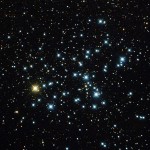
M6, the Butterfly ClusterAnd yet there is a significant portion of our fellow citizens who insist that the universe is only a few thousand years old. I encounter this belief all too often, a dogged insistence that everything was created just a few thousand years ago. There are variations on the theme, with differing numbers, but these beliefs generally accept that our universe and the Earth were formed within the last ten thousand years. Never mind we have literally mountains of evidence to the contrary, when that evidence clashes with worldviews instilled since birth by a religion and parents, a discouraging number of people ignore reality and cling to what they were taught. To admit otherwise would open up too many other dearly held beliefs to questioning, a truly uncomfortable challenge.
Today the planet Saturn will pass through opposition, directly opposite the Sun in our sky. The planet will be well placed for observation all night long, rising at sunset, transiting at midnight, and setting at sunrise.
Mercury is sliding into the light of dawn this week. Currently about 10° elevation at sunrise, the planet will disappear into the Sun’s glare over the next few days. It will pass through superior conjunction on May 11th, to reappear for an evening apparition around May 20th.
A nice short video on Keck and the hunt to find and confirm extrasolar planets. It features regular Keck observer Nader Haghighipour from the Institute for Astronomy, University of Hawaii talking about his research into exoplanets.
I had a chance to help out with some of the interior shots. We had to hurry as the film crew was running late and they were up against the schedule, it was time to release the telescopes to the astronomers for the night. It is nice to see the crew got the needed shots and to see the final result a few months later.
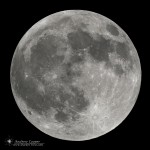
Full Moon taken 27Aug2007, 90mm f/12 APO and Canon 20DaFull Moon will occur today at 09:57HST.
Viewers across Africa, Central Asia and Australia will be able to see a partial lunar eclipse. Pacific and North American observers will not be able to see any of this event. No matter, this is a fairly minor eclipse, with the Moon just brushing the umbra.
Friday marked another important step forward for the future of astronomical discovery and economic opportunity on Hawaii Island. The Hawaiian Board of Land and Natural Resources (BLNR) announced that it has granted a permit to the Thirty Meter Telescope (TMT) project to build and operate the next-generation observatory near the summit of Mauna Kea.
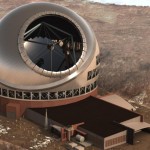
An overhead view of the proposed Thirty Meter Telescope, credit TMT Observatory CorporationWith this approval, the BLNR has recognized TMT’s goal of responsible development and environmental stewardship of Mauna Kea in close partnership with local interests. The carefully considered conditions in the permit help ensure the protection of sensitive environments in Hawaii.
“Over the last several years, the TMT project has welcomed the support it has received from all sectors of the Hawaiian community, from education to cultural to business to labor,” said Sandra Dawson, TMT’s Manager of Hawaii Community Affairs. “We look forward to beginning construction and becoming a neighbor of the outstanding observatories on Mauna Kea.”
Beaches? Tropical gardens? The volcano? Yeah, BTDT, not what I came to Hawaiʻi for. Visiting Mauna Kea is at the top of the list for some folks who visit our island, a priority I can fully understand. Even better? Bring a camera to this spectacular mountain. After six years of working on Mauna Kea I still carry a camera and find new shots. Some of the most fascinating photographic opportunities occur after the Sun has set. For those who pursue shots in the dark, long exposure photography, the summit provides a setting that is worth the effort to shoot.
The Keck 1 Laser undergoing engineering tests, Subaru telescope in backgroundThe summit is open after dark, but not unconditionally, I need to stress some explanations concerning that. Officially the Mauna Kea Comprehensive Management Plan limits public recreational use to ½hour before dawn and ½hour after dark. This has not been strictly enforced any time in my experience on the mountain. There is no gate in use, you will see people drive up the summit road in the middle of the night.
So what are the real rules for summit access after dark?
Join us this Sunday for a live broadcast from Keck 2 remote observing! Here at Keck we will be participating in a campaign to observe Saturn’s auroras. Join JPL scientist Dr. Kevin Baines and Dr. Tom Stallard of the University of Leicester while they are engaged in using the telescope.
This false-color composite image, constructed from data obtained by NASA’s Cassini spacecraft. Image credit NASA/JPL/University of Arizona/University of LeicesterSunday April 21st
3am-5am Hawai’i Standard Time
6am-8am Pacific Daylight Time
9am-11am Eastern Daylight Time
1pm-3pm UT
At Keck the team of astronomers have five half night’s of observing on Keck 2 using the NIRSPEC spectrograph. They will be making infrared observations to understand more about the auroral features and the interaction of Saturn’s atmosphere with the planet’s magnetic fields.
Another exhibit built for public outreach functions. It was completed and used for the recent W. M. Keck Observatory open house. You will also be able to see it at the upcoming AstroDay fun in Hilo.
Ray-tracing is a standard way to analyze optical designs. The technique allows the optical designer to follow the path of each ray of light through a system of lenses and mirrors. While ray tracing used to be done with pencil and paper, it is now done on a computer screen. What I had never seen was this process done in the physical. But I can figure out how…
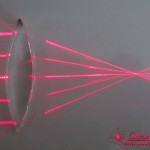
A laser ray trace table used to demonstrate the focal point of a simple lensTake a few laser line modules, a bit of sheet metal and paint, a bit of circuitry and we can do this!
In the photo you can see the idea… Five red laser line modules are aligned across a table. Stick a lens section in the beams and you can observe refraction as it happens. Using a double convex lens, all of the beams converge to a focus. A clear demonstration of the basic principles of optics!
Today Mars will pass through superior conjunction, passing behind the Sun from our vantage point on Earth. During this time the red planet will be lost to view, vanishing from the evening sky, but reappearing in the morning sky during the last days of May.
While the Sun blocks our direct view of Mars the probes we currently have on and around Mars will suffer communications interference. For a few weeks mission planners at NASA place the various orbiters and rovers into a reduced communications routine. No commands will be sent to the spacecraft and only basic status updates sent back. This is nothing new, all Mars missions have had to deal with superior conjunction every two years. Once the red planet is clear of the Sun normal mission activities will resume.