Four Synchronized Planets Reveal Clues to How Planets Form

W. M. Keck Observatory press release

The search for planets orbiting other stars in our galaxy has revealed an extraordinary family of planets whose orbits are so carefully timed that they provide long-term stability for their planetary system. The data came from observations from the Kepler Space Telescope and the W. M. Keck Observatory on Maunakea, Hawaii. A paper describing the formation of this planetary system by a research team was published in the journal Nature today.

Kepler223 Animation
The Kepler–223 planetary system, click on the image for an animation. Credit: W. Rebel
“The Kepler-223 planetary system has unusually long-term stability because its four planets interact gravitationally to keep the beat of a carefully choreographed dance as they orbit their host star,” said Eric Ford, a professor of astronomy and astrophysics at Penn State and a member of the research team. Each time the innermost planet (Kepler-223b) orbits the system’s star 3 times, the second-closest planet (Kepler-223c) orbits precisely 4 times. Thus, these two planets return to the same positions relative to each other and their host star.

Continue reading “Four Synchronized Planets Reveal Clues to How Planets Form”
Mercury Transit

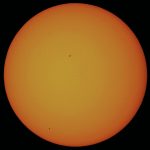
It was a beautiful morning! Alarm set for 4:30am, out of the house at 5am, setup just at sunrise on the old Saddle Road. The sun rose through low clouds over the grasslands of Parker Ranch with Waimea to one side and Mauna Kea on the other.

Mercury Transit 9May2016
Mercury transiting the Sun on May 9, 2016. Celestron C8 and Canon 6D at f/10.
Setting up a telescope as the Sun was rising seemed just wrong. I am used to breaking down a telescope as the Sun comes over the horizon at the end of a night’s observing. It is not often that an observing session results in my risking sunburn!

The seeing was pretty horrible at sunrise but rapidly improved as the Sun rose. As the transit ended the seeing was quite sharp and the photos not all that bad. At least as long as I kept the shutter speeds high. Visually the view was quite nice, a sharp black dot against the Sun, a far cry from the dancing blur you usually see when trying to view Mercury in the glow of Sunset.

Continue reading “Mercury Transit”

Mercury Transit Reminder

Just a quick reminder that mercury will transit the face of the Sun tomorrow morning. You can read full details in my earlier post or check out a decent transit calculator. For observer in Hawaii the transit will already be well underway at sunrise, making this a set-the-alarm-early exercise. My telescope and solar filter are already loaded… Are yours?

Transit of Mercury
The 2006 transit of Mercury, photographed with a 90mm telescope and a Canon 20Da

Moon in the Hyades

This evening a pretty crescent Moon will pass through the bright Hyades star cluster. The Moon will be a very thin crescent, only 2.9% illuminated and 1.5 days past new. As such it will not be so bright as to completely over power the star cluster. The Moon will be 3° west of the bright red star Aldebaran, at the center of the vee shaped cluster. As the cluster is 15° above the horizon at sunset there should be ample time to enjoy the sight before the Moon sets at 20:12 HST.