The storm appears to be waning now, the satellite shows that much of it has passed the island. Not long ago the snowplow crews let it be known that they would not reach the summit today, try again tomorrow as the storm abates.
I did a bit of a photo survey of the summit using MastCam to check on the summit conditions. Poliʻahu rules Mauna Kea!
Looking at the summit ridge from the Keck after the storm
The IRTF coated with heavy ice
Looking at the summit ridge from the Keck after the storm
A ladder platform of the Keck 2 dome with a heavy coating of ice
Looking at the summit ridge from the Keck after the storm
UH88 under a heavy coating of ice after the storm
UKIRT under a heavy coating of ice after the storm
Keck 2 dome with a heavy coating of ice
A MastCam image of the snowdrifts covering the road between Keck and IRTF
The storm continues unabated atop Mauna Kea. Word from the snowplow crews is bad, deep drifts cover the road above the switchbacks. They are stating that it is unlikely our summit crew will be able to access the telescopes today. That will make the second day in a row with no access.
MastCam is still functioning, only half the dome is covered with ice. I have turned the heater on in an attempt to clear what I can. The view it reveals is deeper snow and a lot more ice. The railings on the dome ladders have coatings many inches thick.
The blizzard continues atop Mauna Kea March 12, 2015
Another experiment in growing tropical fruit… Deb had sprouted a pineapple using the top to one she had bought at the farmers market. With roots showing she asked me to set up a more appropriate home for the plant. That came in the form of a large pot on our front lanai. I was surprised when the pineapple not only survived but thrived. the plant is an attractive pot plant just outside our front door. I have shared some photos of the geckos and anoles that call the plant home.
Then the first signs of blooming appeared… In place of a new leaf a little spiky ball appeared at the center of the plant. This has developed into a very nice looking fruit, a recognizable pineapple covered with little purple blossoms. It is another tropical fruit I never imagined myself growing, one of the interesting things about living in Hawaii.
Folks sometimes get a little perturbed when MKSS closes the Mauna Kea summit road. Everyone wants to go up and see the snow. Yes, the road is closed right now, for good reason, there really is no accessible road on the summit at the moment. Not taking my word for it? See for yourself…
A MastCam image of the snowdrifts covering the road between Keck and IRTF
It has been raining all day in Waikoloa, a few tenths in the rain gauge as I left the house for work. In Waimea it is even worse, cool and damp, enough so that everyone is complaining about the cold. But then, island folks complain about anything under 80°.
Raindrops cover the leaves of the money treeThe weather was great for my mother’s visit two weeks ago. She was able to get some sun and beach before returning to the Northwest. Good thing she did not come this last week, nothing but grey skies and rain for the island. The storm is expected to last a few more days.
No progress on the lanai project this weekend, far too wet to paint. The trees in our landscape will like this rain, a steady soaking rain. Likewise the weeds will probably be doing all too well. I can turn off the watering system for a while. This morning’s shower was a tad cooler than I like, need to remember to turn on the electric backup in the solar hot water heater this evening.
The storm is raging at the summit. The wind is howling and freezing fog is coating everything with ice. The webcam images are mostly blocked as ice covers the camera windows, but I can still see out of one side of MastCam towards the Keck 2 dome.
Just received word that our day crew will not attempt the summit, they are leaving HP and headed home. The rangers report snow drifts on the road at fairly low elevations and the snow plow crews will not attempt to clear the roads until the storm abates. Looks like we will lose cooling on some of the instruments as the liquid nitrogen runs out.
Freezing fog forms ice on the weather mast on March 9th, 2015
For the first time in decades I have been playing a video game.
Growing up, we had a state of the art video game console in the house, an Atari 2600. This machine was impressive… For the late 1970’s. Specifications included color graphics, 160×192 pixel resolution, and monaural sound. My brother and I played for hours, eventually beating some of the joysticks to the point where they required replacement. I mastered Space Invaders, I could play through all of the levels, wrapping back to level 1 for as long as my stamina allowed.
Atari tanks game, circa 1978One of the games bundled with the Atari was Combat, there were four games on the cartridge including a tank game. I look back on that first game, one of the first we played on that console, with a bit of nostalgia. Two tanks maneuvered around a simple obstacle course, with a point awarded for each shot that hit the opponent. The audio was similarly quite simple, a basic growling sound meant to sound like engines and a few sound effects for the shots.
In the intervening decades I have seldom played video games with any great intensity. There was an Apple II space adventure game called Elite that I did play for a while in the 1980’s, but little else.
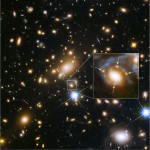
Astronomers have for the first time spotted four images of a distant exploding star, arranged in a cross-shape pattern by a powerful gravitational lens. In addition to being a unique sighting, the discovery will provide insight into the distribution of dark matter. The findings will appear March 6 in a special issue of the journal Science, celebrating the centenary of Albert Einstein’s Theory of General Relativity.
This image shows the light of a supernova split into four images by a foreground elliptical galaxy embedded in a giant cluster of galaxies. The four images were spotted on Nov. 11, 2014. Credit: NASA/ESATwo teams spent a week analyzing the object’s light, confirming it was the signature of a supernova, then turned to the W. M. Keck Observatory on Mauna Kea, in Hawaii, to gather critical measurements including determining the distance to the supernova’s host galaxy 9.3 billion light-years from Earth.
To explain the unique, four-up projection, the scientists determined a galaxy cluster and one of its massive elliptical members are gravitationally bending and magnifying the light from the supernova behind it, through an effect called gravitational lensing. First predicted by Albert Einstein, this effect is similar to a glass lens bending light to magnify and distort the image of an object behind it. The multiple images, arranged around the massive elliptical galaxy, form an Einstein Cross, a name originally given to a multiple-lensed quasar that appear as a cross.
Although astronomers have discovered dozens of multiply imaged galaxies and quasars, they have never seen a stellar explosion resolved into several images. “It really threw me for a loop when I spotted the four images surrounding the galaxy – it was a complete surprise,” said Patrick Kelly of the University of California, Berkeley, lead author of the paper and a member of the Grism Lens Amplified Survey from Space (GLASS) collaboration. The GLASS group is working with the FrontierSN team to analyze the supernova.
Scientists using the W. M. Keck Observatory and Pan-STARRS1 telescopes on Hawaii have discovered a star that breaks the galactic speed record, traveling with a velocity of about 1,200 kilometers per second or 2.7 million miles per hour. This velocity is so high, the star will escape the gravity of our galaxy. In contrast to the other known unbound stars, the team showed that this compact star was ejected from an extremely tight binary by a thermonuclear supernova explosion. These results will be published in the March 6 issue of Science.
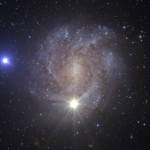
An artist impression of the mass-transfer phase followed by a double-detonation supernova that leads to the ejection of US 708. Credit: ESA/Hubble, NASA, S. GeierStars like the Sun are bound to our Galaxy and orbit its center with moderate velocities. Only a few so-called hypervelocity stars are known to travel with velocities so high that they are unbound, meaning they will not orbit the galaxy, but instead will escape its gravity to wander intergalactic space.
A close encounter with the supermassive black hole at the centre of the Milky Way is typically presumed the most plausible mechanism for kicking these stars out of the galaxy.
A team of astronomers led by Stephan Geier (European Southern Observatory, Garching) observed the known high-velocity star know as US 708 with the Echellette Spectrograph and Imager instrument on the 10-meter, Keck II telescope to measure its distance and velocity along our line of sight. By carefully combining position measurements from digital archives with newer positions measured from images taken during the course of the Pan-STARRS1 survey, they were able to derive the tangential component of the star’s velocity (across our line of sight).
Putting the measurements together, the team determined the star is moving at about 1,200 kilometers per second – much higher than the velocities of previously known stars in the Milky Way galaxy. More importantly, the trajectory of US 708 means the supermassive black hole at the galactic center could not be the source of US 708’s extreme velocity.