
Hydroid
When you want to see the stars, find someplace dark

Hurricane Ana brought nothing more than a day of soaking rain to our part of the island. It was the lack of wind that was striking, with the hurricane directly offshore we had calm conditions. There was some flooding and moderate winds along the Kaʻu coast. Not much word on damage, I suspect it was minimal, nothing like what would have happened if the storm had followed the original forecast track.
A new week has begin, time to see what next adventure life will bring…

I like to cross-post some of my blog postings to Facebook. Yes it serves to publicize and steer traffic to my blog. However, I am selective in the articles I cross-post, and I find that many of my Facebook friends and followers appreciate it. I get a lot of likes and shares with some types of posts.
There is also the issue of Facebook’s intellectual property policies, a bit of a rights grab, quite disturbing to a photographer like myself. Thus I do not generally post any of my better photos directly to Facebook. Snapshots? These are OK. Good photos? These I post to my own blog and then just link them on Facebook.
On occasion I find that Facebook does not cross-post properly, the usual issue is the lack of a thumbnail. For this I have found there is a developer’s tool on the Facebook site for evaluating links.
Just paste the URL into the bar and check it out. Interestingly this tool seems tied to the main website servers. Try linking on your Facebook wall, when this fails go to the debugger and paste the link in. The image should appear in the information listed about the link. Then go back to your own page and re-post the link, it will now work and the image will be displayed properly. Surprisingly reliable.
The evening started as if there was no storm. Partly cloudy skies and a very pretty sunset. There was an odd element… Very hot and muggy, no wind. Bad enough you wanted the hurricane to start just to get the air moving.
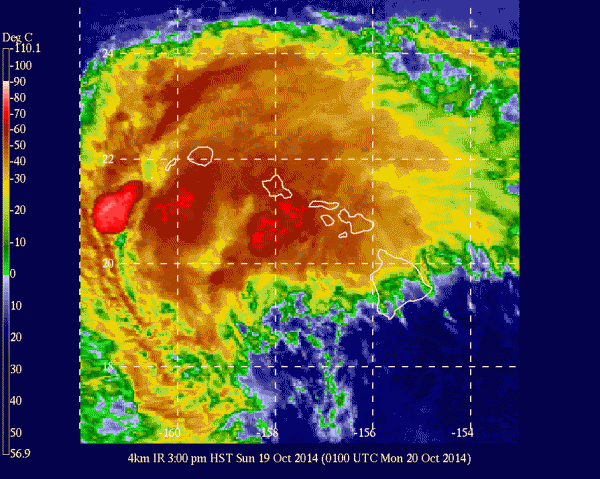
Late in the evening the rain started, a soft steady rain that has lasted for several hours now. The storm is bringing a huge mass of moisture over the island. The satellite shows enormous blobs of angry red, you would expect the world to be ending under colors like that. Instead we have soft rain and almost no wind.

Not quite a hurricane… Yet. Ana is expected to reach hurricane status later today. it is an impressive sight in the satellite imagery as it closes on the island. This mornings forecast places the track even further offshore. We will not witness the full force of the storm, but will still experience some effects. While the storm is centered about 250 miles south of us, the outer cloud-bands are already over the island.
It is an interesting life.

W. M. Keck Observatory press release…
A team led by astronomers from the Max Planck Institute for Astronomy has created the first three-dimensional map of the ‘adolescent’ Universe, just 3 billion years after the Big Bang. This map, built from data collected from the W. M. Keck Observatory, is millions of light-years across and provides a tantalizing glimpse of large structures in the ‘cosmic web’ – the backbone of cosmic structure.
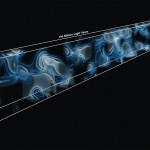
Now a team of astronomers led by Khee-Gan Lee, a post-doc at the Max Planck Institute for Astronomy, has created a map of hydrogen absorption revealing a three-dimensional section of the universe 11 billions light years away – the first time the cosmic web has been mapped at such a vast distance. Since observing to such immense distances is also looking back in time, the map reveals the early stages of cosmic structure formation when the Universe was only a quarter of its current age, during an era when the galaxies were undergoing a major ‘growth spurt’.
The map was created by using faint background galaxies as light sources, against which gas could be seen by the characteristic absorption features of hydrogen. The wavelengths of each hydrogen feature showed the presence of gas at a specific distance from us. Combining all of the measurements across the entire field of view allowed the team a tantalizing glimpse of giant filamentary structures extending across millions of light-years, and paves the way for more extensive studies that will reveal not only the structure of the cosmic web, but also details of its function – the ways that pristine gas is funneled along the web into galaxies, providing the raw material for the formation of galaxies, stars, and planets.
Continue reading “Scientists Build First Map of Hidden Universe”
Tomorrow morning the Moon and Jupiter will be close. The Moon will rise first, followed by Jupiter at 01:34 to be almost 65° above the eastern horizon at sunrise. The Moon will be about 32% illuminated and about 6° above a bright Jupiter. The next day the Moon will have moved to the other side of Jupiter and be a bit further apart, about 10° separation.
Today the planet Mercury passes through inferior conjunction, passing between the Sun and the Earth. In a week or so the planet will again be visible in the dawn sky, climbing higher each day. Maximum elongation will occur November 1st.
Here we go with hurricane two for the season. The forecast continues to put the island of Hawaiʻi directly in the path of the storm. If anything the news is a little worse, with the storm tracking up the west side of the island.
I suspect we will need to take this storm even more seriously than Iselle. Time to put the patio furniture away again, and check around the house for anything loose that may be an issue. Pick a few of my ripe grapefruits as well.
The observatory is reactivating the response plan we had a chance to refine and put into action for hurricane Iselle. Time to batten down the hatches, somewhat literally in the case of the summit facility. We are working on the Keck 1 shutter today, checking the seals and resetting the fully closed position to deal with some leaks.
