The University of California has appointed Claire Max, professor of astronomy and astrophysics at UC Santa Cruz, to serve as director of UC Observatories on an interim basis while an international search is conducted to appoint a permanent director. Max succeeds Sandra Faber, whose two-year appointment as interim director ended in June.
Claire Max, credit: University of CaliforniaMax is internationally known for her research in plasma physics, astronomy, and astronomical instrumentation. A pioneer in the field of adaptive optics, she has served as director of the Center for Adaptive Optics at UC Santa Cruz. Max is a member of the National Academy of Sciences and a fellow of the American Academy of Arts and Sciences, the American Physical Society, and the American Association for the Advancement of Science. She received the U.S. Department of Energy’s E. O. Lawrence Award in Physics in 2004.
UC Observatories (UCO) is a multicampus research unit headquartered on the UC Santa Cruz campus. UCO operates the Lick Observatory on Mount Hamilton and the UCO Technical Labs at UC Santa Cruz and UCLA, and is a managing partner of the W. M. Keck Observatory in Hawaii. UCO is also the center for UC’s participation in the Thirty-Meter Telescope (TMT) project.
The board of the W. M. Keck Observatory is pleased to announce that Hilton Lewis has been appointed Director of Keck Observatory, effective immediately. He has served as the Interim Director since May.
Hilton Lewis, Director, W. M. Keck Observatory, credit Ethan Tweedie“The board is delighted that Hilton has agreed to take on this substantial responsibility,” said Ed Stolper, Chairman of the California Association for Research in Astronomy board, which manages Keck Observatory. “In his many years of service at Keck Observatory, and in the past four months as its Interim Director, Hilton has demonstrated his technical, managerial and leadership skills, and his commitment to the observatory. We are pleased that we have been able to attract such an outstanding and experienced leader to serve as our next Director”.
“We are delighted to welcome Hilton Lewis as the new Director of Keck Observatory. Hilton has a deep understanding of the opportunities and challenges that lie ahead for the observatory, a thorough knowledge of its workings, and the strategic vision to keep Keck Observatory at the forefront of astronomical research,” said UC Santa Cruz Chancellor George Blumenthal, who also serves as the vice chair of the Keck Observatory board.
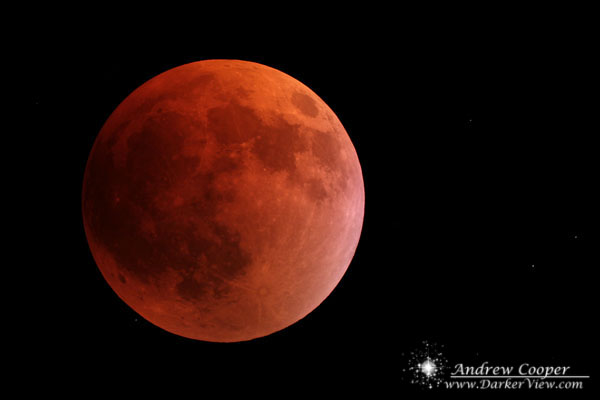
A total lunar eclipse will occur on the next full Moon, Oct 8th. The eclipse will be visible across much of the western hemisphere, including the west coast of North America and across the Pacific. This is an excellent eclipse for observers here in Hawai’i, the entire eclipse will be visible from start to end.
Total lunar eclipse, photo is a 8sec exposure with a Canon 20Da on a 90mm f/12 APOSome references note that this eclipse will occur on the 8th, and so it will for much of the world. For Hawai’i this will start late on the 7th when considering the time zone correction.
The Moon will be thoroughly submerged in the umbra, the darkest part of the Earth’s shadow, with an umbral magnitude of 1.16. The Moon will not pass directly through the umbra, but rather through the northern section, thus the north pole of the Moon will remain somewhat brighter, even at maximum. The eclipse occurs at the Moon’s descending node in southern Pisces, two days after perigee (October 06 at 09:41 UT). This means that the Moon will appear 5.3% larger than it did during the April 15 eclipse (32.7 vs. 31.3 arc-minutes).
Observing a total lunar eclipse requires no special equipment, simply the desire to look up. The most useful piece of equipment will be a reclining chair or some other method of staying comfortable while watching the sky. A pair of binoculars or small telescope can provide beautiful views of the Moon during an eclipse. Photography is somewhat more challenging, but not that difficult. Focal lengths of around 1000mm will fill the field of most DSLR cameras allowing photos like that shown here.
Penumbral Eclipse Begins
22:15:33 HST
08:15:33 UT
Partial Eclipse Begins
23:14:48 HST
09:14:48 UT
Total Eclipse Begins
00:25:10 HST
10:25:10 UT
Greatest Eclipse
00:54:36 HST
10:54:36 UT
Total Eclipse Ends
01:24:00 HST
11:24:00 UT
Partial Eclipse Ends
02:34:21 HST
12:34:21 UT
Penumbral Eclipse Ends
03:33:43 HST
13:33:43 UT
Timing for the 7Oct2013 total lunar eclipse
The entire eclipse will be visible during the night, quite convenient for amateur and casual sky-watchers. This is an excellent eclipse to publicize and use for outreach purposes.
Over the next few days the planet Mars will pass the bright star Antares. The two appear so similar in color and magnitude that the star’s name derives from Mars… The name Antares is from Anti-Ares or opposite of Mars. Recalling that the Greek name for the god of war Mars was Ares.
These two will appear close for several days, passing closest on the September 27th at a distance of 3.1°. Mars will be shining brightly at magnitude 0.8 while Antares will be very slightly dimmer at 1.1, almost too close to differentiate. The coloration is also quite close, a ruddy orange, making the two almost indistinguishable. Mars will be the one to the west. Both will be easily visible in the south after sunset.
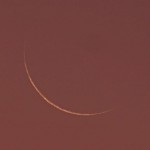
A very young moon over Waikoloa, this is only 26 hours after new, visible to the unaided eye as a sliver in the fading glow of sunsetNew Moon will occur today at 20:14HST.
Do you know where you live? You probably know your street address and the name of your town, state, and country. But what about your cosmic address — your location among the stars? Thanks to efforts by some astronomers in Hawaii, you can now tell people you live in Laniakea.
Scientists have known for decades that our solar system rests on an outer arm of the Milky Way galaxy. In turn, galaxies are not sprinkled randomly throughout the cosmos; they cluster into groups, which themselves are part of larger groups.
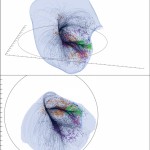
Two views of the Laniakea Supercluster. The outer surface shows the region dominated by Laniakea’s gravity. Credit CEA/SACLAYWhat has been known is our Milky Way is part of the Local Group, a collection of galaxies some 10 million light-years across. Now, a team of scientists led by University of Hawaii at Manoa astronomer R. Brent Tully have mapped the boundaries of a “supercluster” of galaxies stretching 500 *million* light-years through space. They named the supercluster “Laniakea,” a Hawaiian word meaning “immense heaven.” The name was suggested by Kapiolani Community College linguist Nawa’a Napoleon as a tribute to the Polynesian sailors who crossed the Pacific, navigating by the stars.
Tully’s team determined Laniakea’s contours using a method similar to the way geographers would map watersheds on Earth. In an article published in the September 2014 issue of Nature, Tully and his co-authors Hélène Courtois, Yehuda Hoffman, and Daniel Pomarède describe how they began by measuring the distance from Earth to more than eight thousand galaxies and observing the galaxies’ movement. From those measurements, they calculated each galaxy’s “peculiar velocity,” or the difference between its observed velocity and the rate at which all galaxies are receding from each other (called the “cosmic expansion”).