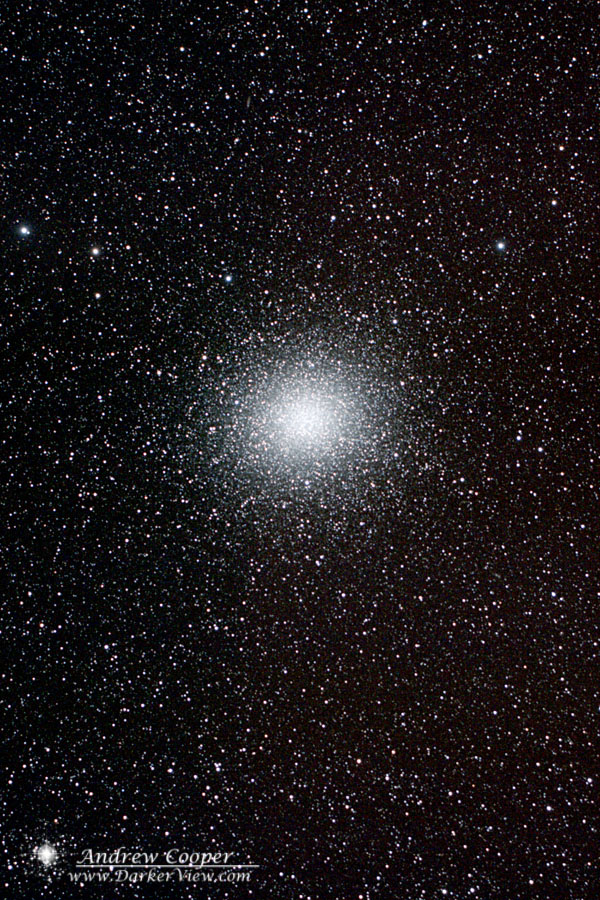
Omega Centauri
When you want to see the stars, find someplace dark

Back in April and May we saw Venus pass Uranus and Neptune making for badly mismatched conjunctions. This week it will be Jupiter, the only planet able to shine brightly enough to make a good pairing for Venus.
Today the pair are drawing close, currently separated by 5.5°. Close approach will occur on the 17th when the pair will rise in the dawn separated by only 35′. The closest approach will happen well after sunrise in the islands, about 18:06HST at a separation of a mere 12′, easily close enough to fit in the same telescopic field. The major challenge here is that the conjunction will occur only 17° from the Sun.
Venus will outshine Jupiter by over a magnitude, -3.9 compared to Jupiter’s -1.8 magnitude. The sizes will be comparable as well. Venus will be smaller at only 10.3″ compared to Jupiter’s 31.6″ across at the equator.
In an odd twist, this conjunction will occur on the edge of the Beehive cluster, M44. The cluster is not likely to be very visible given the advent of dawn, but it will be there.

The island is still dealing with the damage wrought by Iselle. The Puna area took much of the damage with power lines down, fallen trees blocking many of the roads and damage to many houses. Fortunately there have been no reports of any deaths due to the storm. There are still thousands of residents without power as utility crews struggle to deal with the mess.
Residents on the west side saw few or no issues from the storm. We had almost no wind and just a little rain. Our precautions were totally unneeded, I guess we will use the water jugs to water the plants out front. Need to put the lanai furniture and barbeque back as well.
Despite our precautions Keck observatory has had issues due to the storm. Several systems suffered damage due to power line disruptions. We lost a motor controller in the K1 dome, I spent all of Saturday helping to replace that. Just as we were finishing repairing the dome the main breaker for the facility failed, leaving us on generator power. Waiting for word from the crew on restoring power. Until it is repaired we are off-sky. Update: Our intrepid day crew has fixed it. Yes, they are that good.
Hurricane Julio has spared the islands completely, tracking well north, far enough that we are clear of its effects. The storm is generating a big northeast swell that has the surfers looking for waves.
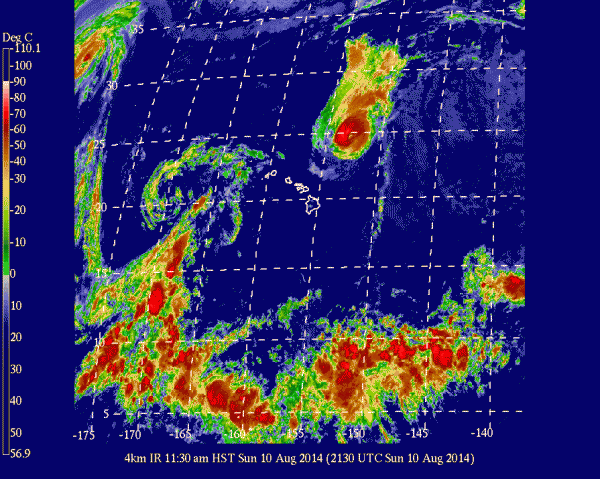

Dawn has come with an eerie silence, not a breath of wind. Yesterday afternoon and well into the night the winds ran hard, this morning there is calm. We received no measurable rain, while friends are posting views of Hilo rivers brown and raging. Obviously our internet is still moving bits and the lights still come on when you toggle the switch. The power flickered many times, but did not fail.
The storm is still here, dropping heavy rains on the south end of the island. Later this morning I will join the summit crew for a late departure to the summit and a quick check of the facility. Fill the instruments with cryogens, do a walk around, and not much more.
Hurricane Julio is still forecast to swing north of the island, sparing us the heavy rains and winds, though we may still feel some effect. It will move past the island on Sunday, as we cast wary eyes on the forecast charts. The coming week will bring a return to normalcy and the frantic activities of segment exchange.
Seasons come around
The Earth orbits once more
Orion in the dawn
Yes, I suck at writing haiku. Somewhat better at photography…

Today Mercury passes through superior conjunction, passing behind the Sun as seen from the Earth. The planet will appear in the sunset in ten days or so, reaching maximum elongation on September 21st.
W. M. Keck Observatory press release…
Weather on any planet can be quite unpredictable. As hurricanes threaten the Aloha State, astronomers working at W. M. Keck Observatory on the island of Hawaii were surprised by the appearance of gigantic swirling storm systems on the distant planet Uranus.
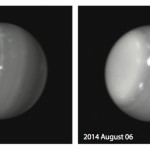
In the past few days, however, astronomers were surprised by a multitude of bright storms on the planet, including one monstrous feature.
“We are always anxious to see that first image of the night of any planet or satellite, as we never know what it might have in store for us,” said Imke de Pater, professor at UC Berkeley and team leader. “This extremely bright feature we saw on UT 6 August 2014 reminds me of a similarly bright storm we saw on Uranus’s southern hemisphere during the years leading up to and at equinox”.