A team of researchers has discovered and photographed a gas giant only 155 light years from our solar system, adding to the short list of exoplanets discovered through direct imaging. It is located around GU Psc, a star with one-third the mass of the Sun and located in the constellation Pisces. See the article in The Astrophysical Journal.
Artist’s view of the planet GU Psc b and its star GU Psc. Credit: Lucas GranitoThe international research team, led by Marie-Ève Naud, a PhD student in the Department of Physics at the Université de Montréal, was able to find this planet by combining observations from the the Gemini Observatory, the Observatoire Mont-Mégantic (OMM), the Canada-France-Hawaii Telescope (CFHT) and the W. M. Keck Observatory.
A distant planet that can be studied in detail
The object was discovered using Gemini-South and followed-up with Gemini-North spectroscopy and CFHT photometry. Once Naud’s team had the entire spectrum, they realized the object had a very low temperature, with properties similar to substellar objects like brown dwarfs or planets.
One possibility was that the object had a peculiar spectrum simply from its youth, and that this had nothing to do with it being a binary, but the other tantalizing possibility was it was a binary planet, with one component being slightly warmer than the team derived from their analysis and the other component slightly cooler.
My father-in-law made a career of repairing the heavy machinery of the local plywood and paper mills in the lumber and farming community of LaGrande, Oregon. Large machines such as high speed saws, conveyors, process tanks and more. One evening he was working with something I did not recognize and I made the mistake of asking what it was.
A snippet of the Keck 1 local controls ladder logicOver the kitchen table were spread the printouts of an arcane programming language, what I learned was called ladder logic. This sort of programming is a throwback to a day when control systems were built from dozens, or even hundreds, of electromechanical relays wired together to perform complex tasks. The relays are gone, replaced by a microcontroller, the programming language remains. It really does look like a ladder, drawn the same as the wiring diagrams used for those banks of relays. Each function, or rung, is filled with symbols for relay contacts and coils.
As a computer engineering student I was appalled that anyone would program this way, I could not conceive of using such a backwards seeming technology. Why not just use a simple programming language like C to build the functions? Ladder logic was the worst sort of programming language, no abstraction, no compartmentalization, prone to building hard to understand spaghetti code.
An Allen-Bradley PLC-2 that controls the Keck 2 dome and shuttersThe ladder logic program is downloaded to a device called a PLC, or programmable logic controller. Usually a rack of cards with a controller at one end and a set of input/output modules filling the remainder of the rack. The PLC takes the code and executes it, scanning the inputs and following the rules set in the logic to switch the outputs. connected the the various push-buttons, limit switches, motors and lights, the PLC can control a huge range of industrial equipment. These devices are the workhorses of entire factories, and often observatories.
Jumping ahead more than a decade… I now find myself using this same technology and programming in ladder logic. Many of the critical systems at Keck use PLC’s for control. The dome controllers, local controls and various safety systems use PLC’s to accomplish the task. Some of these systems are over two decades old, and for the most part spares can still be purchased.
The technology is not dead, far from it. The new telescope control systems currently being designed will feature modern ControlLogix PLC’s to implement the critical safety functions. There are dozens of interlocks throughout the telescope, switches that detect the condition of the system and prevent bad things from happening. If a lock pin is not installed, if a drawbridge is down or a crane not stowed properly, the telescope does not move.
Never mind me, I am just reading a twenty year old user manual, learning how to set the serial communications on a PLC-5.
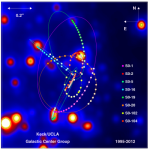
The Galactic Center Group at UCLA has used the W. M. Keck Observatory for the past two decades to observe the center of the Milky Way at the highest angular resolution possible. This work established the existence of a supermassive black hole at the heart of our Galaxy. In this talk, Dr. Leo Meyer, Research Scientist for the UCLA Galactic Center Group, will focus on the black hole itself and the gas that it swallows. The feeding of the black hole is a turbulent process resulting in highly variable emission of infrared light. Observations of this variability provide a great way to learn about the black hole and its immediate environment.
Stars orbiting the black hole at the center of our Milky Way galaxy, credit: UCLA Zooming into the Center of our Galaxy Dr. Leo Meyer – UCLA
May 20, 2014
Show starts at 7 p.m.
Kahilu Theatre, Waimea
Over the next few days Venus will swing quite close to Uranus. Today the pair is separated by 2°48′. This will decrease to 1°15′ on the 15th for the closest approach.
Much like the Venus and Neptune pair we saw last month, the pair is quite a mismatch… Uranus is a mere 5.1 magnitude while Venus is a brilliant -4.0. There will be two 4th magnitude stars to the north of the pair, δPsc and εPsc, but these will be about 4° away from Venus and should be easy to distinguish. Look for Neptune betwixt Venus and the stars.