
Postcard from Hawaiʻi – Koa
When you want to see the stars, find someplace dark


Seven hundred tons of steel and aluminum, thirty meters diameter. The dome represents a huge piece of machinery critical to the operation of the observatory.
Controlling everything is a PLC, a programmable logic controller, twenty year old technology from another era. Operation is critical, if the dome or shutter fail at the wrong time the telescope could be left exposed to the elements causing untold damage.
Despite, or perhaps because of, their huge mass the domes move with stately grace. I never seem to tire of hitting the button and listening to the rumble, of riding the huge structure as it smoothly rotates.
Every time something breaks it is a chance to learn. In this case it is an inclinometer, a simple angle measurement sensor that allows the system to read out the position of the shutter. Tests from the control panel show that it is simply not talking, I will have to get at the device itself, deep inside the structure of the shutter.
I feared that accessing the inclinometer would be difficult. The reality was somewhat easier, just drop the lower shutter all the way down, and climb into a hatch at the top.
Inside the first chamber is found much of the cabling and the inclinometer. There are even a few lights available so I am not working in the dark. Still, it is a bit eerie to be working inside a big aluminum box, a box that moves.
This evening the Moon and Jupiter will be close. The two will be visible in the sky throughout the day becoming a striking pair as the sky grows dark. The Moon will be 23% illuminated and about 7° from the bright planet. Tomorrow night the pair will still be close, about 9.5° apart.

The meteor wildcard of 2014 is something new. Several meteor experts are predicting a possible shower from comet 209P/LINEAR. The Earth will pass close to the debris stream from this comet in late May this year, possibly creating a decent meteor shower, or even a meteor storm.

Of greatest potential significance this quarter, indeed this year, is an encounter between the Earth and a number of dust trails left by Comet 209P/LINEAR at its perihelion returns within twenty years to either side of 1900 AD. Several predictions have already been issued for what may occur, and further updates are likely nearer the event. Based on the most recent independent calculations by Esko Lyytinen, Mikhail Maslov and J´er´emie Vaubaillon, the strongest activity from this source should happen on May 24, most likely between about 07h to 08h UT from a radiant near the borders of Lynx, Ursa Major and Camelopardalis, quite close to o UMa. The predicted radiant locations fall within a few degrees of α = 124° , δ = +79° . Timings in UT for the centre of the strongest activity overall are around 07h 03m (Lyytinen), 07h 21m (Maslov) and 07h 40m (Vaubaillon) respectively.
However, much is unknown about this comet, including its dust productivity and even its precise orbit. Consequently, while tentative proposals have been made that ZHRs at best could reach 100+, perhaps up to storm proportions, based purely on the relative approach distances between the Earth and the computed dust trails, these are far from certain. The strongest activity could be short lived too, lasting perhaps between a few minutes to a fraction of an hour only. In addition, the number of dust trails involved means there may be more than one peak, and that others could happen outside the “key hour” period, so observers at suitable locations are urged to be vigilant for as long as possible to either side of the predicted event to record whatever takes place.
Remember, there are no guarantees in meteor astronomy! Lunar observing circumstances are very positive, with May’s new Moon on the 28th. The north-circumpolar radiant area for many sites means the three main geographic zones where most radio observers are located – Europe, North America and Japan – should be able to follow all that occurs, interference permitting. The time of year means the northern nights are close to their shortest for visual and imaging work, but the predicted strongest activity timings fall perfectly for night-time coverage all across North America and the nearby oceans to its east and west.
–IMO Website 2014 Calendar
The takeaway from what we know… This shower is highly uncertain, we could get anything from nothing to meteor storm. The peak will be short and sharp, lasting only a few hours. With a peak near 07:00-08:00hUT on May 24th, observers in the Pacific should be alert from 21:00 to 22:00HST on the evening of the 23rd. New Moon occurs on the 28th, indicating there should be no moonlight to contend with.
Caltech astronomers have taken unprecedented images of the intergalactic medium (IGM)—the diffuse gas that connects galaxies throughout the universe—with the Cosmic Web Imager, an instrument designed and built at Caltech. Until now, the structure of the IGM has mostly been a matter for theoretical speculation. However, with observations from the Cosmic Web Imager, deployed on the Hale 200-inch telescope at Palomar Observatory, astronomers are obtaining our first three-dimensional pictures of the IGM. The Cosmic Web Imager will make possible a new understanding of galactic and intergalactic dynamics, and it has already detected one possible spiral-galaxy-in-the-making that is three times the size of our Milky Way.

Credit: Christopher Martin, Robert Hurt
Since the late 1980s and early 1990s, theoreticians have predicted that primordial gas from the Big Bang is not spread uniformly throughout space, but is instead distributed in channels that span galaxies and flow between them. This “cosmic web”—the IGM—is a network of smaller and larger filaments crisscrossing one another across the vastness of space and back through time to an era when galaxies were first forming and stars were being produced at a rapid rate.
Martin describes the diffuse gas of the IGM as “dim matter,” to distinguish it from the bright matter of stars and galaxies, and the dark matter and energy that compose most of the universe. Though you might not think so on a bright sunny day or even a starlit night, fully 96 percent of the mass and energy in the universe is dark energy and dark matter (first inferred by Caltech’s Fritz Zwicky in the 1930s), whose existence we know of only due to its effects on the remaining 4 percent that we can see: normal matter. Of this 4 percent that is normal matter, only one-quarter is made up of stars and galaxies, the bright objects that light our night sky. The remainder, which amounts to only about 3 percent of everything in the universe, is the IGM.

Taking star trails is one of the easiest forms of nighttime photography. it requires less equipment than full out astrophotography, only a camera that can take a long exposure and a tripod. In a pinch you can do without the tripod.
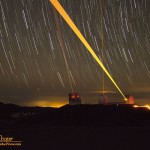
For a number of reasons taking one very long exposure is a problem with digital cameras. Without getting into a technical discussion of noise, dark current and hot pixels we will simply advise taking short exposures. You can always try a twenty minute or half hour exposure and see for yourself. Thus the technique is to take a series of short exposures, usually one to five minutes long, and add these together in processing. By taking a series of short exposures, the final exposure length is limited only by the camera battery or the arrival of dawn.
If the camera is sensitive enough, and you have a fast lens, you might try starscape photography, where the stars are not trailed by the motion of the Earth. In contrast, star trail photography can be done by almost any camera that can take a long exposure. The difference is in the length of the exposures, long versus short, star trail or starscape.
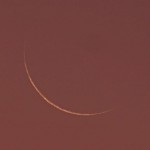
An annular solar eclipse will be visible from Australia, Antarctica and across the southern Indian Ocean today. This is a somewhat odd eclipse as the center of the Moon’s shadow misses the Earth entirely. The eclipse will be quite short and visible over a limited geographic area.
