
Subaru and Zodiacal Light
When you want to see the stars, find someplace dark

It is not really called Goat House. It is just that I have never heard another name, Goat House is what I have named the cave considering the lack of any better designation. The tube is no great secret, its existence is well known to longtime residents.
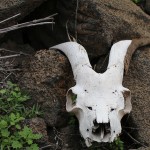
This tube is found several miles out the power line road just above the village. The road starts across from the stables and heads straight south. There are side roads that go left and right, just go straight to the cave.
Along the way you find the mauka fence of the Waikoloa Dry Forest Initiative restoration effort. This fence keeps the goats out of a 275 acre area in an effort to preserve native trees like the Wiliwili. With some success it appears, the trees look pretty good. The wiliwili are strikingly beautiful trees, I am happy to see them thriving here.

This post is just a test of Hawaiʻian diacritical marks to check rendering on different systems. Let me know if this displays properly on your computer…
A bit of the Kumulipo…
O ke au i kahuli wela ka honua
O ke au i kahuli lole ka lani
O ke au i kukaʻiaka ka la
E ho’omalamalama i ka la
O ke au i Makaliʻi ka po
O ka Walewale hoʻokumu honua ia
O ke kumu o ka lipo
O ke kumu o ka Po i po ai
O ka Lipolipo, o ka lipolipo
O ka lipo o ka La, o ka lipo o ka Po
Po wale ho-i
A bit of text clipped from the UH College of Hawaiian Language website…
Ka Haka ʻUla O Keʻelikōlani
Koleke ʻŌlelo HawaiʻiKa Haka ʻUla O Keʻelikōlani ʻO ka ʻŌlelo ke Kaʻā o ka Mauli
Ua hoʻokumu ʻia ʻo Ka Haka ʻUla O Keʻelikōlani ma ke Kulanui o Hawaiʻi ma Hilo i ka MH 1997, ʻo ia ke Koleke ʻōlelo Hawaiʻi mua o ka honua nei a puni. Ua kapa ʻia kona inoa no ke aliʻi wahine ʻo Luka Keʻelikōlani Keanolani Kanāhoahoa ma muli o kona kūpaʻa wiwo ʻole ma hope o ka ʻōlelo a moʻomeheu Hawaiʻi.

There are a lot of caves on this island. Much of the island of Hawaiʻi is riddled with lava tubes. Hiking or riding the trails or back roads of the island often offers a mysterious opening into darkness. Not that I explore too far, I am not a hard core spelunker. But I do often poke my head in to see what the cave has to offer.
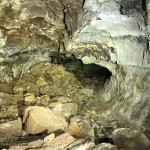
Unless the cave is quite small the camera flash will provide unsatisfactory lighting of the cave. The flash will also tend to light up nearby parts of the cave and leave anything at any distance poorly lit. I generally do not use a flash in a cave unless I am photographing small features close at hand.
The technique is simple… Set the camera on a tripod, or a rock, and open the shutter for as long as the timer will allow, usually 15 or 30 seconds. During the exposure you paint the cave with light. Simply wave the light around in a random pattern, never letting the beam rest too long in a single place to evenly distribute the light. This simple method will allow even a large cave to be illuminated with a relatively modest light.
You will need to do this a few times and adjust your process to suit the situation. You can adjust the camera shutter timer or gain (ISO) to adjust the exposure. You can decide where to spend more or less time with the light if there are dark areas or hotspots in the image.
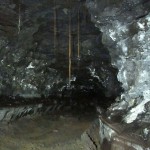
Focus can be difficult. Set the camera for a smaller focal ratio, perhaps f/5.6 or f/8 to keep a good depth of field. Hold the flashlight on a feature well into the scene and focus on that. Some trial and error may be needed to get a good focus.
It can be fun too! When exploring the lower end of Thurston Lava Tube I was all set up with the camera and tripod when a group of kids arrived. Curious as to what I was doing I showed them. During the exposure I had the whole group wave their lights around as we all stood behind the camera. The kids were amazed when the photo appeared on the LCD display, they had no idea you could light up a cave and take a photo with a bunch of little flashlights.
Today Mercury reaches maximum elongation, the furthest point it will reach from the Sun in the sky and the highest it will be above the sunrise for this morning apparition. The planet is easily visible as a bright, starlike object about 27° above the rising Sun as the twilight begins. Over the next couple weeks Mercury will slide back into the sunrise, heading for superior conjunction on April 25th.
A photograph of serendipity.
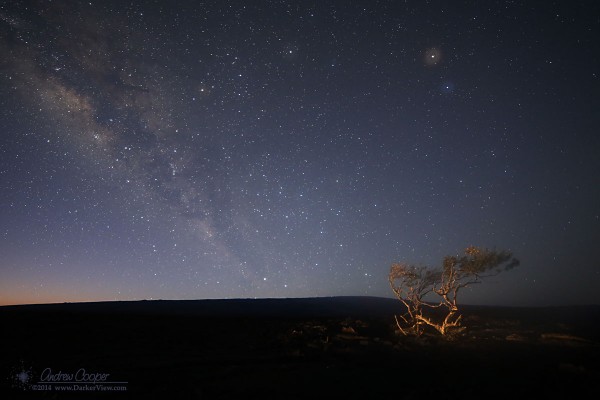
The photograph was planned… Somewhat. I knew there were some picturesque trees on the lava field along Saddle road. The plan was to shoot one of these trees silhouetted against the Milky Way and Mauna Loa. That was the plan. At least until the plan met reality.
Shot as planned the results were less than stellar. Actually they were rather boring. The rising summer Milky Way was spectacular, nothing else worked. The enormous bulk of Mauna Loa became a bump on the horizon from the low angle with the 14mm lens. The trees did not look like much against the dark.
Serendipity intervened… First a passing car lit the trees with dramatic results. Car headlights caught the trees at just the right angle to light up the right bits, a lucky bit of geometry and road alignment. Looking at the image on my screen I was intrigued… I repositioned the camera and shot again when another vehicle passed… This was working!
As I waited for other passing cars the shots deteriorated, odd glows across the frame. Were the headlights catching the big dome of glass at the front of the lens? Blocking the light from the headlights on the camera did not help. I pull out a flashlight to check the camera… Ack! The lens was fogging up!
Retrieving the anti-dew kit and a battery from the vehicle I secured a dew strap around the camera lens. At this point I wanted the shot and was willing to work for it. I was lucky again… I had thrown the dew gear in the car as a last moment afterthought.
It took time for the lens to warm and clear. As I waited dawn crept into the sky. I took a last few shots as the light increased and the stars faded. The dawn light added a nice shade of blue to the sky with a hint of peach to one side, another serendipitous bit that added to the photo. A last wisp of fog on the lens was just enough to create halos around Mars and the brighter stars.
Not a bad result! With a little skill and more than a little luck. The shot has been entered in the Hawai’i Photo Expo. Hopefully the jurors think the shot is as good as I think it is.
A windswept place of rock and water. A place where the few trees seem bent and twisted. A place with an ancient feel, where time has a different quality. The landscape is bleak, nothing at all like the tourist postcards of Hawaiʻi, open grassland with scattered copses of trees here and there. Look twice and the remains of history litter the landscape. A rubble of stacked stone betrays ancient Hawaiian settlements. Concrete foundations show the more recent remains of wars past or failed farms.
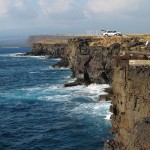
Such is Ka Lae, the southernmost tip of land in the islands. A place where the land and sea meet the past. There is nothing beyond this point but thousands of miles of empty ocean.
This may be the place men first discovered these islands, by Polynesians sailing from the south on those daring voyages of discovery. Many of the most ancient archeological sites are here, on the southern tip of the island. This may be the coastline first sighted by Europeans, Spanish galleons certainly passed south of the islands for centuries prior to Cook’s later discovery of the islands in 1778.
Fishermen have come here as long as men have dwelt in Hawaiʻi. The steep cliffs drop into deep water. A place where the great pelagic fish come close enough to shore to catch without venturing to sea. Ahi, ono, mahi-mahi and other prize catches can be had from a pole at the top of the cliff. On any given day a dozen local fishermen can be found atop the cliff, each with a favorite spot.
The modern technique is to secure a plastic bottle or inflated bag to the line, allowing the wind to pull the line out from the cliff. In years past the fishermen would fish from a boat secured to the cliff by a line. Along the cliff are the remains of winches and ladders used to access the boats.
Continue reading “Ka Lae – South Point”