Today Mercury passes through superior conjunction, passing behind the Sun as seen from the Earth. The planet will appear in the sunset later next month, reaching maximum elongation on January 30th.
Author: Andrew
An electrical engineer, amateur astronomer, and diver, living and working on the island of Hawaiʻi.
Quadrantid Meteor Shower
The first meteor shower of 2014 is the annual Quadrantid meteor shower. The Quadrantids are a reliable shower, producing 60-120 ZHR, one to two meteors per minute. The Quadrantids are named for the obsolete constellation Quadrans Muralis, now part of the constellation Boötes.

Watching meteors requires no more equipment than your eyes and a dark sky, and can be enjoyable for just about anyone. Set the alarm early?
Comet C/2012 S1 ISON Closest to Earth

Update: Yes, this post was written and scheduled well before the comet disintegrated at perihelion. If there is anything left it is closest to the Earth today. Many amateurs, large scopes, even Hubble have attempted to recover the remains. No one has reported finding anything.
Christmas Tree

Banded Coral Shrimp

Whitemouth

Winter Solstice
Winter solstice occurs today at 07:11HST. Today the Sun will occupy the most southerly position in the sky of the year. The term solstice comes from the Latin terms Sol (the Sun) and sistere (to stand still). On this day the Sun seems to stand still as it stops moving southwards each day and begins move to the north. This is the first day of winter as marked by many cultures in the northern hemisphere. Alternately, this is the first day of summer for those folks in the southern hemisphere.
| 2013 Solstices and Equinoxes | ||||
|---|---|---|---|---|
| UT | HST | |||
| Perihelion | Jan 2 | 00:59UT | Jan 1 | 14:59HST |
| Spring Equinox | Mar 20 | 11:02UT | Mar 20 | 01:02HST |
| Summer Solstice | Jun 21 | 05:04UT | Jun 20 | 19:04HST |
| Apehelion | Jul 5 | 18:59UT | Jul 5 | 08:59HST |
| Fall Equinox | Sep 22 | 20:44UT | Sep 22 | 10:44HST |
| Winter Solstice | Dec 21 | 17:11UT | Dec 21 | 07:11HST |
| Source: NASA Sky Calendar | ||||
Alignments
Through trial and error my friend Dean Ketelsen has worked out a perfect place and the correct dates to observe the Sun setting behind the telescopes of Kitt Peak National Observatory. The site is along the Mt. Lemmon Highway above Tucson, over 50 miles away from the observatories. The correct alignment occurs just a few days before and after the solstice. It has become a bit of a holiday tradition for the members of the local astronomy club to join Dean at the correct spot in an attempt to get just the right photo. This year the weather treated them well…
I have looked for a similar alignment on Mauna Kea. Unfortunately the telescopes are not highly visible from sites east and west of the summit where the Sun will rise or set behind. The full Moon might be possible, but much tougher to predict.
Comet ISON is Still Dead
The definitive results are in from the Hubble Space Telescope… Comet ISON is still dead.

25th magnitude is a lot deeper than amateur attempts at recovery, though the amateur efforts likely covered a great deal more area than Hubble with wider fields of view. Still, there have been no reports of any remains detected by any searcher.
Does this rule out any surviving fragments?
We can’t completely rule out the possibility that something is left of the comet. After all, it was seen after its passage close to the Sun, but disappeared not long after. This material would still exist, but is likely very diffuse gas, dust, and very small pieces spread over an extremely large area. – Zolt Levay, The HubbleSite Blog
I think it is pretty safe to call this comet dead.
Postcard from the Universe – Christmas Tree Cluster
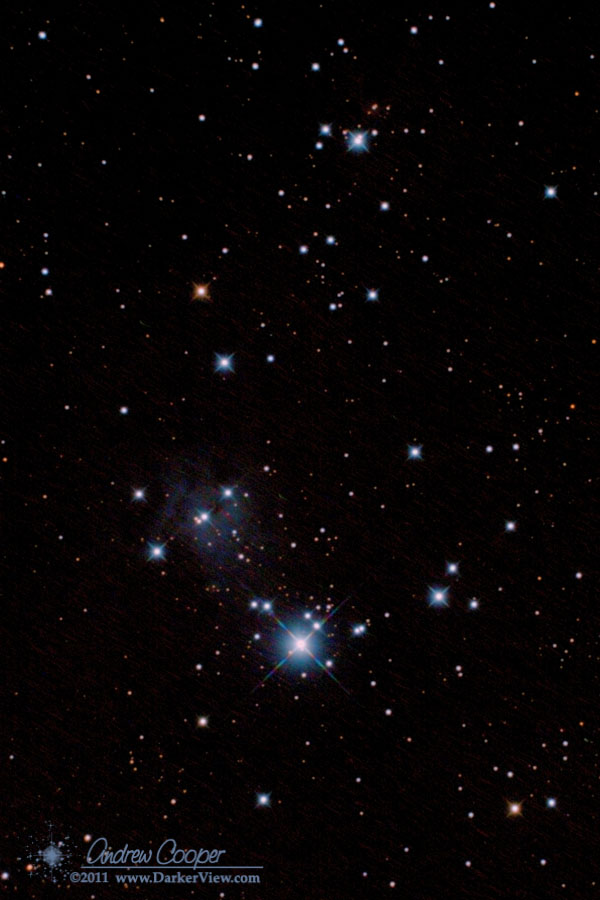
A seasonally appropriate astrophoto, NGC2264, also known as the Christmas Tree Cluster. It does have the outline of a tree decorated with stars in place of ornaments. This was shot on the evening of the 23rd from the driveway.
Keeping the exposures short I concentrated on the stars rather than the nebula that fills the region. I am working on the appearance of my stars, attempting to improve my technique. Not sure if I have succeeded here, they are better. I used some Photoshop tricks to preserve the color of the stars in working on the image. Better, but not quite up the the standard I aspire to.
There seem to be a few deep sky objects that are appropriate for the season. The Rosette Nebula makes a nice wreath, the Christmas Tree, etc. The folks at WISE published a nice infrared image of Barnard 3 that also looks like a wreath. Long winter nights are an excellent time to consider the night sky. Not much else to do, I am on call for the weekend, thus staying home. It is new moon and the recent storms have departed allowing dark skies. May as well take a few more astrophotos.
Mele Kalikimaka!