
Postcard from the Summit – Test Leads
When you want to see the stars, find someplace dark

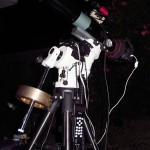
A small, light telescope mount, a small refractor, and a modern autoguider. Seems like a perfect setup! There are a few issues…
The setup is pretty straightforward. A TeleVue 76mm riding atop the iOptron ZEQ25 mount. Atop the TV-76 is a red dot finder and an SBIG STi autoguider. The guider is attached with a bit of custom machining and uses the SBIG accessory kit, including a 100mm lens giving a 2.7 x 2.0 degree field of view. With such a wide field of view the guider also functions as a finder to aid in aligning and framing the photographic telescope.
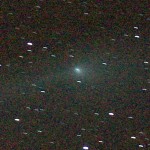
Without guiding the performance is not satisfactory. Even with a modest focal length of 380mm there are objectionable guiding errors. The frame at right shows the errors seen during a four minute exposure. Based on my first impressions I would expect to need guiding on any exposure using more than 100mm and a few minutes exposure.
A few steps here have not gone smoothly..
Configuration? There are a lot of setups to check. All of the correct software and drivers… Planetarium software, autoguiding software, camera control, ASCOM, all of the hardware drivers, etc., etc. After everything talks it is a matter of checking settings and tuning the setup with several parameters in the software and on the mount that need to be checked.
I am using PHD to do the guiding, a bit of kit I have used for a while. It works quite well with straightforward controls. It does have quite a few parameters that require checking to tune the control algorithms.
The iOptron controller has a setting for guiding speed in the menus. This is purported to be a fraction of sidereal speed by the manual, up to 100%, but the menu reads as if it is 100x on the controller. I suspect the manual is correct here, will need to test.
The first issue cropped up fairly quickly. I could get no motion from the mount while sending corrections with the STi. PHD was unable to calibrate, no motion. I attempted to use the manual controls in PHD with similar lack of motion. (See update below)
To troubleshoot I needed to make sure that the guide port on the ‘scope worked. I grabbed a Losmandy hand controller and connected it to the ZEQ25 guide port. This worked, the port was working properly and I could see what the guide speed setting on the controller really meant. It looks like 100x is 100% of siderial speed, or close enough.
| Parameter | Value |
|---|---|
| RA Aggressiveness | 100 |
| RA Hysteresis | 10 |
| Max RA Duration | 750ms |
| Search Region | 15pix |
| Min Motion | 0.1pix |
| Calibration Step | 2000ms |
| Time Lapse | 0ms |
| Dec Guide Mode | Auto |
| Dec Algorithm | Resist |
| Dec Slope Weight | 5 |
| Max Dec Duration | 750ms |
| Star Mass Tolerance | 0.5 |
| Noise Reduction | None |
Some tuning of the parameters in PHD has started to result in very nice guiding graphs and some excellent test images. These could probably be refined a bit more, but they are working for now. The PHD help menu has a fairly good description of each of the parameters, there is also a great guide to PHD on the Rose City Astronomers website.
It is really necessary to set the autoguide rate to 100% when using shorter focal lengths. Otherwise the mount does not move very far during each calibration step, as a result calibrations take a very long time and will sometimes fail.
Another observation. When guiding near the pole, shooting comet PanSTARRS at near +80° declination, I encountered very regular declination errors using PHD. Every couple minutes the dec error would deviate by about a pixel, alternating in each direction. Shutting off the declination correction worked pretty well, the mount was polar aligned accurately enough that there was very little declination drift.
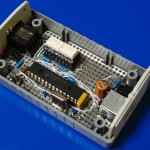
I still have yet to understand just why the STi will not directly interface with the ZEQ25, something in the ratings of the photo-isolators used in the STi? The manual simply states these are good to 25mA and 25V, which seems generous for the task. It may be in the voltage levels, I did discover that the iOptron uses 3.3V on the guide port. Perhaps the STi will not pull down low enough for a valid low logic level? I built the USB to ST-4 adapter with MOSFET optocouplers, these can switch harder than standard photo transistors.
UPDATE– The interface issue was just a cabling problem. The same cable I use with my Losmandy G11 does not work, it is flipped from the pinout needed for the ZEQ25. With a corrected cable I now connect the STi directly to the guide port on the ZEQ… It works.

With the Moon and Jupiter having departed the sunset stage, Mercury and Venus continue their dance. This evening finds the two about 4° apart with the dimmer Mercury higher in the sky. Mercury has dimmed over the last few weeks and is now only 0.7 magnitude, far dimmer than Venus at -4 magnitude.
Over the coming days the pair will draw closer, passing within 2° on June 19th. As the month wanes the two will then separate ending the dance.
I saw it on Facebook first, shared by a family member… The meme that will not die…

The claims are the usual… The Moon will be huge in the sky. The Moon will be closer than is has been in some huge time span.
There is some truth here, the June full Moon will be a bit bigger and brighter than usual. And it will be closer to the Earth than it has been in a long time, if you consider 27.5 days to be a long time.
The SuperMoon meme exaggerates the truth to varying degrees.
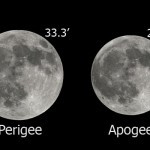
It all relates to lunar apogee and perigee. As the Moon’s orbit is elliptical, it does get a little further and closer during each orbit, but the difference is fairly minor, the distance varies from 405,000km (251,000miles) to 360,000km (223,000miles) from the Earth. This difference in distance results in the Moon appearing up to 12% larger at perigee compared to apogee. For a better explanation you can go to another post that explains this more fully, with graphics.
12% difference, noticeable if you look close, but hardly a “SuperMoon”.
The Moon passes through perigee, the closest point every 27.5 days, about once each orbit. Not a very long time. But SuperMoon only occurs if perigee happens to coincide with full Moon. As these two cycles are usually out of sync with each other people do not usually notice. About once a year the two cycles coincide and we get a slightly larger, brighter full Moon… The SuperMoon. Interesting, but not as dramatic as the hype.
Geologists have studied the lunar earthquake/volcano possibility for decades with varying results. Indeed, some older studies seemed to indicate a link. More recent studies have pretty much ruled out any association, better data associated with more instrumentation and improved worldwide coverage has shown that if there is any effect it is quite small.
Besides, if there were a link, the earthquakes should occur every 27.5 days as the Moon passes through perigee, they do not. There is no reason to make anything special of the full Moon/perigee synchronicity.
June 23rd will offer a nice, bright full Moon. A great time to take a moonlit walk, or a night dive. Ignore the scaremongers, and use this as an excuse to enjoy our beautiful universe.
Today Mercury reaches maximum elongation, the furthest point it will reach from the Sun in our sky and the highest it will be above the sunset for this evening apparition. The planet is easily visible as a bright, starlike object about 24° above the setting Sun as twilight begins. Over the next couple weeks Mercury will slide back into the sunset, heading for inferior conjunction on July 9th.

A rigid mount to adapt the TeleVue-76 to the SBIG STi autoguider? I need such a solution, I have both of these bits of kit that need to be wed together for the minimal astrophoto setup. As I am unlikely to find such a part commercially, I would have to make it myself.
Another couple hours in the machine shop were in order, another small pile of aluminum chips. This actually went pretty quickly, these are easy cuts to make. No tapping is required, the four holes are simply drilled through. The two hours included design and cleanup for a quick project.
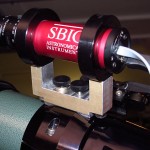
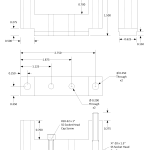
The TV-76 has a rather non-standard mounting point on top for accessories like this. A pair of #10-32 threaded holes, 0.75″ apart and located in a slot 0.625″ wide milled into the mounting ring. This seems simple enough. An adapter made for the TV-76 should work with any of the TeleVue refractors that use this mounting. Another concern is that the solution must also be very rigid, any flexure between the autoguider and the telescope will result in smeared stars.
The design assumes that you have the additional guiding kit sold by SBIG for the STi autoguider. This provides the mounting rings that clamp the camera body.
The hardware required will be two ¼-20 x 1½” socket head cap screws, and two #10-32 x 1″ socket head cap screws. A pair of plastic press on caps convert the #10 screws to knobs. All parts you can find in a neighborhood hardware store.
The mount is 1.5″ high to set the autoguider away from the main OTA, as to not encounter any vignetting. This also allows space to get fingers onto the mounting knobs. The dimensions are chosen so that standard screws protrude by just the right amount. I messed this up on the one I made, machining the center to far. As a result a few washers are needed for the screws that mate with the refractor. This is fixed in the mechanical drawing.
To co-boresight the TV-76 with the autoguider it was necessary to slip a 1/4″ washer between the mount and the rear ring as a shim. With that in place the same object is centered in both fields of view. The STi has a 2.7° x 2.2° field when used with the 100mm lens supplied in the SBIG accessory kit. With this wide field of view it also serves as a finder to locate and frame the photographic target.
It assembles nicely, a good start. The true test will be the quality of the images produced by the rig.
W. M. Keck Observatory press release…
The least massive galaxy in the known universe has been measured by UC Irvine scientists, clocking in at just 1,000 or so stars with a bit of dark matter holding them together.

“Finding a galaxy as tiny as Segue 2 is like discovering an elephant smaller than a mouse,” said UC Irvine cosmologist James Bullock, co-author of the paper. Astronomers have been searching for years for this type of dwarf galaxy, long predicted to be swarming around the Milky Way. Their inability to find any, he said, “has been a major puzzle, suggesting that perhaps our theoretical understanding of structure formation in the universe was flawed in a serious way.”
Snails move at a surprising speed underwater, much faster than their terrestrial counterparts. This shell was moving much to fast even for a marine snail. A hermit crab, of course. The shell was familiar, I had photographed a snail wearing the same shell a few mere minutes earlier. The hermit crab was using a basket snail shell.


In the course of identifying the hermit crab I was surprised to learn it was an anemone crab. These usually host an anemone or three on their shells. This crab had none. A new shell? No time yet to recruit the usual anemone? It was fairly small for the species, perhaps a young example.