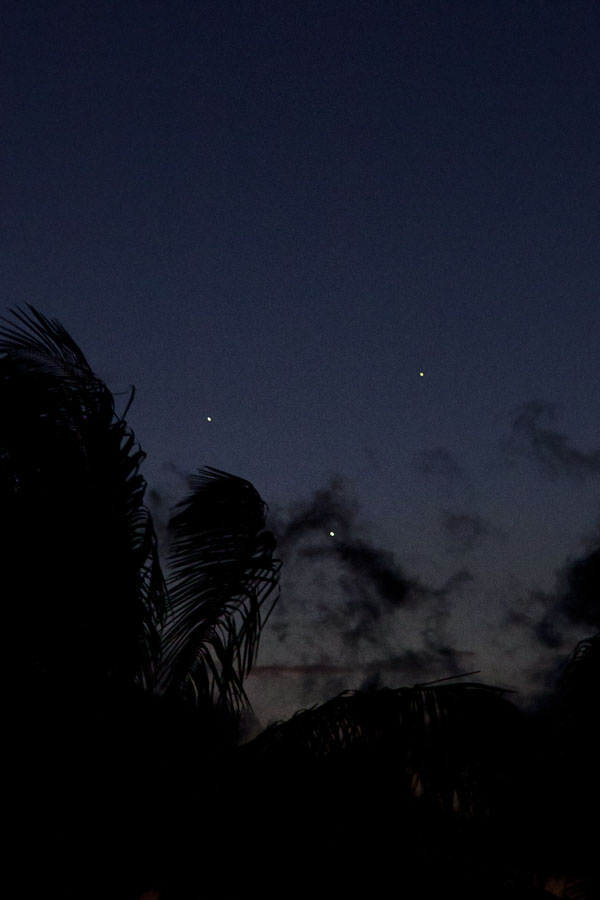
Tonight will see a bright Moon just a few degrees from Saturn in the constellation Virgo. The Moon will be nearing full, about 94% illuminated and 4° south of Saturn.
Author: Andrew
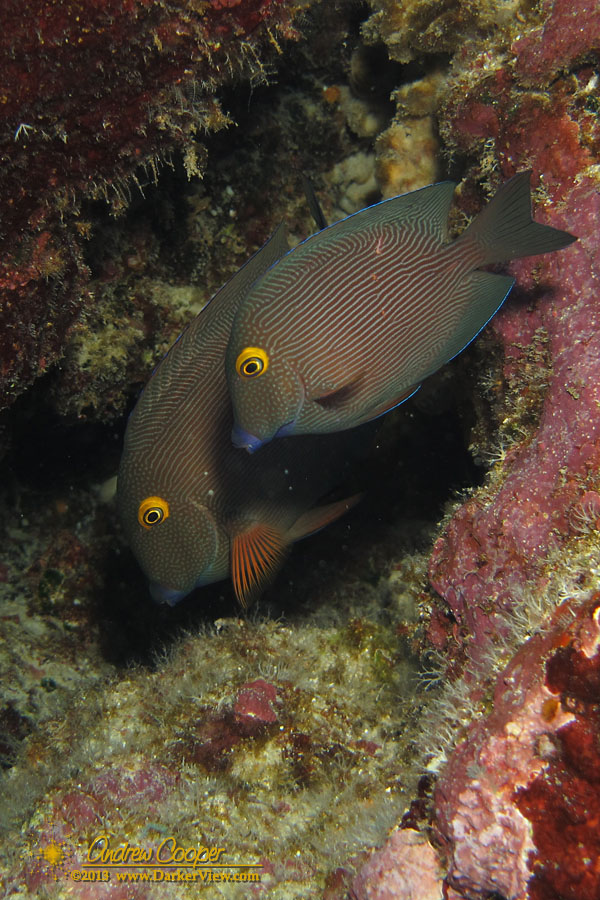
Whitemouth Moray
The Moon and Spica
Tonight the Moon will rendezvous with the bright star Spica in the constellation Virgo. The Moon is approaching full, just under 90% illuminated. Evening will see the two quite close, about 2° apart. As the night progresses this separation will diminish as the Moon slides just south of the star. For viewers in Hawai’i the minimum separation will be about 40′ around 2:00 in the morning with the star just 25′ from the Moon’s pole.
A Phone Book… Really?

I am old enough to remember when a phone book was actually useful. It was the way to locate businesses and the phone numbers of friends. That was a long time ago. At this point I can not remember when I last opened a phone book to accomplish anything useful, an internet search is faster and more informative. A search provides so much more than a phone number…. Business hours, a map to the location with directions if needed, reviews and more. Not to mention that the information is up to date, not printed once a year, a business can update their website as details change. Need to see tonight’s menu?
Phone books are an anachronism from another time, one that belongs in the past. As with any business there is a certain inertia, they will not die quickly. While it does appear that the white pages have properly died, someone needs to put a stake into the yellow pages.
For this household? It is straight into the recycle bin with the book. Unused, unlamented, existing only long enough to inspire a rant.
2013 Big Island MATE ROV Competition
For the sixth year running I made the drive to Hilo to help in judging the Big Island Regional 2013 MATE Underwater ROV competition. Too much fun to miss!
As usual Keck provided much of the official staff. This is the fault of Keck software engineer Al Honey, the head official, who drafts the rest of us into being there! An engineer from Liquid Robotics and a couple folks from the observatories in Hilo rounded out the judging staff. Add teams from schools all over the island and mix with water to create an event.

The GoPro HD Hero 2 for Diving
I know, I am late to this party. Not unusual, I do not often jump on the latest tech. I still use an iPhone 3GS, only three models back. It was, as usual, my wife who bequested this latest toy upon me. Without her I would be hopelessly out of date.
The GoPro HD Hero 2 camera is interesting to us as it comes with a standard waterproof housing good to scuba depths. The price was right, Deb picked it up as a Costco special.
Thus I attached it to the top of my usual rig to give it a try on a dive or two. As it turns out, it is a good thing I had my regular camera along, there are some issues with a stock GoPro underwater.
The first obvious issue is focus, as I had heard the camera will not focus properly underwater with the standard dome port. The solution to this is to get a flat port.
The more concerning issue is the burned out highlights visible in the video below. This is not unusual in a camera using a typical exposure algorithm designed for daylight above water. Underwater the red light is gone, absorbed by the water. This lack of red creates a tendency for the camera to overexpose the green or blue.
The usual solution is to set a slight under exposure in the scene using exposure compensation. However, the Hero 2 has no exposure compensation control. There are a couple possible solutions… Commonly available is a red filter for the flat port camera. Will this solve the burnouts? Another possibility lies in using a less saturated color profile as available in the new firmware.
While there were issues with the image, the sound seems pretty good for being in a case, much the same as what I hear when diving. The real test would be to dive with a few whales around to see how well it records whalesong. Alas, the humpbacks headed north a couple months ago. I miss the whalesong soundtrack on our dives. A pod of dolphins perhaps?
I plan to set up the GoPro as a stand alone camera and video rig for diving. Just the camera, an Ultralight handle and arm I have on-hand, plus a video light, which I also have on-hand. I just need to manufacture a tray for the setup, another hour in the machine shop. This should make a compact, lightweight dive or snorkeling camera rig.
I can think of a few other interesting uses for the camera, it has some nice timelapse facilities I need to test. Just the camera to use on the top of a boat. The camera does not do low light, just too small a sensor and lens. Still, there are quite a few things it should do well, a fun addition to the kit.
Mercury, Venus and Jupiter

On the evening of May 24th Venus and Mercury will be about 2° apart with Jupiter 4° above. Closest approach of the three will occur the evening of May 26th with the trio forming a neat triangle about 2° on a side. On the 28th Venus and Jupiter will be just over 1° apart. During the first few days of June, the planet Jupiter will bow out of the dance, exiting the stage into the Sun’s glare. Venus and Mercury will join up one more time for a few days after June 17th, with a close approach on the 19th and 20th with about 2° separation between the two. When Mercury also heads into the sunset this dance will end during the last days of June.
On the 9th and 10th of June the Moon will run across the stage, a very thin crescent around 2% illuminated and 6° south of the planets.
Much of the dance will take place about 15° above the sunset, high enough to be nicely visible, low enough that the glow of sunset will provide a colorful backdrop to light the stage.
Postcard from the Reef – Hawaiian Cleaner Wrasse
A very common fish, endemic to Hawaiian reefs, the pretty cleaner wrasse easily catches your attention with a brilliant neon color scheme. You see these fish nearly every time you get in the water. They are usually found in some cleft in the reef or above a prominent coral head working over another reef fish. They feed on parasites, mucous and dead skin of the other fish. The cleaning services offered by these small wrasse are so popular that there will often be several fish waiting their turn.
While cleaner wrasse are quite pretty they are also infuriatingly difficult to photograph. You can usually get close, they are not overly shy. The problem is that they never stop moving, swimming with an odd, jerky motion in the water. I have long since lost count of the number of blurred photos I have of this fish.

Mercury Appears in the Evening Sky
The planet Mercury is starting an evening apparition. The planet should become visible this week just above the fading glow of the setting Sun as a magnitude -1 object. Currently about 10° from the Sun it will rise higher each evening, reaching a maximum elongation of 24° on June 12th.
Mercury will join Venus and Jupiter in the sunset making for a series of planetary conjunctions over the coming month.
Lahaina Noon
Living south of the Tropic of Cancer we get to experience an interesting phenomena that folks outside the tropics will not see. There are two days each year when the Sun passes directly overhead. In the islands this event is called Lahaina Noon.
| Location | Date | Time |
|---|---|---|
| Hilo | May 18th | 12:17pm |
| Waimea | May 19th | 12:20pm |
| Kahului | May 24th | 12:23pm |
| Honolulu | May 26th | 12:30pm |
| Lihue | May 30th | 12:36pm |
The date on which this event occurs each year depends on your exact latitude, the further north the later in the spring it will occur. Thus the day for Lahaina noon will vary by eight days from Hilo to Honolulu, and another five to Lihue. As you approach the Tropic of Cancer at 23°26’N Lahaina Noon will occur closer to the summer solstice. The date will also slip a little due to the out of sync nature of our seasons and our calendar. This is the reason we insert a leap year into the calendar every four years.
This year Lahaina Noon will occur on May 18th for residents living in Hilo, or May 26th for Honolulu. It is also important to remember that the Sun is not directly overhead at 12:00 exactly. As the islands lie west of the center of the time zone, true local noon occurs up to half an hour after 12:00.