Tomorrow morning, on April 8th, a thin crescent Moon will share the sky with Mercury. The pair will be separated by 8°41′ with the Moon further north. Both will be about rise within minutes of each other about 04:55HST and both will be about 16° above the horizon at sunrise. At magnitude 0.1 Mercury should be easy to spot, making a nice companion to a 3% illuminated Moon.
In an age of cost cutting on products to compete in a very competitive market place, some producers seem to go too far. Reducing the quality of the product to the very edge in order to shave a few pennies. One consequence of this has been more battery leaks, with Duracell being by far the worst offender. Seriously, why does anyone still buy Duracell products! This time it was a friend who brought me the latest corrosive disaster, a Wii Balance Board with a mess in the battery compartment.
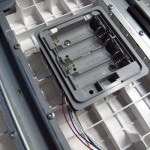
The battery compartment of a Wii Balance Board after the repairAt least the balance board was easy to get apart, just a mess of screws on the back to remove, a few minutes with a phillips screwdriver. First remove the feet with three screws each, then the backplate with another ten screws. The unit is essentially a fancy bathroom scale with load cells in each foot. Rather nicely made, the engineers did a good job here.
Opening the case reveals the good news and the bad news. Good… The battery compartment is removable with just another couple screws. Bad… The damage here is severe, the small circuit board under the battery compartment is heavily corroded, traces and components destroyed. Good… The complex circuits for the unit, the processor and transmitter, are on another circuit board on the other side of the balance board and are untouched. Bad… The battery contact plating is gone, these are unusable. Even the wiring harness is damaged.
Observations of Europa from the W. M. Keck Observatory help NASA and California Institute of Technology (Caltech) astronomers go one step further in demonstrating life may be possible in the ocean of one of Jupiter’s moons. In addition to the known existence of water, a paper published today shows hydrogen peroxide is abundant across much of the surface of the smallest of the Galilean Moons. The paper argues that if the peroxide on the surface of Europa mixes into the ocean below, it could be an important energy supply for simple forms of life. The paper was published online in the Astrophysical Journal Letters.
(On March 14, a separate paper was published by the same team in Astronomical Journal, demonstrating the salty ocean of Europa makes its way through the frozen surface, introducing the possibility the ocean is habitable. Click here for that news release.)
“Life as we know it needs liquid water, elements like carbon, nitrogen, phosphorus and sulfur, and it needs some form of chemical or light energy to get the business of life done,” said Kevin Hand, the paper’s lead author, based at NASA’s Jet Propulsion Laboratory, Pasadena, Calif. “Europa has the liquid water and elements, and we think that compounds like peroxide might be an important part of the energy requirement. The availability of oxidants like peroxide on Earth was a critical part of the rise of complex, multicellular life.”
This color composite view combines violet, green, and infrared images of Jupiter’s intriguing moon, Europa, image credit NASA/JPL/University of Arizona
The scientists think hydrogen peroxide is an important factor for the habitability of the global liquid water ocean under Europa’s icy crust because hydrogen peroxide decays to oxygen when mixed into liquid water. “At Europa, abundant compounds like peroxide could help to satisfy the chemical energy requirement needed for life within the ocean, if the peroxide is mixed into the ocean,” said Hand.
Co-author Mike Brown of Caltech in Pasadena, analyzed data collected from the Near-Infrared Echelle Spectrograph (NIRSPEC) and OH Suppressing Infra-Red Imaging Spectrograph (OSIRIS) instruments on the mighty Keck II telescope on Mauna Kea, Hawaii, over four nights in September 2011. The highest concentration of peroxide found was on the side of Europa that always leads in its orbit around Jupiter, with a peroxide abundance of 0.12 percent relative to water. (This is roughly 20 times more diluted than the hydrogen peroxide mixture available at drug stores.) The concentration of peroxide in Europa’s ice then drops off to nearly zero on the hemisphere of Europa that faces backward in its orbit.
Hydrogen peroxide was first detected on Europa by NASA’s Galileo mission, which explored the Jupiter system from 1995 to 2003, but Galileo observations were of a limited region. The data from Keck Observatory shows that peroxide is widespread across much of the surface of Europa, and the highest concentrations are reached in regions where Europa’s ice is nearly pure water with very little sulfur contamination. The peroxide is created by the intense radiation processing of Europa’s surface ice that comes from the moon’s location within Jupiter’s strong magnetic field.
“The Galileo measurements gave us tantalizing hints of what might be happening all over the surface of Europa, and we’ve now been able to quantify that with our Keck telescope observations,” Brown said. “What we still don’t know is how the surface and the ocean mix, which would provide a mechanism for any life to use the peroxide.”
Basic household tasks require some re-engineering when performed in the presence of a feline. Making the bed, vacuuming, loading the dishwasher, all tasks must take into account the needs of the cat. This includes doing laundry. While the task seems straightforward, it is usually more complicated than a simple evaluation would suggest. For example, with a feline present the actual procedure for changing loads in the clothes dryer runs something like this…
In the photo you might note the large bell on Ras’ collar, this has repeatedly been a useful item, saving both us and Ras from much trouble. It has also taken a couple experiments to locate a suitably Ras resistant bell that he is unable to quickly destroy.
It will soon be time to head for Hilo to enjoy AstroDay 2013! This year AstroDay will be May 4th, join us at the Prince Kuhio Plaza in Hilo for a celebration of astronomy and culture. The Mauna Kea observatories will fill the mall with exhibits, activities and entertainment. The action will run from 10am to 4pm. And yes, Keck will have a booth this year, with real exhibits!
Today Mercury reaches maximum elongation, the furthest point it will reach from the Sun in the sky and the highest it will be above the sunrise for this morning apparition. The planet is easily visible as a bright, starlike object about 28° above the rising Sun as the twilight begins. Over the next couple weeks Mercury will slide back into the sunrise, heading for superior conjunction on May 11th.
“I see your problem right here…” Rasalhague inspecting my work while I installed a new ceiling fan in our bedroom.A house is empty without some sort of furry residents. Living without cats for much of last year just seemed wrong to me. The house to quiet, without the life that makes it a home.
Our previous cats had moved from the mainland with us. A year ago we lost both in a short span of time. It was not really a surprise, both were older cats and had been with us for many years. But still, loosing such longtime companions was hard. It was a while before we brought new cats into the house, over three months. But eventually a pair of pound kittens from the local humane society were bouncing around our home.
Two active kittens, now young cats are quite the change from two sedentary, elderly cats. Life is quite a bit livelier around the house. We have had to kitty-proof many things that were in no danger before. Anything with a cord has to be put away, certainly not left dangling over the edge of a table or desk. So far I have had to replace two headphone cables and one Apple charging cord. At least I can easily solder a new cord into something.
Any small creature that ventures into the house is in mortal danger. Cockroaches? Large ants? Played with until dead and then eaten. Geckos foolish enough to use the floor? Now tailless. We have not yet encountered a centipede, something I worry about a bit. The monsters we have around here can be six inches long and pack a serious sting.
Having my feet attacked under the bed covers, a streak of grey fur wizzing past as I sit at the kitchen table, being greeted at the door when returning from work, a cat curled up beside me, purring as I read the daily news… These are the things I enjoy, and really do not want to be without.
The Canada-France-Hawai’i Telescope greets the dawnI stumbled across a useful site. Well… perhaps useful to those who do not already have a job on the mountain. It used to be the case that to check for jobs at the observatories you had to check each observatory website separately. Now you can find all of the listings in one convenient website.
The site does not identify who is assembling the information, but it does seem to be accurate, the current Keck listings are there. I found the site through a prominent link on the MKSS website. It appears to be official, but oddly enough is privately hosted at GoDaddy, not a UH or observatory server, need to see who is putting this together.