Today Mercury reaches maximum elongation, the furthest point it will reach from the Sun in the sky and the highest it will be above the sunrise for this morning apparition. The planet is easily visible as a bright, starlike object about 15° above the rising Sun as the twilight begins. Over the next couple weeks Mercury will slide back into the sunrise, heading for superior conjunction on May 27.
Author: Andrew
An electrical engineer, amateur astronomer, and diver, living and working on the island of Hawaiʻi.
Employment Opportunity at Keck – Student Assistant
Advancement Student Assistant
W. M. Keck Observatory
The Observatory seeks a Student Assistant to support the Advancement office by helping to stimulate public awareness and interest in our work through boutique maintenance, marketing, donor relations activities, and informational materials.
ESSENTIAL FUNCTIONS:
- Assist with the functions of the Advancement Office.
- Assist with the management of retail sales of the KeckWear boutique. Maintain and update product inventory and sales record keeping database. Handle sales in house, at public lectures, telephone and online. Maintain professional presentation of KeckWear; keep inventory clean, neat and tidy, restock lobby displays, re-order necessary products, as well as update KeckWear items online, as needed. Handle money tracking system; daily closing of credit machine, and weekly/biweekly closing of cash box. Update merchandise location sheet and work with Guidestars on boutique related matters.
- Maintain the W. M. Keck Observatory Keck Nation subscription list; add new subscribers.
- Assist with preparations and activities related to special events. Staff public lectures and special events, as well as assist in mailings, appeals etc.
- Assist with keeping accurate records of communications with and event participation by donors and donor prospects.
- Maintain and update the Advancement and KeckWear Web pages.
- Respond to requests for informational materials and friends’ packets, specific to donor relations.
- Greet visitors and orient them to lobby displays and informational materials. Ensure equipment is clean and working properly. Maintain lobby brochures and other information.
- Assist in design and layout of articles, flyers, reports, slideshows, boutique webpage/catalog, and various educational materials.
Minimum Qualifications: High School student in good standing
Skills required include:
- Ability to read and understand policies, directives, and instructions in English.
- Problem solving—the individual identifies and resolves problems in a timely manner and gathers and analyzes information skillfully.
- Interpersonal Skills—the individual maintains confidentiality, remains open to others’ ideas and exhibits willingness to try new things.
- Oral communication—the individual speaks clearly and persuasively in positive or negative situations.
- Written Communication—the individual edits work for spelling and grammar, presents numerical data effectively and is able to read and interpret written information.
To learn more about this position, and to apply, please go to: http://keckobservatory.iapplicants.com/ViewJob-298093.html
EEO Employer
A Thin Moon and Mercury
Tomorrow morning a thin Moon will join Mercury in the dawn. The 6.5% illuminated moon will be a bit over 6.5° from the planet. The pair will be over 15° above the horizon at sunrise. The planet Uranus is only 4.5° from Mercury, but at magnitude 5.9 it will be difficult to spot, even with a telescope, in the bright dawn.
Postcard from the Reef – Sea Turtle
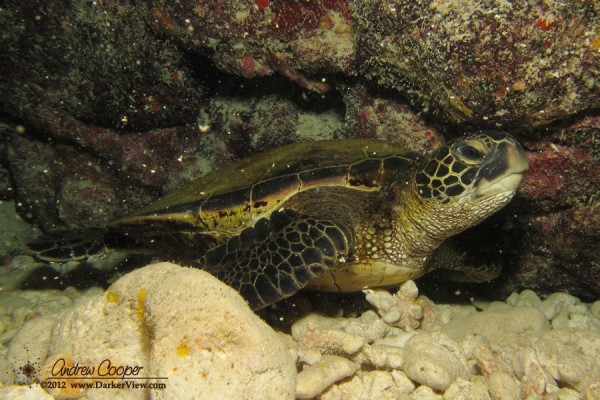
Turtle breathe air. When an air-breathing marine creature needs to sleep there is an interesting choice. It is easy to understand pulling up on a beach to sleep securely, without the waves and currents to worry about. Sea turtles also use another tactic, one harder to fathom, sleeping in the back of a cave 30ft below the waterline…
Saturn at Opposition
This morning, at 07:44HST, the planet Saturn will pass through opposition. Earth will pass between the outer planet and the Sun. During this time Saturn rises at sunset, transits at midnight and sets at dawn. The planet is perfectly placed for observation, high in the sky, for much of the night. You can find Saturn in Virgo, five degrees from the bright star Spica.
For a few days before and after opposition the planet and it’s rings will be a bit brighter, an effect called, appropriately enough, the opposition effect. This is because we are directly in line with the Sun and planet, minimizing any shadows on the planet and in the rings.
An Offering
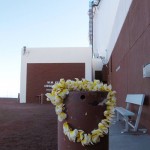
Early this week we were surprised to find a set of plumeria lei on one of the pillars in front of our building. Bright white and yellow, the scent of the flowers hanging heavy around the loading dock door. Quite a contrast in a world of dark red cinder and cold, a bit of the tropics that lie far below the summit.
Why would someone leave the lei at our door? A thank-you for what we do? A gentle protest at our presence on the mountain? I wonder as we drive down, lost in thought.
Transponder Based Aircraft Detection
When you shine a powerful laser into the sky, someone is likely to notice.
That someone is likely to be the Federal Aviation Administration, who, for some reason, seem to be concerned about the possibility of our illuminating a passenger airliner with an AO laser.
Enter TBAD, the Transponder Based Aircraft Detector. All commercial and most civil aircraft carry a 1090MHz ADS-B transponder that identifies the aircraft and provides basic data. The transponder is part of an aircraft tracking system now used by air traffic control centers around the world to supplement, or in some cases replace, radar systems. An idea… Create a directional antenna that can determine if a 1090MHz transmitter is in the beam of the antenna and mount that antenna to the telescope. With such a system we can detect an aircraft approaching our beam and shutter the laser. The idea was conceived by Tom Murphy and Bill Coles at the University of California San Diego. Thus TBAD can alternately mean Tom and Bill’s Aircraft Detector.
An Evening with Astronomers
A quandry… Our regular astronomy club meeting was the same night as Keck’s evening with astronomers lecture. These invitation events are presented to donors, featuring a lecture from a professional astronomer beneath the palm trees of the Fairmont Orchid resort. A number of our members go to both events and faced a choice of which event to attend.
A solution was proposed… Cancel the club meeting in Waimea and head for the lecture down at the resort instead. To cap the evening we would bring along a few telescopes to share the sky.
The club setup five telescope ranging from Purrcynth’s 80mm refractor to Cliff’s 24″ Dobsonian. It was an impressive line of telescopes. I setup next to Maureen with her new 10″ SCT, a nice match for the 11″ NexStar I use for public work. Arriving before the guests we had a line of telescopes setup and ready for viewing well before dark. As Venus and Jupiter appeared in the sunset we began providing views to the early arriving guests.
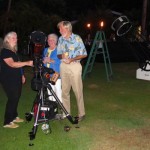 Maureen sharing her telescope with guests at Keck's Evening with Astronomers
The lecture was presented by Dr. Chris Martin of Caltech, covering a subject that is often overlooked, the environment between the galaxies, vast expanses of space that are anything but empty. Here can be found enormous reservoirs of gas, accounting for the majority of normal matter in the universe, something astronomers call the intergalactic medium.
I enjoyed the lecture. Having a somewhat more than average astronomy education, I find so many public lectures a bit repetitive, I have heard it before. Not this night! Dr. Martin covered a lot of material I had never previously encountered. How the universe is filled with streamers of moving gas, influenced by the gravity of dark matter the gas streams into the galaxies and clusters of galaxies, allowing the formation of new stars in an extraordinarily dynamic process. It was a view that has altered the way I see the universe.
Face to Face

Uranus Appears in the Dawn