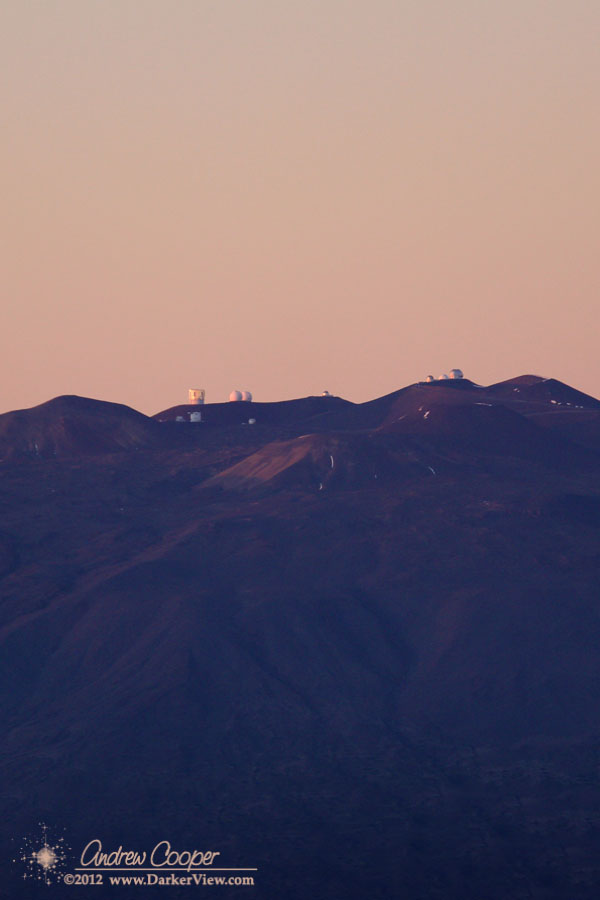
Toby
When you want to see the stars, find someplace dark

Most of my astrophotos are taken with my venerable Canon 20Da, a special version of the EOS 20D that was produced for astrophotography. Normal DSLR cameras work quite well for astrophotography, with one major drawback… The filter placed in front of the sensor blocks much of the Hα light emitted by many nebulae.

Specifically for astrophotography, Canon produced a special version of the 20D with a re-designed filter that allowed Hα light to reach the sensor, the Canon 20Da. The camera also featured on-screen focusing, a feature now found on most DLSR cameras, but unusual back in 2005.
The 20Da was discontinued in 2006. Astrophotographers wanting a DSLR camera with a filter that admits Hα light must buy a standard camera and remove the filter, or have it modified by specialist that offers a conversion service.
Just another whitemouth moray. But then, I hadn’t seen anything interesting to photograph for a few minutes as I wandered along the reef face. May as well shoot a few frames. Wait? There is a second eel in the cavity! A dwarf moray?

W. M. Keck Observatory press release…
When astronomers add up all the gas and dust contained in ordinary galaxies like our own Milky Way, they stumble on a puzzle: There is not nearly enough matter for stars to be born at the rates that are observed. Part of the solution might be a recycling of matter on gigantic scales – veritable galactic fountains of matter flowing out and then back into galaxies over multi-billion-year timescales.
Now, a team of astronomers led by Kate Rubin of the Max Planck Institute for Astronomy in Germany has used the W. M. Keck Observatory to find evidence of just such fountains in distant spiral galaxies.
In the Milky Way, it’s estimated that every year about one solar mass (an amount of matter equal to that of our Sun) worth of dust and gas is turned into stars. Yet a survey of the available raw materials shows that our galaxy could not keep up this rate of star formation for longer than a couple of billion years. Star ages and comparisons with other spiral galaxies show that one solar mass per year is a typical star formation rate. So the puzzle appears to be universal.
Currently passing through Usra Major, comet C/2009 P1 Garradd, is bright enough to appreciate in small telescopes. It is well placed for observation, well up in the sky through much of the night. At about magnitude 6.8 it is also bright enough to make an attractive photographic target.
I am not totally happy with the photo, I could have really used more time on target. Another issue, the exposures I used were a bit too long for this fast moving target, the coma is elongated in the frames. I will probably re-shoot the comet if I get a chance soon.

Over the next few days, the planet Venus will transit the Pleiades star cluster. Tonight sees the planet about two degrees from the cluster center, tomorrow the planet will have closed to just over a degree from Merope. April 2nd and 3rd will see the planet essentially among the primary stars of the cluster. On the 2nd the planet will be only 25′ from Merope, on the 3rd it will be 14′ from Atlas.
At -4.4 magnitude the planet will be far brighter than the brightest stars of the cluster which are 3rd and 4th magnitude. Still, it should be an interesting sight to see the brilliant Venus surrounded by a cluster of stars.
Computer and Network Systems Manager
The W.M. Keck observatory operates two of the largest and most scientifically productive optical/infrared telescopes in the world. The twin 10-meter telescopes are located amidst several other world class observatories on the summit of Mauna Kea on the Big Island of Hawaii, one of the premier sites for astronomy.
The observatory seeks an experienced computer systems administrator manager to lead a talented team of technical professionals responsible for the computer and network systems at the observatory. The networked computing environment is distributed over multiple locations and includes well over one hundred Unix nodes, several hundred Windows desktops, tens of Windows servers, and extensive video conferencing. Unix systems are primarily used for controlling the twin telescopes and science operations while the Windows systems are primarily used for office, administration and engineering functions. Desired competencies include: proven computer and networking skills, demonstrated ability to plan, manage and implement use of new computer and network technologies for a 24/7 operation.
The ideal candidate should be a creative and highly motivated, self-starter who can manage multiple projects and priorities within a fast paced environment and is expected to have the ability to lead the systems administration team in adopting new technologies to deliver cost effective best-in-class service to 120 plus customers. The successful candidate is expected to have significant hands-on systems management and deployment experiences with Linux operating systems. An understanding of virtualized computing infrastructures and experience migrating to virtualized solutions is highly desirable.
This position requires you to submit your resume on-line at: http://keckobservatory.iapplicants.com/ViewJob-290885.html with your cover letter that states why you are uniquely qualified for the position.
Additional information about WMKO and this position may be found on our web site at www.keckobservatory.org.
EEO Employer
Finally, a night where… A) The sky is clear. B) The wind is not howling through the palm trees. C) I am not exhausted by working the summit. D) I do not have to get up early the next morning.
A + B + C + D = Astrophotography from the driveway!
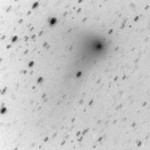
The comet is nicely placed in Ursa Major, transiting late in the evening, available for several hours of exposures. And expose I did, with the auto-guider locked on the a dim star beside the comet, the shutter open for well over two hours. I was shooting my Canon 20Da and the AT6RC, a combination that framed the comet nicely.
It will take a while to get the resulting images processed. In the meantime I did a quick process on a set of images taken with the wide field/finder CCD camera. The results of which can be seen at the right. I also shot a few quick images of the M95 area with the CCD to capture SN2012aw.
You are invited to attend a free Keck Observatory lecture…

Dr. Richard Wainscoat
University of Hawai’i Institute for Astronomy
Kahilu Theater
Thursday, April 5th, 2012
7:00pm
The advent and spread of electrical lighting has made it ever harder to find the dark skies valued by professional and amateur astronomers, not to mention lovers of starry skies in general. Dr. Wainscoat tells the story about light pollution and astronomy, with special emphasis on light pollution’s effects on the world’s best astronomical observing site: Mauna Kea on the Big Island of Hawai’i. Dr. Wainscoast is an astronomer as well as an accomplished photographer.
There is no charge for admission to any events in the Makana series.
Presented by W.M. Keck Observatory.