I didn’t spot it this time either. It was Mark who was pointing at the coral. I looked, looked again… Oh! There is something there. The camouflage these fish utilize is impressive, even from quite close they blend amazingly well with the coral and algae. I wonder how many times I have drifted past one of these fish without seeing it.
As Olivier and I got closer to take a few photos, the fish began to walk away. Yes, I said walk. The fish would walk several feet on its pectoral fins then try to sit still and hide again. A truly weird thing, watching a fish walk across the reef.
Devil Scorpionfish (Scorpaenopsis diabolus) on the reef at O'oma
This evening a pretty crescent Moon will be just over 4° from the Pleiades star cluster. The Moon will be just 19% illuminated, a pretty companion for the bright star cluster. The pair will set after 10pm allowing plenty of time to appreciate.
While Jupiter and Venus are now drawing apart after their rendezvous a few days ago one more pretty dance will liven the evening sky. With the two only 10° apart a crescent Moon will slide between them. The 11% illuminated Moon will make a nice match for the two brilliant planets, creating a lovely trio in the evening sky.
Tomorrow night the Moon will have moved to the other side of Venus, still quite close at about 4° separation, creating another pretty view.
I was determined to get out and use the telescope during the March new Moon, but had planned to go observing with the guys at Hale Pohaku on Mauna Kea. At the last minute I decided to accept an invitation from the Hilo group to observe from Mauna Loa instead. The guys planned on running a Messier Marathon, something I have enjoyed many times before.
Our usual observing location is Hale Pohaku, at 9,000ft on the south side of Mauna Kea. Hale Pohaku is a great observing site, high enough to be above the clouds, but well below the summit where thin air, wind and frigid temperatures can be miserable. It is impossible to do a complete Messier Marathon from Hale Pohaku, the bulk of Mauna Kea blocks too much of the northern sky making a few objects, most notably M52, difficult to impossible.
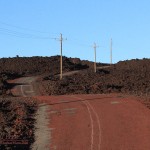
The Mauna Loa access road, carved through the lava and paved with red cinder asphaltThe road and climate research station on Mauna Loa sit on the northern face of the mountain, offering a perfect vantage point for the Messier catalog objects given our 20° latutude. The only issue is the road. While Hale Pohaku is reached by six miles of quite nice state highway, Mauna Loa requires navigating an 18 mile drive up a single land paved road. Use of the word “paved” is somewhat casual, as is the maintenance on the road. The first few miles feature new pavement. Beyond that? Not so much, the road becomes a pothole obstacle course. Driving the road with a delicate telescope in the back is rather nerve-wracking.
The planet Uranus as it appears in a mid-sized telescopeToday, at 07:45HST, the planet Uranus will pass through superior conjunction with the Sun. The planet will reappear in the dawn around mid-April.
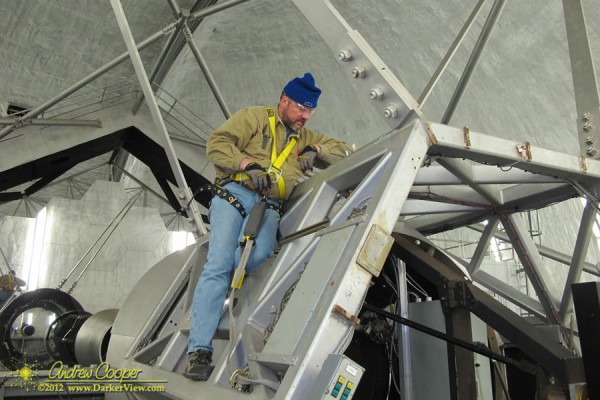
I spent the day drilling and tapping holes into the side of the Keck 2 secondary assembly at the front of the telescope. This is to install two pieces of steel that will serve as a mount for an electronic module behind the secondary mirror. The only way to do this is to climb out onto the secondary assembly. Not a job for anyone that has a problem with heights.
Mind you I am tied to the telescope with safety straps and a full harness. While a fall would not be fatal, it would be an experience in hurt, slammed up against the steel when the straps catch the fall.
The system I am installing is TBAD. I will have to write more about it later, a quick description for now. TBAD is a method of detecting aircraft in front of the telescope, intended to shutter the AO laser before we illuminate an aircraft. It will use a directional antenna to receive transponder transmissions from the aircraft. Of course, the antenna needs to be mounted to the telescope along with the receiver electronics. Thus today’s work.
When you read this I will probably be back at it. Today I will be pulling the cable for the system to the secondary. This is done using our JLG man-lift, a hydraulically powered basket/crane that can access much of the telescope. I think I remember how to drive it…
Hanging on to the side of the secondary assembly to install mounting points for TBAD
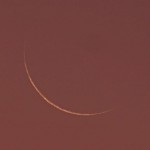
A very young moon over Waikoloa, this is only 26 hours after new, visible to the unaided eye as a sliver in the fading glow of sunsetNew Moon will occur today at 04:37HST.
Today the planet Mercury passes through inferior conjunction, passing between the Sun and the Earth. In a week or so the planet will again be visible in the dawn sky, climbing higher each day. Maximum elongation will occur April 18th.