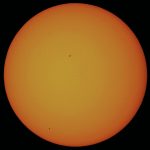
Today Mercury will be at inferior conjunction. After today the planet will reappear in the dawn, rising high enough from the Sun’s glow to be seen around the end of the year.
When you want to see the stars, find someplace dark

Sky events
Today Mercury will be at inferior conjunction. After today the planet will reappear in the dawn, rising high enough from the Sun’s glow to be seen around the end of the year.
The annual Geminid meteor shower has become one of the most reliable annual meteor showers. Known for bright and slow moving fireballs the Geminids can provide a good reason to spend a few hours outside on a December night. This shower has routinely provided rates above 100 meteors per hours in past years, this year should be no exception.

The peak is expected to occur around December 14, 06:30UT. For viewers here in Hawaiʻi this occurs on the evening of December 13th. The Geminids feature a broad peak, with high rates for nearly 24 hours, thus allowing the all time zones a decent chance to enjoy the show.
There should be no substantial moonlight to drown out this years showing, dark skies to allow even the faintest meteors to be seen. The Moon is a thin waxing crescent, 1% illuminated on the morning of the 13th, essentially new.
The Geminid radiant rises round 8pm, thus meteors should be visible all night long. You can stay up late or set the alarm early, your preference. Southern viewers will have to wait until around midnight for the constellation Gemini to rise, making this a morning shower.
Watching meteors requires no more equipment than your eyes and a dark sky, and can be enjoyable for just about anyone. Well? It is December, you should probably add a warm coat to the equipment list.
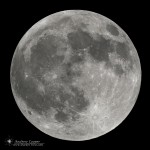
This full Moon will be a perigee full Moon, with the Moon appearing a bit larger and brighter. Today lunar perigee occurs about 17 hours of full, producing a full moon that is about 12% larger and 30% brighter than if full occurs while the Moon is at apogee.
Today Mercury will be at maximum eastern elongation, as high in the evening sky as it will appear for this current apparition. After today the planet will slide back into the sunset, passing through inferior conjunction on December 12th to reappear in the morning sky around the end of the year.
There are no transits of Mercury in 2017, the next will be Nov 11, 2019.
Today the planet Uranus will pass through opposition, directly opposite the Sun in our sky. The planet will be well placed for observation all night long, rising at sunset, transiting at midnight, and setting at sunrise. If you are looking to observe Uranus, it is currently shining at magnitude 5.7 in the center of the constellation Pisces.
Today Mercury will be at superior conjunction. After today the planet will reappear in the evening sky, rising high enough from the Sun’s glow to be seen around the end of the month.
As Mercury is on an orbit inside that of Earth’s it will see both inferior and superior conjunctions as it passes from the evening sky to the dawn sky and back again.