Today the Earth is furthest from the Sun, a point called apehelion. We will be about 152,096,000km (94,508,000miles) from the Sun. Compare this to the 147,099,000km (91,403,000miles) we were at perihelion on January 2rd, a difference of about 4,996,000km (3,104,000miles) occurring throughout one orbit.
It may seem odd that we are actually at the furthest for the middle of northern summer, you just have to remember that proximity to the Sun is not the cause of the seasons. The seasons are caused by the axial tilt of the Earth, creating short and long days throughout the year, with a resulting change in the angle and intensity of the sunlight.
Summer solstice occurs today at 12:34HST. Today the Sun will occupy the most northerly position in the sky of the year. The term solstice comes from the latin terms Sol (the Sun) and sistere (to stand still). On this day the Sun seems to stand still as it stops moving northwards each day and begins move to the south. This is the first day of summer as marked by many cultures in the northern hemisphere. Alternately this is the first day of winter for those living south of the equator.
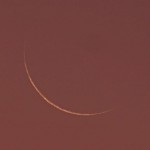
A very young moon over Waikoloa, this is only 26 hours after new, visible to the unaided eye as a sliver in the fading glow of sunsetNew Moon will occur today at 17:00HST.
Just a quick reminder that mercury will transit the face of the Sun tomorrow morning. You can read full details in my earlier post or check out a decent transit calculator. For observer in Hawaii the transit will already be well underway at sunrise, making this a set-the-alarm-early exercise. My telescope and solar filter are already loaded… Are yours?
The 2006 transit of Mercury, photographed with a 90mm telescope and a Canon 20Da
This evening a pretty crescent Moon will pass through the bright Hyades star cluster. The Moon will be a very thin crescent, only 2.9% illuminated and 1.5 days past new. As such it will not be so bright as to completely over power the star cluster. The Moon will be 3° west of the bright red star Aldebaran, at the center of the vee shaped cluster. As the cluster is 15° above the horizon at sunset there should be ample time to enjoy the sight before the Moon sets at 20:12 HST.
A very young moon over Waikoloa, this is only 26 hours after new, visible to the unaided eye as a sliver in the fading glow of sunsetNew Moon will occur today at 09:30HST.
Both of the planets that orbit closer to the Sun, Mercury and Venus, can be seen to cross the face of the Sun if everything lines up just right. The last transit of Venus was in 2012. It has been much longer since a transit of Mercury, that last occurred in 2006.
The 2006 transit of Mercury, photographed with a 90mm telescope and a Canon 20Da
In comparison the the rare transits of Venus, transits of Mercury are fairly common. There are 13 or 14 transits of Mercury each century, meaning there is a transit on average every seven years. On May 9th this year we have another chance to observe a Mercury Transit.
Photographing the 2006 transit of Mercury from TucsonBack in 2006 I took the day off work and photographed the transit from my backyard in Tucson. As a transit is a five hour event the effort to observe the entire thing takes a while.
Mercury is quite small with respect to the Sun. During the transit the planet will be a mere 12-13 arcsec across. Considering the Sun is about 1920 arcsec across, the planet will be a fairly small dot on the face of the Sun.
In some respects a transit is the clearest view of Mercury small telescope users are able to view. Normally observed low on the horizon, the innermost planet never gets far from the Sun. During transit a fairly sharp disk can be seen, far better then the mushy view offered near the horizon at sunset and dawn.
First Contact
11:12 UT
1:12 HST
Second Contact
11:15 UT
1:15 HST
Mid-Transit
14:57 UT
4:57 HST
Third Contact
18:39 UT
8:39 HST
Last Contact
18:42 UT
8:42 HST
2016 May 09 Mercury Transit
Unfortunately for observers in the middle of the Pacific the 2016 transit will begin well before dawn. It is only the last hour or so of transit that will be easily visible as the morning Sun rises into the sky. Viewers in eastern North America and Europe will have a better vantage point for this transit.
Please exercise caution when viewing the Sun! Use appropriate eye protection or indirect observing techniques to project an image of the Sun. The link at the start of this paragraph leads to a great discussion on viewing the Sun safely. As always the single best source on the web (or anywhere) for eclipse and transit information is Fred Espenak’s eclipse website at NASA. Stop by whenever you have a question on upcoming events as well as viewing and photography tips.
The next Mercury transit will occur November 11, 2019. This next transit also favors Europe as mid transit occurs at 15:20UT. For the next Venus transit? You are out of luck as it occurs in 2117, over a century away.