Fall equinox occurs today at 16:30HST. Today there will be little difference between the length of the night compared to number of daylight hours. This is the first day of fall as marked by many cultures in the northern hemisphere.
This year many calendars will mark September 23rd as the beginning of fall, and so it is for much of the world. Here in Hawai’i the equinox actually occurs on the 22nd when considering the time zone differences.
Today Mercury reaches maximum elongation, the furthest point it will reach from the Sun in our sky and the highest it will be above the sunset for this evening apparition. The planet is easily visible as a bright, starlike object about 26° above the setting Sun as twilight begins. Over the next couple weeks Mercury will slide back into the sunset, heading for inferior conjunction on October 16th.
Tomorrow morning the Moon and Jupiter will be close. The Moon will rise first, followed by Jupiter at 03:06 to be almost 40° above the eastern horizon at sunrise. The Moon will be about 18% illuminated and about 8° above a bright Jupiter. The next day the Moon will have moved to the other side of Jupiter but will be even closer, about 7° separation.
After spending much of the year in dawn skies, this week will see Venus disappear into the dawn. Superior conjunction will occur October 24th, with the planet appearing in the evening sky at the end of November.
With 24 exposures, each 4 minutes long, it is possible to animate the comet’s movement among the stars. Just process the photos individually and import into photoshop as an animation, then export as an animated GIF. Just click on the image to view…
24 x 4min exposures of comet C/2014 E2 jacques assembled as an animation
An assembled version of the imagery I took of comet C/2014 E2 Jacques. 24 x 4min exposures, stacked in Images Plus and final processed in Photoshop. While traces of the tails were visible, I was unable to preserve the faint signal in this processed color frame.
Comet C/2014 E2 Jacques, 24 x 4min with a Canon 6D and a TV-76mm scope
I have talked to a couple folks who have observed the comet in mid-sized telescopes, 14 and 24 inch, instruments. One thing they note is the absence of any visual tails on this otherwise bright comet. In processing the imagery from last night I can see the tails, but only in a very strong stretch of the data.
Below is an inverted version of mostly the green channel. Both the ion tail and dust tail are visible, but they are truly subtle. The ion tail is visible as a streak going to the right in the image, quite thin and straight, extending well over three degrees. The dust tail is visible as a wide are below the coma in this image.
Still working to properly the process the full image, the data looks very good so far.
The faint tails of comet C/2014 E2 Jacques, stack of 24x240s exposures, Canon 6D and TV-76mm
A bright comet is always a good reason to drag the telescope out of the garage. In this case it is comet C/2014 E2 Jacques, currently about magnitude 7 in Cepheus. The comet is rising over the house about 9pm and available for shooting from my usual driveway setup location.
Setup went pretty smoothly, I have not changed anything in the basic configuration for a while. Shooting the Canon 6D on the TV-76mm scope. I did have some issues getting the autoguider to calibrate. The low magnification and high latitude meant the the calibration moves are just too small. Realizing that this also meant that any potential guide errors would also be small, I just shut the autoguider off. No guiding errors are visible in the four minute exposures.
Comet C/2014 E2 Jacques on the evening of 27Aug2014, single 240s exposure with a Canon 6D and a TV-76mm telescope
Yes, the shot looks pretty bad… The frame is a quick process of a single sub-frame, just a white balance and curve adjustment in Photoshop. As I write this there are 13 completed exposures with another 17 to go. I do not think I will complete the sequence, I do need to go to bed sometime soon, I have to head to Hilo early tomorrow morning for a conference at Gemini.
Given a couple dozen good exposures I should be able to produce a much better image than is seen here. So far all of the sub-frames look good indeed, nice signal to noise, a bit of nebulae showing near the comet, and maybe a trace of the wispy ion tail. It will be a few days before I have a chance to properly process the image.
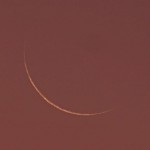
A very young moon over Waikoloa, this is only 26 hours after new, visible to the unaided eye as a sliver in the fading glow of sunsetNew Moon will occur today at 04:13HST.