Asteroid 1998 QE2 to Sail Past Earth

JPL press release

On May 31, 2013, asteroid 1998 QE2 will sail serenely past Earth, getting no closer than about 3.6 million miles (5.8 million kilometers), or about 15 times the distance between Earth and the moon. And while QE2 is not of much interest to those astronomers and scientists on the lookout for hazardous asteroids, it is of interest to those who dabble in radar astronomy and have a 230-foot (70-meter) — or larger — radar telescope at their disposal.

Asteroid 1998 QE2 Orbit
The orbit for asteroid 1998 QE2 earth approach on 31 May 2013. Image credit: NASA/JPL-Caltech
“Asteroid 1998 QE2 will be an outstanding radar imaging target at Goldstone and Arecibo and we expect to obtain a series of high-resolution images that could reveal a wealth of surface features,” said radar astronomer Lance Benner, the principal investigator for the Goldstone radar observations from NASA’s Jet Propulsion Laboratory in Pasadena, Calif. “Whenever an asteroid approaches this closely, it provides an important scientific opportunity to study it in detail to understand its size, shape, rotation, surface features, and what they can tell us about its origin. We will also use new radar measurements of the asteroid’s distance and velocity to improve our calculation of its orbit and compute its motion farther into the future than we could otherwise.”

The closest approach of the asteroid occurs on May 31 at 1:59 p.m. Pacific (4:59 p.m. Eastern / 20:59 UTC). This is the closest approach the asteroid will make to Earth for at least the next two centuries. Asteroid 1998 QE2 was discovered on Aug. 19, 1998, by the Massachusetts Institute of Technology Lincoln Near Earth Asteroid Research (LINEAR) program near Socorro, New Mexico.

The asteroid, which is believed to be about 1.7 miles (2.7 kilometers) or nine Queen Elizabeth 2 ship-lengths in size, is not named after that 12-decked, transatlantic-crossing flagship for the Cunard Line. Instead, the name is assigned by the NASA-supported Minor Planet Center in Cambridge, Mass., which gives each newly discovered asteroid a provisional designation starting with the year of first detection, along with an alphanumeric code indicating the half-month it was discovered, and the sequence within that half-month.

Continue reading “Asteroid 1998 QE2 to Sail Past Earth”

Comet C/2011 L4 Pan-STARRS

The weather finally broke, leaving a clear western sky and a chance to photograph the comet. I set up and managed just a few shots before the comet set into the top of a tree across the street.

At least I was able to get on-sky. Much more than can be said about our ‘scopes on the mountain. Observing was cancelled earlier this afternoon, there is too much ice on the domes to operate safely. At least the ice was pretty, and photogenic.

Comet C/2011 L4 Pan-STARRS
Comet C/2011 L4 Pan-STARRS over the Hawai’i, AT6RC and Canon 60D

Comet C/2011 L4 Pan-STARRS at Perihelion

Today Comet C/2011 L4 (Pan-STARRS) will pass through perihelion, its closest approach to the Sun. Take a good look now, given the 110,000 year orbital period, the comet will not be back anytime soon.

The comet should be visible as a 1st magnitude object 13° above the horizon at sunset and directly above the glow of the setting Sun. It will climb higher each evening after passing through perihelion. It will begin to fade as well, most likely dimming below 4th magnitude by the end of March.

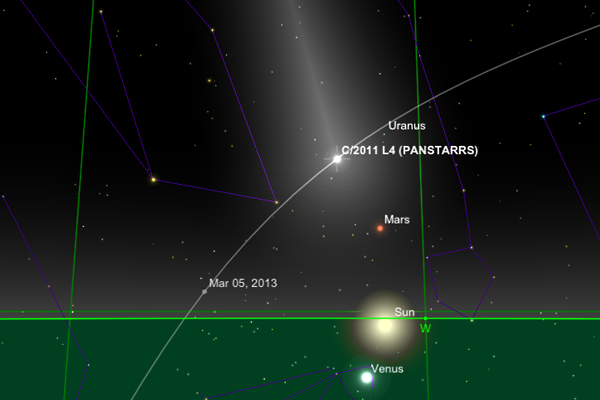
Comet 2011 L4 Perihelion
C/2011 L4 ( PanSTARRS ) positions in the sunset as it passes through perihelion, chart for March 10th, 2013

Comet C/2011 L4 Pan-STARRS

Now for a truly awful comet image.

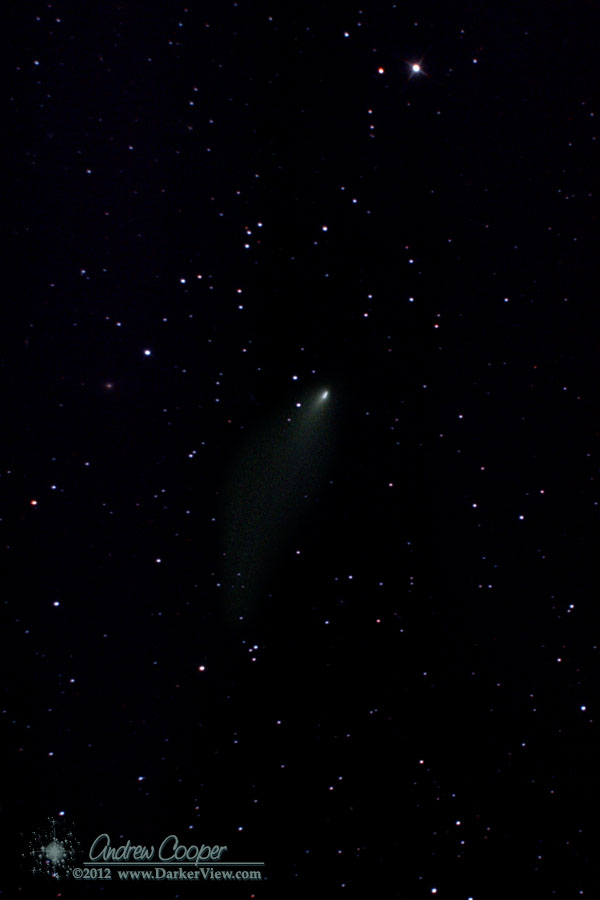
C/2011 L4 PanSTARRS
An awful photo of C/2011 Pan-STARRS, SBIG STi and 100mm lens
But it is all I managed to get this evening. A to-do list that is much to long and vehicle trouble caused me to reconsider plans to observe at the VIS. Thus I planned to observe the comet from the driveway. This works well in some respects, using the mounting points in the driveway I can have the ‘scope reasonably well polar aligned in the daytime. This would make finding the comet far easier, I could offset from the Sun and have the ‘scope aimed at the correct coordinates before it was dark.

It had been wonderfully clear all afternoon. It was just as the sky darkened that trouble appeared, a band of high clouds sweeping in from the west. Noooo!

The comet appeared in the STi guide camera right on schedule, my coordinates less than half a degree off! Not bad with a manual telescope mount offsetting from the Sun. The clouds swept over the comet a few minutes later, just as the tail was beginning to appear in the darkening sky.

I did grab a few images from the guide camera and snap a few frames with the DSLR. The monochrome CCD on the guider managed slightly better shots despite a fairly bright sky. I managed a few more frames as an opening appeared a few minutes after that. It is still an awful image. The only reason I could tell it was the comet is that it remained centered as the clouds swept through the image. Take my word for it, the barely there spot at the center of the photo is the comet.

At least my vehicle is fixed, a new alternator in place. Try again tomorrow?

Comet C/2011 L4 Pan-STARRS Closest to Earth

Today Comet C/2011 L4 (Pan-STARRS) will make its closest approach to Earth. Not that that is saying too much, close approach will be 1.09 AU or about 101,300,000 miles, just over the average distance from the Earth to the Sun. In contrast Comet C/2012 S1 (ISON) will approach us to closer than half that distance, about 0.42 AU or 39,000,000 miles from Earth on December 26th, 2013.

The comet should be visible as a 2nd magnitude object 7° above the horizon and a little south of the Sun at sunset. It will climb higher each evening, passing through perihelion, close approach to the Sun on March 10th.

Comet 2011 L4 Perihelion
C/2011 L4 ( PanSTARRS ) positions in the sunset as it passes through perihelion, chart for March 10th, 2013

Comet C/2011 L4 Pan-STARRS

Like so many other amateur astronomers, I am eagerly awaiting the appearance of Comet C/2011 L4 Pan-STARRS.

The comet was discovered in June of 2011, by the Pan-STARRS survey telescope atop Haleakala, Maui. The comet will pass closest to earth on March 5th, at a distance of 1.09 au. Perihelion, the comet’s closest approach to the Sun, occurs early on March 10th UT.

Comet 2011 L4 Perihelion
C/2011 L4 (PanSTARRS) positions in the sunset as it passes through perihelion, chart for march 10th
For northern hemisphere observers the comet is still quite low, just rising out of the Sun’s glare. Over the next week it will rise above the sunset, and will be 12° above the horizon at sunset on Saturday, March 9th.

Initial predictions were quite optimistic with this comet, indicating a possible -1 magnitude for the comet. Reality seems to be somewhat more restrained, with a peak somewhere between magnitude one and two being more likely. Reports indicate that the comet has brightened to about 2nd magnitude, bright enough to be easily seen without optical aid.

Even more convenient, the comet will be well placed for observation this coming weekend. With new moon occurring on March 11th, this will be the prime weekend for a telescope outing. Amateur astronomers everywhere are already planing for this weekend. Our local club is no exception, expect a good crowd of telescopes to be at the Mauna Kea VIS this weekend. Myself? I will probably setup at the Substation site, just across the road from the VIS. The site offers a much better western horizon, which is blocked from the VIS by a line of pu’u, old cinder cones.

I will be taking photo gear, looking to get a decent photo of the comet. Stay tuned to Darker View to see the results if I meet with any success.

The latest orbital elements from the MPC

Another interesting opportunity will come on March 12th, when a slim crescent Moon will join the comet in the sky. A 1.4 day old moon, about 2% illuminated will be about 4° north (to the right) of the comet.

Postcard from the Universe – Comet C/2012 K5 (LINEAR)

Another product of imaging earlier this week. Comet C/2012 K5 (LINEAR) is fading, but still bright enough to image. Right beside Orion it was well placed to target from my driveway. Just refreshing my comet hunting skills, getting ready for the show over the next few months as C/2011 L4 (PanSTARRS) comes into view.

C/2012 K5 LINEAR
C/2012 K5 LINEAR with AT6RC and Canon 20Da, stack of 18x6min

A Cometary Breakup

While Comet 168P Hergenrother may be a bit of a mouthful, it is the proper designation for an interesting comet. Discovered in 1998, the comet is one of dozens that orbit in the inner solar system. Normally inconspicuous objects, these comets orbit quietly, objects that only astronomers love, or even know about. You would normally have needed a substantial telescope to see 168P, shining very dimly at magnitude 15.5 at it’s brightest. A community of amateur astronomers keeps tabs on these comets, occasionally photographing them, updating the orbits.

As the comet approached perihelion during the beginning of October, it became apparent that something had happened. Several observers were reporting that the comet had brightened. Suddenly the comet was far brighter, eventually reaching near 8th magnitude, over 500 times brighter than expected. We have seen this sort of thing before, a cometary breakup. Observations from several large telescopes, including Gemini North here on Mauna Kea, showed that the comet has split into at least four pieces.

When a breakup occurs it exposes a great deal of fresh material and debris, dramatically adding to the supply of dust and gas in the coma and creating a far brighter object. It is not the comet itself we see, that is fairly small. It is the coma and tail, the cloud of dust and gas that reflects the sunlight and gives a comet the synonymous appearance.

Comet 168P Hergenrother currently sports a small fan shaped tail, easily visible in the telescope. We enjoyed this classic comet shape in the telescopes last new moon at the Mauna Kea VIS. Setting up a telescope and CCD camera last night allowed me to photograph the comet, appearing much the same as it did a few weeks ago.

Comet 168P Hergenrother
Comet 168P Hergenrother taken with a 28cm SCT and a CoolSNAP ES2 CCD camera at f/10, sum of 12x30s exposures binned 4×4

Comet C/2012 S1 ISON

A new comet discovered earlier this week has caught the attention of the astronomy community. Comet C/2012 S1 (ISON) was discovered Tuesday by a telescope affiliated with ISON, the International Scientific Optical Observation Network. This is a network of mid-sized telescopes dedicated to surveillance of the near earth region of our solar system.

The reason this comet is intriguing is a combination of a large estimated size and an orbit that appears to provide both a close approach to the Sun and favorable viewing from the Earth.

The comet will approach the sun as close as 0.012 AU on November 28th, 2013, quite close indeed. The comet will also approach Earth as close as 0.4 AU (60 million kilometers or 37 million miles) on December 26th, 2013. As a result this comet could achieve a magnitude well into the negative numbers, brighter than most objects in the sky except the Sun or Moon.

This comet is in addition to comet C/2011 L4 (PanSTARRS), expected to be an unaided eye comet during the spring of 2013. If we get lucky 2013 will be a great year for comets.

As I have cautioned in the past, comet predictions are to be taken with a good amount of skepticism. This could be a spectacular comet, or this could be a mediocre comet, we will just have to wait and see. In the meantime pay attention to the light curve as it nears the Sun. As my friend David Levy observed… “Comets are like cats; they have tails, and they do precisely what they want.”

Postcard from the Universe – C/2009 P1 Garradd

Currently passing through Usra Major, comet C/2009 P1 Garradd, is bright enough to appreciate in small telescopes. It is well placed for observation, well up in the sky through much of the night. At about magnitude 6.8 it is also bright enough to make an attractive photographic target.

I am not totally happy with the photo, I could have really used more time on target. Another issue, the exposures I used were a bit too long for this fast moving target, the coma is elongated in the frames. I will probably re-shoot the comet if I get a chance soon.

C/2009 P1 Garradd
Comet C/2009 P1 Garradd taken on 28Mar2012, average of 14 x 8min frames with a Canon 20Da and the AT6RC