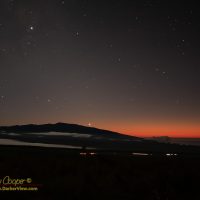
The last glow of Sunset over Hualālai, with Venus just about to set behind the mauna and Jupiter high above.
An innocent email… Anyone interested in a star party this weekend?
Last weekend’s new Moon star party had been a bust, heavy clouds overhead were a disappointment to those of us waiting for a good dark night.
Given the positive response to Norman’s email there seems to be a few folks ready to go despite a bright Moon in the sky. With the weather looking good the Saturday afternoon email flurry showed that a few folks were going, thus I joined in.
As per Mauna Kea normal I drove through the clouds, heavy fog on Saddle Road just a mile from Kaʻohe made the trip seem hopeless. But as I neared the turn I suddenly found myself above the clouds, the bright Moon high over Hualalai.
Our monthly dark skies star party had been originally planned for the night of July 27th, a few days before full Moon. With the governor’s emergency order all access to the mauna was closed, and the gals at the DLNR office let me know I could not get a permit. With that I put out a message I hate to post… Star party cancelled.
The NexStar 11 setup under the Milky Way at Kaʻohe, photo processed with Prisma
One week later and things look better, the emergency order has been rescinded and we again have access to the mauna, no problem getting our permit.
The problem this time looked to be weather, no big problem… Just a couple of hurricanes.
I was a bit concerned as I drove to the site, a heavy fog all the way up Saddle Road persisted as I turned off on the old Saddle Road to climb the ridge to Kilohana. It was not until halfway up the gravel access road that I broke out of the fog, just a hundred yards before the Kaʻohe site.
The restored 8″ f/6 Cave Astrola under a dark sky at Kaʻohe
On top of the fog it was gorgeous, a beautifully clear sky overhead with the first stars peeking out. Time to setup a telescope!
I brought the restored 8″ Cave Astrola expecting to spend the evening exploring the clusters and nebulae of the southern Milky Way in Scorpio or a bit further south. This rich region would be well positioned through the night.
We had a small group this particular evening, just six of us… Andre and Anna, Maureen, Andrew, Cliff, and myself set up by the gravel pile. There were pleasant conversations in the night, cookies and brownies to share, and views through each other’s telescopes.
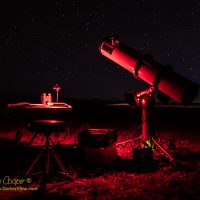
A telescope and observing table in the dark at Kaʻohe
This evening, June 1st, the West Hawaii Astronomy Club will meet at the Kaʻohe site for our monthly star party. Plan to arrive before sunset which should be about 19:07.
Our next club dark sky star party will be June 1st at the usual Kaʻohe site.
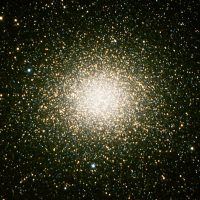
Omega Centauri, NGC5139
For the evening I have again assembled an observing list for those who want to explore some of the more interesting objects available in the sky this month.
These are all visible in the early evening, all suitable for average telescopes of at least 6-8″ aperture.
M5 RA: 15h 18′ Dec: 2° 4’N Mag: 5.8 Globular cluster in Ser A nice bright globular, about 15′ in diameter
Iota Cnc RA: 8h 46′ Dec: 28° 46’N Binary star in Cnc A pretty yellow and white pair, 4.0 and 6.6 separated by 30″
V Hya RA: 10h 52′ Dec: 21° 15’S Mag: 8 Carbon star Reddest carbon star known variable from 6.5-12 magnitude with a period of 533 days
M92 RA: 17h 17′ Dec: 43° 8’N Mag: 6.5 Globular cluster in Her This nice globular cluster is often overlooked in favor of its more famous neighbor M13, but M92 is also worth the stop.
NGC6207 RA: 16h 43′ Dec:36° 50’N Mag: 11.6 Galaxy in Her Just 28′ north of M13 this faint 11th magnitude galaxy is a nice challenge object for eight inch or larger optics.
NGC5846 RA: 15h 6′ 29.3″ Dec: 1° 36′ 20″N Mag: 10.2 Galaxy in Vir A bright elliptical, those with larger aperture may note a small companion galaxy on the south edge of the halo
M99 Coma Pinwheel Galaxy RA: 12h 18′ 49.7″ Dec: 14° 24′ 59″N Mag: 9.8 Galaxy in Com A nice spiral galaxy, larger aperture will show some of the spiral structure
NGC5128 Centaurus A RA: 13h 25′ Dec: 43° 1’S Mag: 7 Galaxy in Cen A large bright galaxy with an obvious dust lane
Proxima Cen RA: 14h 29′ 43″ Dec:62° 40′ 46″S Red dwarf star The closest star outside our solar system, a challenge object to be sure, you will want good charts to find this one. The coordinates given above are from the Gaia mission data release 2 and are recent enough to be accurate, this high proper motion star moves about 4 arcseconds each year.
NGC5286 RA: 13h 46′ Dec: 51° 22’S Mag:7.6 Globular in Cen Another nice, but oft overlooked globular star cluster
Keep in mind that this list is assembled for the usual West Hawaii Astronomy Club observing site at Kaʻohe, on the side of Mauna Kea at 20N latitude. It may include southern objects out of reach for anyone much further north.
For our late April West Hawaii Astronomy Club star party I have put together a short observing list. This in my effort to expand our skills and knowledge of the sky.
M22 or NGC6656 in Sagittarius, a classic globular cluster
The best upcoming weekend for a star party is May 4th, the same day as new Moon. The 4th is also AstroDay Hilo and many members including myself will be busy. Thus our next new Moon star party will be Saturday, April 27th. With a last quarter Moon rising a little before 2am it is a nice night for a star party with dark skies until long after midnight.
Ten objects, from easy to a few more challenging targets, something for everyone. None of these are Messier objects, a couple are from catalogs you may have never heard of. Trust me in that there are a few nice surprises to be found here…
NGC2362 RA: 7h 18′ Dec: 24° 57′ S Mag: 4.1 Open cluster in CMa Centered on the bright star Tau CMa
h3945 RA: 7h 16′ Dec: 23° 19’S Mag:4.8 Binary star in CMa Pan north of NGC2362 a few fields or about 1° north and a touch west, called the Winter Alberio
The Stargate RA: 12h 36′ Dec: 12° 1’S Mag:7 Asterism in Crv Very bright, easy to find, just one degree SW of M104, look for a triangle within a triangle
Melotte 111 RA: 12h 22′ Dec: 25° 51’N Mag:1.8 Open cluster in Com Hint: Do not use the telescopeNGC4565 RA: 12h 36′ Dec: 25° 59’N Mag: 9.5 Galaxy in Com
Trumpler 20 RA: 12h 39′ Dec: 60° 36’S Mag 10.1 open cluster in Cru Large, try binoculars or lowest power, very rich!
DY Cru RA: 12h 47′ Dec: 59° 42’S Mag: 8.4-9.8 Carbon star in Cru Put Mimosa in the field, put in an eyepiece for about 100x and look 2′ W of Mimosa, if needed put Mimosa just out of the field of view to cut the glare
Pismis 4 RA: 8h 34′ Dec: 44° 24’S Mag: 5.9 Open cluster in Vela Large, bright, use lowest power
Trumpler 14 RA: 10h 43′ Dec: 59° 32’S Mag: 5.5 Open Cluster in Car Part of the Eta Carina nebula complex, 19′ NW of Eta Carina
NGC3532 RA: 11h 5′ Dec: 58° 46’S Mag:3 Open cluster in Car Big, bright, use lowest power
You may notice a lot of seemingly odd catalog designations… Pismis, Trumpler, Melotte… Just to show that there is a lot to discover beyond the Messier and NGC catalogs.
A couple hints… All of these objects are to the south, setup your telescope to be comfortable looking south. Most of these will not be in your telescopes little computer if you use GOTO. Learn how to enter manual RA and Dec coordinates.
M6, the Butterfly Cluster, 9 x 1min Canon 60D and AT6RC
All of these objects should be visible in the early to mid-evening on April 27th. Those in Canis Major should be viewed first, while the last are in Crux which rises around 7pm and culminates around 10pm.
The dimmest objects listed here are tenth magnitude, within easy reach of a six inch telescope. If you do not have a six inch, check out the view in someone else’s telescope. The brightest object here does not even need a telescope, indeed it is too large to fit in the field of view.
I have noted a tendency among my fellow observers in our little local club… To observe the same objects over and over.
M6, the Butterfly Cluster, 9 x 1min Canon 60D and AT6RC
These are the big, bright, showpiece objects that we observe repeatedly. You know the ones… the Orion Nebula, Andromeda Galaxy, Omega Centauri, Eta Carina, Jewelbox, Etc.
I too visit old favorites in the night, stopping by to enjoy the beauty. I will also make it a point to view some new objects each observing session, something I have not seen before. Our universe has more to offer, there are many beautiful sights to be had that are all too often overlooked.