
Dual Lasers on the Galactic Center

I have been trying to get some good photos of both Keck lasers on the galactic center for some years. Other photographers have produced spectacular photos that have me seething with envy. Why can I not get equivalent photos? It is not like I have a lack of access. The answer is mostly bad luck and circumstance. I do work, this limits the nights I can make the attempt. On those times I have ascended the mountain to photograph I have been plagued by bad weather.

Dual Lasers on the Galactic Center
Both Keck lasers aimed at the center of the Milky Way galaxy
There are only a few nights a year when Andrea Ghez and the UCLA Galactic Center Group have both telescopes scheduled, the night when both lasers will be focused on the core of our galaxy and the massive black hole that dwells there. Last year I had attempted a night only to find clouds and fog through the night allowing only a few moments of dual lasers and disappointing results.

This year looked to be much the same. The night was set, I had volunteered to host several local photographers, we had film permits on-hand, an observatory vehicle reserved, all the arrangements made. The only issue? The Mauna Kea Weather Center forecast promised high clouds and fog for the night. I was bracing for yet another disappointment.
Continue reading “Dual Lasers on the Galactic Center”

Mercury Transit

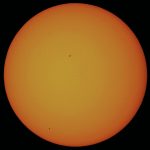
It was a beautiful morning! Alarm set for 4:30am, out of the house at 5am, setup just at sunrise on the old Saddle Road. The sun rose through low clouds over the grasslands of Parker Ranch with Waimea to one side and Mauna Kea on the other.

Mercury Transit 9May2016
Mercury transiting the Sun on May 9, 2016. Celestron C8 and Canon 6D at f/10.
Setting up a telescope as the Sun was rising seemed just wrong. I am used to breaking down a telescope as the Sun comes over the horizon at the end of a night’s observing. It is not often that an observing session results in my risking sunburn!

The seeing was pretty horrible at sunrise but rapidly improved as the Sun rose. As the transit ended the seeing was quite sharp and the photos not all that bad. At least as long as I kept the shutter speeds high. Visually the view was quite nice, a sharp black dot against the Sun, a far cry from the dancing blur you usually see when trying to view Mercury in the glow of Sunset.

Continue reading “Mercury Transit”

Jupiter 27 March 2016

Another pass on Jupiter this evening, the string of decent seeing nights has continued. I am working on improving the setup and my technique. I had been using a diagonal to mount the camera… That is gone. I futzed with the collimation a bit, but it really is quite close. I need to figure out how to get a barlow into this arrangement, do they make a rear cell thread barlow like the focal reducer?

The seeing really does appear to be my greatest limitation. Planning a trip to better seeing in the next couple weeks.

It is not an Easter egg, but this will have to do, the closest I have for the day…

Jove 20160327
Jupiter on March 27th, 2016. Celestron 11″ and a Canon 60D @ f/10

Jupiter Again

After a stormy Friday night we had clear skies and decent seeing over Waikoloa again last night. Again I set up the telescope for a little planetary photography. The seeing was marginally better, and so is the resulting image.

The night also featured three moons in close to the planet. Io can be seen alone to one side of the Planet while Europa and Ganymede form a close pair. Ganymede is the larger moon and slightly closer to the planet

I really need to do this from the summit under good seeing some time.

Jove 26Mar2016
Jupiter under moderately good seeing from Waikoloa

Jupiter High

Jupiter passed through opposition back on March 7th. Thus the giant planet is high in the sky through much of the night, well placed for observations.

Jove 20160324
Jupiter on March 24th from Waikoloa
I was thinking of going to bed, but it was a hot windless evening in Waikoloa, not much point in trying to sleep before it cooled off a bit. The dead calm conditions made me think… What is the seeing like? A question only an amateur astronomer would ask.

Turns out the seeing was pretty good. The typical horrible seeing in Waikoloa is 2 to 3 arcseconds or worse, when the trades are blowing it can be quite bad. I suspect the seeing was 1 arcsecond or better last night, the view of Jupiter in the eyepiece was quite pleasing. Putting a camera in place of the eyepiece yielded video worth the effort in processing.

MIlky Way Arching over Hualālai

My first attempt at a proper Milky Way arch photograph. Not easy to stitch properly, but worth the effort! Click on the image for a file size large enough to properly enjoy…

MIlky Way Arching over Hualālai
The winter Milky Way arches over Hualālai with Orion and the setting Moon at the center, taken from the Kaʻohe observing site, panorama of five images taken with a Canon 6D and a Rokinon 14mm lens with over 300 degrees of horizon