ISON Webcast

We put it together in very short notice. Fortunately a webcast is pretty easy to put together.

Keck is hosting a sizable team of folks who are here to observe comet ISON. Astronomers from several institutions are participating in the NASA Comet ISON Observing Campaign. They have a total of 6½ nights, but only the last few hours of each night as the comet rises in the dawn. Comet C/2012 S1 ISON is starting to encounter significant publicity, we may as well take advantage of this.

It was a lot of fun. I particularly like the spot (41:00) where I made the mistake of saying spectra were not very pretty to look at in a room full of spectroscopists. These folks love spectra and quickly corrected me, leading to a nice discussion on why spectra are so valuable to astronomy, often more valuable than photos.

The video is embedded below. A lot of good information about comet ISON, indeed about comets in general. Nothing like having a room full of comet experts…
Keck Lecture – Comet ISON

Astronomy Talk: The Wonder of Comet ISON, A Relic From the Beginning of the Solar System

Thursday October 24, 2013
07:00 pm – 08:00 pm

Comet C/2012 S1 ISON
An image of comet C/2012 S1 ISON acquired by the Hubble Space Telescope on October 9th, 2013, credit: NASA, ESA, and the Hubble Heritage Team
Kahilu Theatre

Dr. Carey Lisse, head of NASA’s Comet ISON Observation Campaign, will present a timely talk on how and when comets were formed, and where they come from. Also a Senior Research Scientist with Johns Hopkins University Applied Physics Laboratory, Lisse will relate how comets may have helped start life on the Earth, and also how they may have ended it for millions of creatures at least 4 times in the past. He’ll also give a bit of the history of comet observing by mankind, and explain how Comet 2012 S1 (ISON) fits into this picture of comets as relics from the beginning of our solar system.

iOS 7 Brightness Problem

Amateur astronomers learn to love the dark.

Astrophoto Acquisition
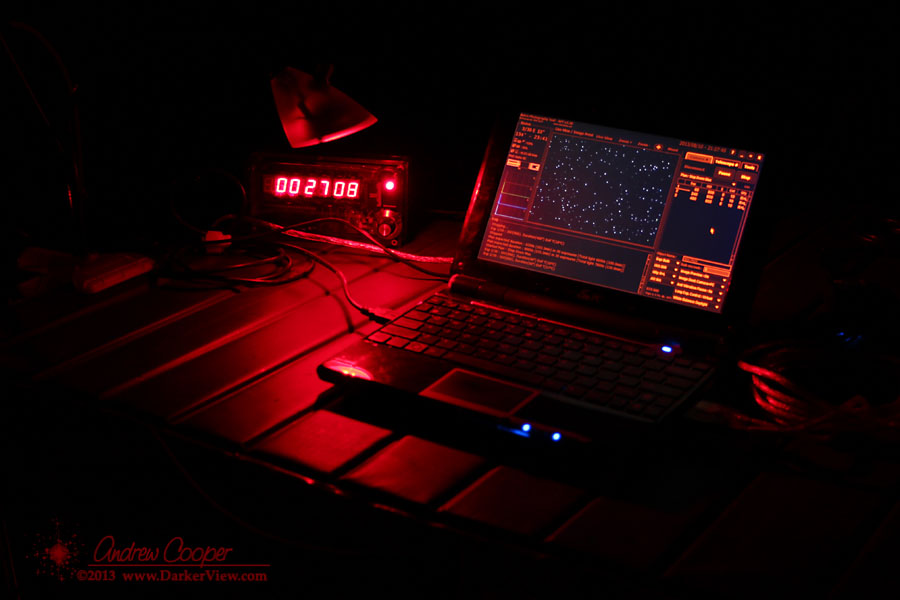
A small netbook computer busy running an astrophoto setup

Unlike the rest of the human species we enjoy seeing the night sky and have learned not to fear the darkness, rather to embrace it. This phlisophy is carried over to our devices as well. We set our computer screens for minimum brightness with red on black color schemes. We understand dark adaptation and what it means for our vision.

You may note that Darker View uses a dark color scheme. This is not by chance, there was a great deal of thought put into the light on dark color scheme here on DV, with full understanding of the advantages of dark on light schemes.

Many people do not like light on dark schemes, avoiding websites that use such colors. Other folks far prefer such color schemes, particularly people who spend long hours at the computer, programmers and CAD technicians in particular. Programming environments and CAD software make switching color schemes easy, understanding the personal color preferences are critical to good software useability.

Continue reading “iOS 7 Brightness Problem”

The Lights Went Out in Kapaʻau

An interesting bit of news passed along, HELCO was planning a power outage at 8pm. I expect my reaction to this information was a little different than most… This is great! With a school star party scheduled at Kohala Elementary, the news that the entire town would be dark for the star party was a pleasant surprise.

Mr. O's Stars
Mr. O shows a family the stars at Kohala Elementary
It would be a long day… Up early to pack the telescope, up to the summit for a day of working on the AO system, troubleshooting a couple issues plaguing observations. Then an early departure from the summit to head for Waimea and over the Kohala Mountain Road to Kapaʻau on the very north end of the island.

I stopped to get dinner in Hawi on the way. Surprisingly the Bamboo Restaurant was open early, they normally do not open until 6pm. I find out that the whole town was bracing for the power cut at 8pm, with events and opening times moved up. Not everyone had gotten the notice, I was the only diner in the restaurant. A pleasant meal chatting with the staff and a good burger were just what I needed, food and a brief rest to prepare for the evening.

Continue reading “The Lights Went Out in Kapaʻau”

NPR Segment on Keck Adaptive Optics

A nice NPR piece on Keck AO today. A decent discussion of the history and advantages of adaptive optics.

For Sharpest Views, Scope The Sky With Quick-Change Mirrors

It used to be that if astronomers wanted to get rid of the blurring effects of the atmosphere, they had to put their telescopes in space. But a technology called adaptive optics has changed all that.

Always a good thing when a system I put so much of my life into receives some good press!

AO Uranus
Uranus in two different wavelength, with and without the AO system on, credit Hammel/de Pater/Keck

Astronomy Lecture in Waimea

Join us for a free astronomy lecture…

KIC 4862625
An artist’s illustration of the exoplanet PH1, Credit: Haven Giguere/Yale
Dr. Charles Beichman, executive director of NASA’s Exoplanet Science Institute at Caltech, will talk about how the dynamic duo of NASA’s Space Missions and Keck Observatory has led to some of the most exciting astronomy results in recent history.

Tuesday
June 25, 2013
Starts at 7 p.m.
Kahilu Theatre, Waimea
Free and Open to the Public

NASA’s Space Missions have identified more than 3,000 possible planets outside of our solar system and Keck Observatory has confirmed the existence of nearly half of the some 900 proven to exist. Join us for another Astronomy Talk to hear about this fascinating field of science unfolding before us.

These lectures are supported by Rob and Terry Ryan and Keck Observatory’s Rising Stars Fund.

2013 Big Island MATE ROV Competition

For the sixth year running I made the drive to Hilo to help in judging the Big Island Regional 2013 MATE Underwater ROV competition. Too much fun to miss!

As usual Keck provided much of the official staff. This is the fault of Keck software engineer Al Honey, the head official, who drafts the rest of us into being there! An engineer from Liquid Robotics and a couple folks from the observatories in Hilo rounded out the judging staff. Add teams from schools all over the island and mix with water to create an event.

ROV
A ROV built from PVC pipe and bilge pumps maneuvers the course at the 2013 MATE ROV regional competition in Hilo
The missions continue to increase in complexity. This year the task was a simulated undersea research platform. Various instruments were in need of upgrade or servicing. Opening a hatch on the “undersea instrument platform”, disconnecting power, removing an instrument, installing a new instrument, removing bio-fouling, a long list of tasks, each worth a few points in the final tally. Never-mind the instruments were made of PVC and the bio-fouling was actually pipe cleaners, it still was not easy!

Continue reading “2013 Big Island MATE ROV Competition”

Space and Astronomy at the Kona Library

Planets, Stars, and How to Live on a Space Station

May 23rd Astronomy Program
Kailua Kona Library
3:30 PM to 4:30 PM

Allan Honey, a program engineer at Keck Observatory, will talk about the different distances in space between stars and planets. Allan’s son, Ben Honey, a flight controller for the International Space Station at the Johnson Space Center in Houston, will explain what happens when astronauts live and work in space. Allan Honey has worked at the Keck Observatory for more than 26 years, and Ben Honey grew up on the Big Island before leaving to study at Embry-Riddle Aeronautical University