Science Fair Season

School science fair season is here! As an engineer, it is wonderful to see school kids doing science and engineering tasks. I enjoy going to see what the students have come up with and giving a little of my time to support science and engineering education.

Science Fair
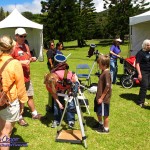
Students from Parker School participate in science fair
In the past two weeks I have served as a judge for two science fairs, Parker School and Kanu o ka ‘Āina. Parker is a private school in Waimea with a well deserved reputation for excellence. Kanu is a charter school with a heavy emphasis on Hawaiian culture. Both schools make a special effort with science fairs, expecting their students to participate and go on to the county and state wide competitions.

As usual, the projects are quite the mix. Some projects are simply the usual stuff, variations on the standard projects one can find posted to the internet, standard fodder for science fairs nationwide. Not that I totally disapprove of these common projects, students can gain valuable experience when performing any good experiment, even one done many times before. It is all in the execution.

One difference you really find here in Hawai’i, is a heavy emphasis on Hawaiian culture and special problems unique to the islands. This leads to unique experiments that address local issues. Propagation of native plants, alternative energy, permaculture, issues that have a direct connection with island life. Some student explore aspects of native Hawaiian technology. I was particularly impressed by experiments in traditional dye mordants examining the effectiveness and permanency of various mordants with tumeric dye and cotton cloth.

The results are likewise quite the mixture. Experiments that result in good success, to others that do not fair so well. Looking at a growth chart with all zeros in the data table I was forced to ask… “did the plants just not grow?” …”They all died.” Still, failures can be just as good learning experiences as success, sometimes better. I am always impressed by a student who admits failure and can explain what went wrong.

Some of the students I graded will go on to the regional competitions, I expect some will do quite well. Good luck!
The December WHAC Meeting

The West Hawai’i Astronomy Club will hold its December Meeting as usual on the second Tuesday of the month, December 11th at 7pm. We will be unable to have the meeting at CFHT due to conflict with another event, thus we will be meeting at Keck Observatory HQ in Waimea.

As many of our members traveled to observe the recent total solar eclipse in Australia we expect to be treated to photos and travelogues of their expedition. Join us for eclipse photos and more.

Keck Lecture Reminder

Günther Hasinger
University of Hawai’i
Black Holes and the Fate of the Universe

The character and distribution of stellar and supermassive black holes is a fascinating and rapidly changing area of astronomy research. Recently, the W. M. Keck Observatory has confirmed supermassive black holes are in the centers of most nearby galaxies, including our own Milky Way. A tight relationship exists between black hole mass and the properties of their host galaxies. New instrument capabilities, like those planned at Keck, will reveal even more about the nature of black holes and how they play a role in the ongoing evolution of the universe and everything in it.

Keck 2
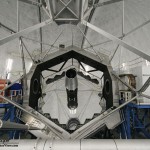
Looking into the optics of the Keck 2 telescope
Tuesday, November 20, 2012
7:00 PM
Gates Performing Arts Center Auditorium
Hawaii Preparatory Academy
65-1692 Kohala Mtn. Rd., Waimea

Seating is limited to first come, first served.
Doors Open at 6:30 PM
Free and Open to the Public

Keck Astronomy Lecture

Günther Hasinger
University of Hawai’i
Black Holes and the Fate of the Universe

The character and distribution of stellar and supermassive black holes is a fascinating and rapidly changing area of astronomy research. Recently, the W. M. Keck Observatory has confirmed supermassive black holes are in the centers of most nearby galaxies, including our own Milky Way. A tight relationship exists between black hole mass and the properties of their host galaxies. New instrument capabilities, like those planned at Keck, will reveal even more about the nature of black holes and how they play a role in the ongoing evolution of the universe and everything in it.

Keck 2
Looking into the optics of the Keck 2 telescope
Tuesday, November 20, 2012
7:00 PM
Gates Performing Arts Center Auditorium
Hawaii Preparatory Academy
65-1692 Kohala Mtn. Rd., Waimea

Seating is limited to first come, first served.
Doors Open at 6:30 PM
Free and Open to the Public

Halloween Sidewalk Astronomy

For many years it has been my tradition to setup a telescope on Halloween. A tradition I have inherited from other amateur astronomers, a tradition I intend to continue.

Princess at the Telescope
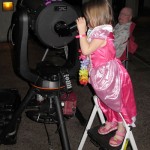
A Halloween princess looking through the telescope while we were set up at the King’s Shops
Unfortunately there are few trick-or-treaters in my own neighborhood. We are somewhat at the end of the street and at the top of the hill.

Looking for an alternative to setting up in the driveway, as I have in the past, I instead arranged to setup at the King’s Shops in the resort at the bottom of the hill. The shops make an evening of it, with various entertainment and activities arranged for children and adults. Contacting the Kings Shops management I was able to arrange permission to set up a few telescopes for the evening.

Cliff and Maureen volunteered to join me, bringing more gear. We had a few other club folks drop by. Also helping out were Dean and Melinda Ketelsen, fellow Tucsonans who share the Halloween telescope tradition and happen to be visiting for the week.

Unfortunately clouds hampered us in the early evening. As usual these cleared as the night progressed so that by 8:30pm we had a mostly clear sky. Moonrise provided a beautiful view, followed by Jupiter. There was a steady flow of folks checking out the telescopes. Princesses, Batman, ninjas and more had views of Alberio, Andromeda and other celestial objects. A fun evening for everyone, mixing in just a bit of science education, just what sidewalk astronomy is all about.

Reminder Keck Lecture Tonight

Keck Astronomy Lecture

Dr. Ben Zuckerman
University of California at Los Angeles
Violent Events in Rocky Planetary Systems: Implications for the fate of technological civilizations

Keck 2
Looking into the optics of the Keck 2 telescope
Thursday, October 25, 2012
7:00 PM
Gates Performing Arts Center Auditorium
Hawaii Preparatory Academy
65-1692 Kohala Mtn. Rd., Waimea

This evening, Dr. Ben Zuckerman of UCLA, will take us on a journey describing Earth’s formation 4.6 billion years ago to its possible demise 4-5 billion years from now. Along the way, we will consider a few tumultuous eras suffered by Earth’s biosphere, including the present. Such eras, from origins to final resting places, can be explored by understanding astronomical studies of other planetary systems. These systems also provide clues for the long-term fate of our technological civilization and the likelihood, or lack thereof, of civilizations beyond our own.

Seating is limited to first come, first served.
Doors Open at 6:30 PM
Free and Open to the Public

Keck Astronomy Lecture

Keck Astronomy Lecture

Dr. Ben Zuckerman
University of California at Los Angeles
Violent Events in Rocky Planetary Systems: Implications for the fate of technological civilizations

Keck 2
Looking into the optics of the Keck 2 telescope
Thursday, October 25, 2012
7:00 PM
Gates Performing Arts Center Auditorium
Hawaii Preparatory Academy
65-1692 Kohala Mtn. Rd., Waimea

This evening, Dr. Ben Zuckerman of UCLA, will take us on a journey describing Earth’s formation 4.6 billion years ago to its possible demise 4-5 billion years from now. Along the way, we will consider a few tumultuous eras suffered by Earth’s biosphere, including the present. Such eras, from origins to final resting places, can be explored by understanding astronomical studies of other planetary systems. These systems also provide clues for the long-term fate of our technological civilization and the likelihood, or lack thereof, of civilizations beyond our own.

Seating is limited to first come, first served.
Doors Open at 6:30 PM
Free and Open to the Public

Walk through the Solar System

A scale model of the solar system, laid out along Mamalahoa Highway through the center of Waimea. That is what we create every year for the Waimea Solar System Walk.

Starting on the lawn of Keck Observatory headquarters you can walk from the Sun to the outer solar system at the Canada France Hawai’i Telescope headquarters. Four and a half billion kilometers reduced to one kilometer (2.8 billion miles to about 1/2 mile). At this scale the Earth becomes a the size of a small bead and Jupiter a marble. Walking a model like this give a whole new appreciation for the scale of our solar system, driving home the idea that space is really, really big.

Dozens of kids and parents took advantage of the event to learn a bit about space and astronomy. Starting at the Sun they could wander from the inner solar system to the outer solar system. Passports handed out at Keck HQ were stamped at each planet along the way as the tour and each planet was manned by volunteers to answer questions.

Against the odds, it was a pretty nice day in Waimea. The characteristic strong winds and blowing drizzle was absent. We had sunny skies and when the wind died away in the afternoon, it became somewhat hot. This allowed for great views through the solar telescopes and nice conditions to stroll the length of the main street.

The experience was aided by volunteers who came in from organizations across the island, each bringing some educational fun to the planet walk. Nancy Tashima from the Onizuka Center covered Mercury, using some great material from the MESSENGER mission including 3D photos and glasses.

Gary Fujihara brought a splendid collection of meteorites. Using the asteroid belt as his home base to educate folks about the many minor bodies in the solar system and the material that falls to Earth.

Keck and CFHT staff put everything together and manned most of the booths. Members of the West Hawai’i Astronomy club helped out at registration and brought solar telescopes to view our Sun. Given clear skies in Waimea the view was fantastic. There were several good sunspots and wonderful prominences to be seen. It was great to see all those who volunteered their Saturday to help out.

A lot of smiling faces to be seen as kids and parents explored our solar system and learned. Always nice when you can slip a little knowledge in with the fun.

Atop Mt. Hamilton

The visitor directions on the website had specifically cautioned that the summit road was curvy, something I found to be a drastic understatement. From the very bottom it is curve after curve all the way up, with almost no straight sections. S-curves followed sharp bends leading to hairpins. Nearer the observatory the curve intensity only increases as the road narrows. Local history indicates that the horse-drawn wagons that transported heavy equipment up this road could not negotiate steep grades, the only solution was to follow the contour of the mountain, resulting in an incredibly curvy road.

On a sunny Saturday afternoon there were other users, the road is apparently popular with local cyclists. With the density of the sharp curves there was often little choice but to follow at bicycle speeds at times. I would much rather drive up Mauna Kea than this road again. Next time up Saddle to the summit I will recall Mt. Hamilton road and consider myself lucky.

The reason I was climbing this winding road was simply to be a tourist. Unlike the previous seven days, this day was to be fun. For much of the previous week there had been full day sessions of lectures and labs covering the intricacies of adaptive optics systems. Spending a full week in Santa Cruz might be considered a vacation, aside from the fact there had been very little open time to explore the surrounding area. There was only one open day in my travel plans, and I had specific plans for that day, a visit to an observatory.

The 36" refractor at Lick Observatory
The 36″ refractor at Lick Observatory
I arrived well ahead of my late afternoon tour appointment, no problem, just play tourist for a while. At the gift shop / information desk I met Lotus Baker, a longtime Mt. Hamilton resident. She was full of stories and information. We chatted for a while, until her turn to lead a tour of the classic 36″ Lick refractor. Lotus proved to be an excellent tour guide, providing an enjoyable tour of this beautiful telescope.

Continue reading “Atop Mt. Hamilton”