
Category: Planet Events
The Moon and Mars
This evening will see the Moon pass by Mars. The two will be about 12° apart tonight and about the same tomorrow night. As the red planet passed through opposition on the 3rd it is still quite bright at -1.2 magnitude, a nice match for a nearly full Moon.
Venus and Jupiter
The two brightest planets in the sky will join up for a dance spanning several days starting this evening. Looking up tonight you will see the pair about 5° apart, with the dimmer Jupiter above Venus. Over the next few days they will slide closer, arriving at their closest approach on March 13th, with about 3° separation. The pair will remain close for several evenings, on the 14th the distance will have widened to just over 3° and on the 15th the separation will be 3.5°. This is the last dance of the February-March planetary alignment, after this the dancers will go their separate ways.
Neptune Appears in the Dawn
This week will find Neptune emerging from the Sun’s glare to reappear in the dawn. The planet will arrive at opposition on August 24th.
Mars Close Approach
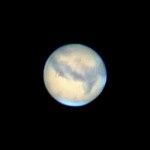
Mars was at opposition two days ago, but not at its closest. Close approach of the two planets is not necessarily on the same day as opposition, but can vary up to two weeks. This year sees the two planets approaching to 99,331,411 km (61,721,554 miles) at 07:01HST. At this distance the red planet will show a disk 13.89″ arc-seconds across in the eyepiece.
All month Mars will be visible throughout the night, high in the sky at midnight. This is the time to enjoy observing our closest neighboring planet while it is nearby and high in the night sky.
Mercury at Maximum Elongation
Today Mercury reaches maximum elongation, the furthest point it will reach from the Sun in the sky and the highest it will be above the sunset this apparition. The planet is easily visible as a bright, starlike object about 15° above the setting Sun as the sky grows dark. Over the next couple weeks Mercury will slide back into the sunset, heading for inferior conjunction on Mar 21.
Mars Opposition
Closest approach of the two planets is not necessarily on the same day as opposition, but can vary up to two weeks. This year closest approach will occur March 5th with the two planets approaching to 99,331,411 km (61,721,554 miles) at 07:01HST. At this distance the red planet will show a disk 13.89″ arc-seconds across in the eyepiece.
All month Mars will be visible throughout the night, high in the sky at midnight. This is the time to enjoy observing our closest neighboring planet while it is nearby and high in the night sky.
Venus and Jupiter
Tonight the two brightest planets in the sky will be almost exactly 3° apart. Jupiter will be shining at a brilliant -2.1 magnitude, even that will be outshone by Venus at an even more brilliant -4.3 magnitude. At 3° separation the pair will fit together in the field of a pair of binoculars or a rich-field telescope. If you miss tonight the pair will remain close for several nights, only 3°11′ apart tomorrow night, and 3°34′ apart on March 15th.
Take a look, it will be hard to miss these two brilliant planets high in the evening sky.
The Moon and Jupiter
As the Moon slides along the line of planets in the evening sky, it becomes Jupiter’s turn to make a pair. The Moon and Jupiter will be under 4° apart tonight. A brilliant pair with the -2.2 magnitude Jupiter beside a 25% illuminated crescent Moon.
Finding Venus in the Daytime
It is possible to see planets in the daytime. Both Jupiter and Venus are bright enough to see fairly easily in full daylight if conditions are right. You need to know where and how to look, but once glimpsed they are fairly easily seen. It is the knowing how that makes it possible. Try these simple hints…
- Try when the planets are far from the glare of the Sun, in the first hours after dawn or last hours of the day are best.
- Clean air is necessary. If the air is hazy, dusty or smoggy it will hide the planets from view, particularly when near the Sun. There will just be too much solar glare to pick out the planet. For the same reason try when the planet is high in the sky and you are looking through much less air.
- The human eye will relax and defocus if there is nothing to focus on. This happens when looking at a plain expanse of blue sky. You could be looking right at the planet and not see it. A few puffy clouds around, or better yet, the Moon, will give the eye something to focus on, allowing the planet to be easily seen.
- Put the Sun out of sight to reduce glare. Simply position yourself in the shadow of a tree or building to get a better view.
- Pick a day when the Moon is near the object you are looking for, it will provide a simple signpost to the correct location.
It is this last hint that can be particularly useful today. Venus is about 4° degrees south of the Moon this afternoon. If you can find the Moon in the late afternoon check just below it and to the left for Venus. The planet will be about a eight lunar diameters away from the Moon, seen as a bright star-like object. Tomorrow it will be Jupiter’s turn, and you can try again to see a planet in the daytime.
Have a try.