Today Mercury will be at superior conjunction. After today the planet will reappear in the evening sky, rising high enough from the Sun’s glow to be seen around the end of the month.
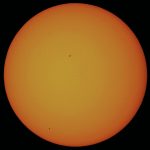
Mercury transiting the Sun on May 9, 2016. Celestron C8 and Canon 6D at f/10.Superior conjunction is when the planet passes around the far side of the Sun as seen from Earth. For a few weeks the planet will be lost in the Sun’s glare, hidden from view.
As Mercury is on an orbit inside that of Earth’s it will see both inferior and superior conjunctions as it passes from the evening sky to the dawn sky and back again.
Today Mercury will be at maximum western elongation, as high in the morning sky as it will appear for this current apparition. After today the planet will slide back into the dawn, passing through superior conjunction on October 8th to reappear in the evening sky around the end of the month.
Mercury transiting the Sun on May 9, 2016. Celestron C8 and Canon 6D at f/10.Mercury typically completes three morning and three evening apparitions in each year. While the innermost planet never gets very far from the Sun, maximum elongation represents the best time to observe Mercury as high in the sky as possible.
There are no transits of Mercury in 2017, the next will be Nov 11, 2019.
Today the planet Neptune will pass through opposition, directly opposite the Sun in our sky. The planet will be well placed for observation all night long, rising at sunset, transiting at midnight, and setting at sunrise. If you are looking to observe Neptune, it is currently shining at magnitude 7.8 in the center of the constellation Aquarius.
As the outer planets Uranus and Neptune move so slowly across the sky, the timing of oppositions is driven by the Earth’s orbit and occur each year at nearly the same time. Neptune’s orbital period is 164.8 years, taking over a century and a half to circle the celestial globe once. As Neptune was discovered in 1846, it has completed a little over one orbit since discovery.
Today Mercury will be at inferior conjunction. After today the planet will reappear in the dawn, rising high enough from the Sun’s glow to be seen in mid September.
Mercury transiting the Sun on May 9, 2016. Celestron C8 and Canon 6D at f/10.Inferior conjunction is when the planet passes between the Sun and the Earth. As such the only planets to see inferior conjunction are Mercury and Venus. A transit is possible if the planet passes directly in front of the Sun, but normally this alignment does not occur, the planet passing above or below the Sun as seen from the Earth. There are no transits of Mercury in 2017, the next will be Nov 11, 2019.
Today Mercury will be at maximum eastern elongation, as high in the evening sky as it will appear for this current apparition. After today the planet will slide back into the sunset, passing through inferior conjunction on August 26th to reappear in the morning sky in mid-September.
Mercury transiting the Sun on May 9, 2016. Celestron C8 and Canon 6D at f/10.Mercury typically completes three morning and three evening apparitions in each year. While the innermost planet never gets very far from the Sun, maximum elongation represents the best time to observe Mercury as high in the sky as possible.
There are no transits of Mercury in 2017, the next will be Nov 11, 2019.
Today Mercury will be at superior conjunction. After today the planet will reappear in the evening sky, rising high enough from the Sun’s glow to be seen early next month.
Mercury transiting the Sun on May 9, 2016. Celestron C8 and Canon 6D at f/10.Superior conjunction is when the planet passes around the far side of the Sun as seen from Earth. For a few weeks the planet will be lost in the Sun’s glare, hidden from view.
As Mercury is on an orbit inside that of Earth’s it will see both inferior and superior conjunctions as it passes from the evening sky to the dawn sky and back again.
Today the planet Saturn will pass through opposition, directly opposite the Sun in our sky.
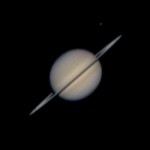
Saturn with Titan aboveSaturn orbits the Sun once every 29.45 years. As the ringed planet continues on its way the Earth swings around much faster on our inside track. As a result we lap Saturn once every 378.1 days, passing between the planet and the Sun. During opposition Saturn will be well placed for observation all night long, rising at sunset, transiting at midnight, and setting at sunrise.
Today Venus is at maximum elongation, as high in the dawn sky as it will get for this morning apparition, about 45.9°. After today the planet will begin its slide back into the glare of dawn. It will disappear from view around the end of the year and reach superior conjunction on January 8th, 2018.
As Earth and Venus race about the Sun, Venus will complete about one cycle of appearances each year. We can expect one evening apparition and one morning apparition to occur in 2017.
Today Mercury will be at maximum western elongation, as high in the morning sky as it will appear for this current apparition. After today the planet will slide back into the dawn, passing through superior conjunction on June 21st to reappear in the evening in mid-July.
Mercury transiting the Sun on May 9, 2016. Celestron C8 and Canon 6D at f/10.This will be the best morning apparition of the inner planet for 2016. The best evening apparition of 2017 will be in July, with a maximum elongation of over 27°.
There are no transits of Mercury in 2017, the next will be Nov 11, 2019.
Today Mercury will be at inferior conjunction. After today the planet will reappear in the dawn, rising high enough from the Sun’s glow to be seen around the end of the month.
Mercury transiting the Sun on May 9, 2016. Celestron C8 and Canon 6D at f/10.Inferior conjunction is when the planet passes between the Sun and the Earth. As such the only planets to see inferior conjunction are Mercury and Venus. A transit is possible if the planet passes directly in front of the Sun, but normally this alignment does not occur, the planet passing above or below the Sun as seen from the Earth. There are no transits of Mercury in 2017, the next will be Nov 11, 2019.