Jupiter will pass through opposition at 10:58HST today.
Jupiter and the moons Europa, Ganymede and Callisto (left-right)Jupiter orbits the Sun once every 11.86 years. As the giant planet continues on its way the Earth swings around much faster on our inside track. As a result we lap Jupiter once every 399 days, passing between the planet and the Sun. During opposition Jupiter will rise at sunset, transit at midnight, and set at dawn. This makes the planet available for observation for the entire night.
Look for a bright object rising in the eastern sky after sunset. It is difficult to mistake for anything else, shining at it’s brightest during opposition, a brilliant -2.7 magnitude. For the remainder of the spring and much of the summer, the planet will be quite prominent in the evening sky.
The bright planet Venus will appear in the dawn sky over the next couple weeks, climbing higher to become the morning star for the remainder of 2017. It is currently 15° from the Sun and shining at magnitude -4.3, bright enough to be seen against the dawn sky. It will reach maximum elongation on June 3rd, 46° ahead of the rising Sun.
Today Mercury will be at maximum eastern elongation, as high in the evening sky as it will appear for this current apparition. After today the planet will slide back into the sunset, passing through inferior conjunction on April 19th to reappear in the morning sky around the end of the month.
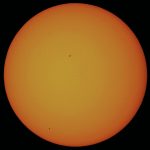
Mercury transiting the Sun on May 9, 2016. Celestron C8 and Canon 6D at f/10.Mercury typically completes three morning and three evening apparitions in each year. While the innermost planet never gets very far from the Sun, maximum elongation represents the best time to observe Mercury as high in the sky as possible.
There are no transits of Mercury in 2017, the next will be Nov 11, 2019.
Today Venus is at inferior conjunction, passing between the Earth and Sun. It will reappear in the dawn sky early next month to become the morning star for the remainder of 2017. The planet will reach maximum elongation on June 3rd at 46° from the Sun.
Venus approaching inferior conjunction, 24Dec2013As Venus emerges from the Sun’s glare it will be a fine crescent, growing thicker each day as we see more of the sunlit side of the planet. While it is still low in the dawn it can be a fine telescopic target. It is these phases of Venus that Galileo noted 400 years ago, one more bit of evidence to the true, Sun centered, nature of our solar system.
Over the next week Venus will be lost to the Sun’s glare. It is currently about 15° east of the Sun, but getting closer quite quickly now and becoming tough to spot in the sunset. The planet will pass through inferior conjunction on March 25th. The planet will appear in the dawn sky around mid April. When it does appear, it will spend the remainder of 2017 as the morning star.
Venus approaching inferior conjunction, 24Dec2013Even when low in the sunset, Venus is worth picking up in a telescope. As the planet approaches inferior conjunction it shows an ever more crescent appearance to our earthbound vantage point. During the last days of visibility it will be a razor thin crescent, worth the effort to look.
Today Mercury will be at superior conjunction. After today the planet will reappear in the evening sky, rising high enough from the Sun’s glow to be seen around the end of the month.
Mercury transiting the Sun on May 9, 2016. Celestron C8 and Canon 6D at f/10.Superior conjunction is when the planet passes around the far side of the Sun as seen from Earth. For a few weeks the planet will be lost in the Sun’s glare, hidden from view.
As Mercury is on an orbit inside that of Earth’s it will see both inferior and superior conjunctions as it passes from the evening sky to the dawn sky and back again.
Even when Venus is high in the sky and well placed for observation I will seldom take the effort of turning a telescope towards the planet. Why? Because Venus is pretty boring to look at. Perpetually cloud covered it has all the detail of a cue ball. It is a white disk with nothing of note to be seen. Yeah, pretty boring. Now turn the telescope to Jupiter.
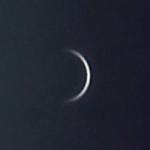
Venus approaching inferior conjunction, 24Dec2013One exception to this occurs when Venus is approaching, or just emerging from inferior conjunction. As the planet passes between the Earth and the Sun we are looking at the nighttime side of the planet, with only a little of the daytime side to be seen. As a result Venus will appear as a brilliant crescent.
This begins as the planet passes maximum eastern elongation, about two months before inferior conjunction. At this point the planet is seen from the side with respect to the sunlight, the planet will be about half illuminated. In the weeks after maximum elongation the planet will appear ever more crescent.
Venus on 28May2012, about 12°44′ from the SunThe last weeks before conjunction, as Venus is very low in the sunset, or the first weeks after conjunction as it sits very low in the dawn are the most interesting. During this time the planet is a very fine crescent, quite a beautiful sight in the telescope. Many observers, including myself, have made a point to observe Venus at this time, the one time this planet really becomes interesting to view.
Imaging Venus in the daytime a mere 12°44′ from the Sun.As the planet is quite low in the sky it makes it a challenging telescopic target and distortion by the atmosphere can be troubling, blurring the view.
It is possible to enjoy this sight in the daytime, while the planet is high in the sky, the seeing can be better and the view sharper. Of course this also occurs when the planet is near the Sun, thus extreme caution should be practiced at the telescope to avoid any direct sunlight and possible eye damage.
A page from Galileo’s 1623 treatise The Assayer—Il SaggiatoreThe phases of Venus are quite interesting from a historical standpoint. The phases of Venus clearly show that the planet revolves around the Sun. The phases were one of the primary arguments used by Galileo in his treatise The Assayer—Il Saggiatore published in 1623, where he lays out many of his ideas on science itself and how observation and experimentation should be primary.
While the the evidence challenged prevailing ideas of the time, some astronomers attempted to explain the phases of Venus by any other means to preserve their Earth centered universe, which led to rather tortured models of planetary motion. But it was clear to most that Galileo was right, the simple and elegant answer was that the Sun lay at the center. The orbits of Mercury and Venus, the phases, along with other observations like the moons of Jupiter, were hard evidence that few could ignore.
In 2017, eastern elongation occurred on January 12th. By now Venus has begun to show a substantial crescent, about 30% illuminated if you look today, Feb 12th. Over the next few weeks as the planet sinks into the sunset, the crescent aspect will thin dramatically.
By the end of February the planet will be only 17% illuminated, another week after that it becomes only 11%, by which time the planet will be difficult to spot in the sunset. Inferior conjunction will occur on March 25th. A couple weeks later and it will be possible to spot the planet in the dawn and observe the now thickening crescent.
Today Mercury will be at maximum western elongation, as high in the morning sky as it will appear for this current apparition. After today the planet will slide back into the dawn, passing through superior conjunction on March 6th to reappear in the evening around the end of March.
Mercury transiting the Sun on May 9, 2016. Celestron C8 and Canon 6D at f/10.The best evening apparition of 2017 will be in July, with a maximum elongation of over 27°. The best morning apparition will be May at over 25°, with today being nearly as good at over 24°.
There are no transits of Mercury in 2017, the next will be Nov 11, 2019.
Today Venus is at maximum elongation, as high in the sunset sky as it will get for this evening apparition, about 47.1°. After today the planet will begin its slide back into the glare of sunset. It will disappear from view around mid-March and reach inferior conjunction on March 25th, 2017.
As Earth and Venus race about the Sun, Venus will complete about one cycle of appearances each year. We can expect one evening apparition and one morning apparition to occur in 2017.
Only once before have I seen Jupiter and Venus this close, many years ago. Being close enough to fit in the same eyepiece field is quite interesting, particularly with enough magnification to see the moons and planet details well.
If you have not been paying attention the evening planet dance is in full swing, Mercury, Venus and Jupiter all in close attendance.
This evening was the close approach of Jupiter and Venus. I set up a telescope briefly to capture the conjunction. More than a little overexposed, but you can see the moons of Jupiter this way…
Venus and Jupiter in conjunction on Aug 27, 2016. The star at lower right is Beta Virginis