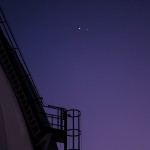
This evening at sunset a nice crescent Moon and the bright planet Jupiter will be quite close. As sunset around 19:00 the two will be separated by a mere 46′, just a little over the width of the full Moon. The two should make a very attractive pair as they sit above the glow of sunset.
Keep an eye out for Mercury and Venus closer to the horizon. At 19:00 Venus will be 9° above the horizon with Mercury a bit higher at 14°. The Moon and Jupiter will be higher yet around 25°. Since Mars and Saturn are also visible in the southern sky all five naked eye planets will be visible.
For much of the month all five naked eye planets will be visible at sunset. Mercury, Venus, Mars, Saturn, and Jupiter can all be seen easily if one knows where to look. Indeed, four of the five are quite bright and quite hard to miss. Neptune and Uranus are generally too faint to be seen without optical aid.
Venus and Jupiter over the Keck 1 domeTonight, August 1st, Venus is just rising high enough to be easily seen. It will be a mere 5° above the horizon at 19:30, probably bright enough to be seen against the glow. You can find Mercury a little higher, about 10° above the horizon. Jupiter is obvious well above the sunset as a bright object shining at -1.7 magnitude. Mars and Saturn are visible to the south on the top of Scorpio.
There will be a nice conjunction of the Moon and Jupiter, only 46′ apart, on the 5th of August. Mercury reaches eastern elongation on the 16th of the month. A beautiful triplet of Mercury, Venus, and Jupiter will gather in the days around the 22nd. Keep an eye to the sky for the month to be treated to some nice planetary views.
Both of the planets that orbit closer to the Sun, Mercury and Venus, can be seen to cross the face of the Sun if everything lines up just right. The last transit of Venus was in 2012. It has been much longer since a transit of Mercury, that last occurred in 2006.
The 2006 transit of Mercury, photographed with a 90mm telescope and a Canon 20Da
In comparison the the rare transits of Venus, transits of Mercury are fairly common. There are 13 or 14 transits of Mercury each century, meaning there is a transit on average every seven years. On May 9th this year we have another chance to observe a Mercury Transit.
Photographing the 2006 transit of Mercury from TucsonBack in 2006 I took the day off work and photographed the transit from my backyard in Tucson. As a transit is a five hour event the effort to observe the entire thing takes a while.
Mercury is quite small with respect to the Sun. During the transit the planet will be a mere 12-13 arcsec across. Considering the Sun is about 1920 arcsec across, the planet will be a fairly small dot on the face of the Sun.
In some respects a transit is the clearest view of Mercury small telescope users are able to view. Normally observed low on the horizon, the innermost planet never gets far from the Sun. During transit a fairly sharp disk can be seen, far better then the mushy view offered near the horizon at sunset and dawn.
First Contact
11:12 UT
1:12 HST
Second Contact
11:15 UT
1:15 HST
Mid-Transit
14:57 UT
4:57 HST
Third Contact
18:39 UT
8:39 HST
Last Contact
18:42 UT
8:42 HST
2016 May 09 Mercury Transit
Unfortunately for observers in the middle of the Pacific the 2016 transit will begin well before dawn. It is only the last hour or so of transit that will be easily visible as the morning Sun rises into the sky. Viewers in eastern North America and Europe will have a better vantage point for this transit.
Please exercise caution when viewing the Sun! Use appropriate eye protection or indirect observing techniques to project an image of the Sun. The link at the start of this paragraph leads to a great discussion on viewing the Sun safely. As always the single best source on the web (or anywhere) for eclipse and transit information is Fred Espenak’s eclipse website at NASA. Stop by whenever you have a question on upcoming events as well as viewing and photography tips.
The next Mercury transit will occur November 11, 2019. This next transit also favors Europe as mid transit occurs at 15:20UT. For the next Venus transit? You are out of luck as it occurs in 2117, over a century away.
Today Mercury will pass through inferior conjunction. The planet will reappear in the dawn during the last week of January.
There will be a lovely conjunction with Venus starting in early February with Mercury and Venus staying fairly close, less than 5° most of the month. On the morning of February 6th the pair will be joined by a crescent Moon for a lovely trio. As this occurs around maximum elongation for Mercury the conjunction will be about 25° from the Sun and well up in the dawn sky.
Today Mercury will be at maximum eastern elongation, as high in the evening sky as it will appear for this current apparition. After today the planet will slide back into the sunset, passing through inferior conjunction on January 14th to reappear in the dawn around the beginning of February.
The planet Mercury is starting an evening apparition. The planet should become visible this week just above the fading glow of the setting Sun as a magnitude -1 object. The planet is moving about 1° further from the Sun and higher in the sunset each day, reaching a maximum elongation of 20° on December 28th.
Today Mercury passes through superior conjunction, passing behind the Sun as seen from the Earth. The planet will appear in the sunset in ten days or so, reaching maximum elongation on Dec 29th.
Today Venus is at maximum elongation, as high in the dawn sky as it will get for this morning apparition, about 46°. After today the planet will begin its long slide back into the glare of dawn. It will disappear from view around the beginning of May, 2016 and reach superior conjunction on June 6th, 2016.
Today Mercury will be at maximum western elongation, as high in the morning sky as it will appear for this current apparition. After today the planet will slide back into the dawn, passing through superior conjunction on November 17th to reappear in the evening sky around the end of November.
The planet Mercury is starting a morning apparition. The planet should become visible this week just above the dawn as a magnitude -1 object. The planet is moving more than 1° further from the Sun and higher in the morning sky each day, reaching a maximum elongation of 18° on October 15th.