Venus and Uranus

Over the next few days Venus will swing quite close to Uranus. Today the pair is separated by 2°48′. This will decrease to 1°15′ on the 15th for the closest approach.

Much like the Venus and Neptune pair we saw last month, the pair is quite a mismatch… Uranus is a mere 5.1 magnitude while Venus is a brilliant -4.0. There will be two 4th magnitude stars to the north of the pair, δPsc and εPsc, but these will be about 4° away from Venus and should be easy to distinguish. Look for Neptune betwixt Venus and the stars.

The Moon and Saturn

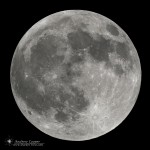
Tonight the planet Saturn will be quite close to the Moon. The pair will rise about 18:20 HST and be well up in the east in the late evening. Look for 0.1 magnitude object just north of the Moon, there are no nearby stars bright enough to confuse for the planet. The Moon is full at 09:16HST tomorrow, just short of full for tonight’s pairing.

Observers in the islands will see the Moon pass less than 1° south of the planet during the early morning hours of the 14th. Observers in the southern hemisphere will be able to view an occultation if at the correct latitude, check a planetarium program for the view from your location.

The Moon and Mars

Tonight the Moon will be close to Mars. The pair will be obvious at sunset, having risen mid-afternoon. Look for the bright planet just 3° north of the Moon. Just a month after opposition the planet is still quite bright, shining at magnitude -0.9 and notably orange in color. The star Spica is about the same magnitude and visible 15° east of the Moon.

Saturn at Opposition

Today the planet Saturn will pass through opposition, directly opposite the Sun in our sky.

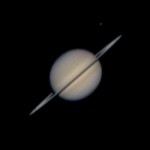
Saturn 22Apr2010
Saturn with Titan above
Saturn orbits the Sun once every 29.45 years. As the ringed planet continues on its way the Earth swings around much faster on our inside track. As a result we lap Saturn once every 378.1 days, passing between the planet and the Sun. During opposition Saturn will be well placed for observation all night long, rising at sunset, transiting at midnight, and setting at sunrise.

During opposition the planet and rings will be slightly brighter than normal, an effect known as the opposition effect. The effect is most notable in the rings where the apparent brightness can increase by 30%. The effect is a combination of two factors, shadow hiding and the retro-reflective properties of the ring particles.

Postcard from the Summit – Stairway

By the time you get to this point you are almost there, you are also out of breath from climbing the vertical ladders. The price of getting to the top of the Keck 1 dome.

Also a good spot to take a photo while catching your breath…

Stairway to the Top
Looking up the stairway to the top of the Keck 1 dome

In the Shutter

Inside the Keck 2 Lower Shutter
The top chamber inside the Keck 2 lower shutter
I am slowly becoming an expert in domes.

Seven hundred tons of steel and aluminum, thirty meters diameter. The dome represents a huge piece of machinery critical to the operation of the observatory.

Controlling everything is a PLC, a programmable logic controller, twenty year old technology from another era. Operation is critical, if the dome or shutter fail at the wrong time the telescope could be left exposed to the elements causing untold damage.

Despite, or perhaps because of, their huge mass the domes move with stately grace. I never seem to tire of hitting the button and listening to the rumble, of riding the huge structure as it smoothly rotates.

Every time something breaks it is a chance to learn. In this case it is an inclinometer, a simple angle measurement sensor that allows the system to read out the position of the shutter. Tests from the control panel show that it is simply not talking, I will have to get at the device itself, deep inside the structure of the shutter.

I feared that accessing the inclinometer would be difficult. The reality was somewhat easier, just drop the lower shutter all the way down, and climb into a hatch at the top.

Inside the first chamber is found much of the cabling and the inclinometer. There are even a few lights available so I am not working in the dark. Still, it is a bit eerie to be working inside a big aluminum box, a box that moves.