
Postcard from the Unverse – Eta Carina
When you want to see the stars, find someplace dark

Exploring the cosmos
Starscape photography is becoming increasingly popular. Dramatic photographs of a starry sky over a scenic landscape. Properly done the results can be truly impressive. The photo is a beautiful landscape with a glorious display of bright stars overhead. For those who have long enjoyed the night such a photo captures a sense of being there, of standing beneath those brilliant stars. This is starscape photography, a relatively new type of photography made possible by improved photographic technology.
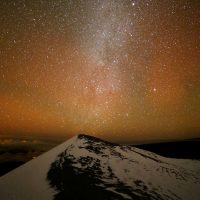
We will define starscape photography as shooting traditional landscape photographs with only starlight and skyglow for illumination. The exposure is fast enough to keep the stars from trailing. The result is a recording of what the scene would look like to a person standing under a starry sky.
Continue reading “Starscape Photography”Yeah, that didn’t work…
Eighty four images representing four and a half hours of exposure on the target. In this case NGC2244, the Rosette Nebula. It takes a few minutes to setup the software to align all of the images, then it takes about half an hour for the software to digest everything and produce a result. At the end of this you get to see if the effort worked. Sometimes it does not.
Complicating the issue is that a number of the sub-frames are taken at different exposures. Finding the correct stars in the these different exposures gives the software fits.


Tomorrow morning, March 26th, will see a brilliant Venus paired with a crescent Moon. Look for the pair to rise about 03:48HST to be 32° above the horizon at sunrise. An 21% illuminated Moon will be a nice match for Venus shining brilliantly at -4.3 magnitude. Separation will be about 9°.
The following morning, March 27th, will see the pair even closer with the Moon 6° below Venus. Observant sky-watchers will note Mercury another 18° closer to the eastern horizon and the rising Sun.

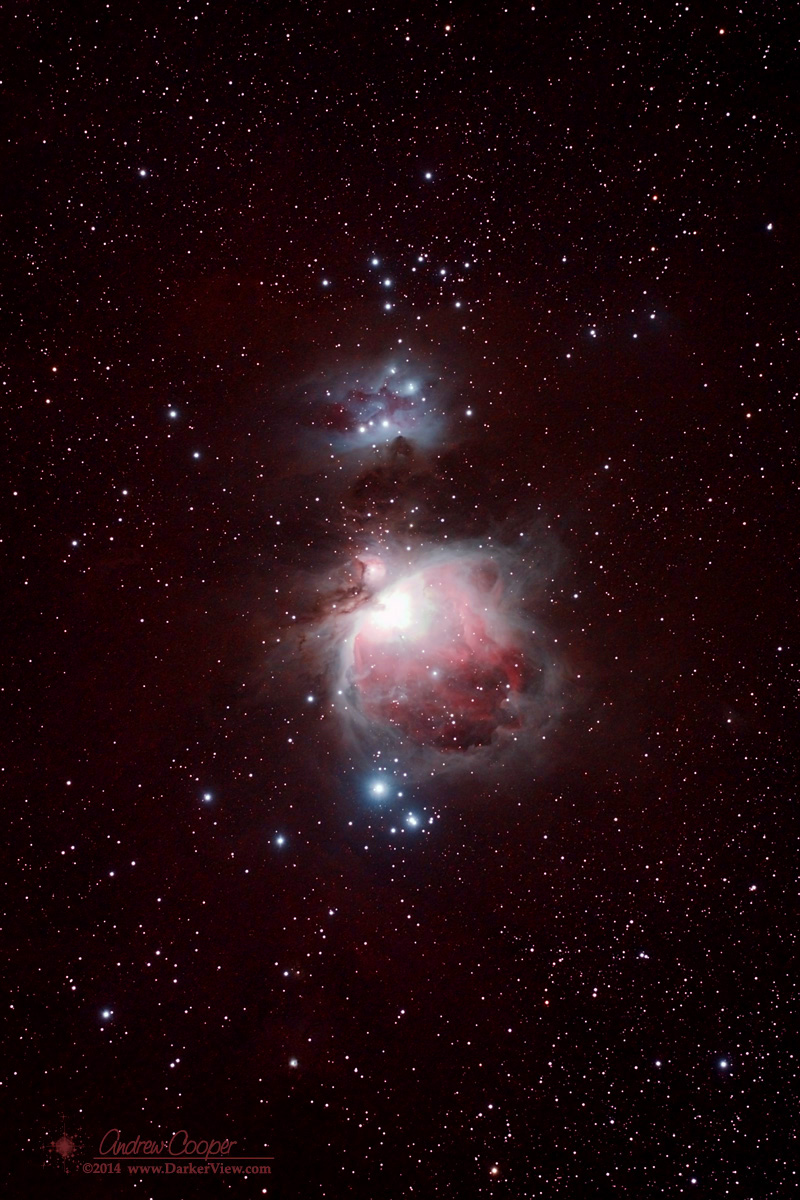
The Great Nebula of Orion is a beautiful object, the brightest nebulae in the sky. It is also quite easy to photograph, making it somewhat of a standard target. I, like many astrophotographers, use the nebula as something of calibration target to check new equipment and processes.
This shot was taken with a Canon 6D and a TV-76mm telescope, a combination I want to work with this summer. I also changed up my processing flow a bit, re-ordering the steps, to achieve better calibration. The result is a more neutral color tone in the original, I can then saturate the image to taste for display or printing. Th original might be a bit closer to true color. Of course, “true color” is a bit of an illusion in astrophotography, where everything is relative.
The vernal or spring equinox occurs today at 06:57HST. Today there will be little difference between the length of the night when counted against the number of daylight hours. This is the first day of spring as marked by many cultures in the northern hemisphere.
| 2014 Solstices and Equinoxes | ||||
|---|---|---|---|---|
| UT | HST | |||
| Perihelion | Jan 4 | 05:59UT | Jan 3 | 19:59HST |
| Vernal Equinox | Mar 20 | 16:57UT | Mar 20 | 06:57HST |
| Summer Solstice | Jun 21 | 10:52UT | Jun 21 | 00:52HST |
| Apehelion | Jul 3 | 22:59UT | Jul 3 | 12:59HST |
| Autumnal Equinox | Sep 23 | 02:30UT | Sep 22 | 16:30HST |
| Winter Solstice | Dec 21 | 23:03UT | Dec 21 | 13:03HST |
| Source: NASA Sky Calendar | ||||
