
Postcard from the Summit – Sunset
When you want to see the stars, find someplace dark

Exploring the cosmos

Today Mercury reaches maximum elongation, the furthest point it will reach from the Sun in the sky and the highest it will be above the sunrise for this morning apparition. The planet is easily visible as a bright, starlike object about 27° above the rising Sun as the twilight begins. Over the next couple weeks Mercury will slide back into the sunrise, heading for superior conjunction on April 25th.
A photograph of serendipity.
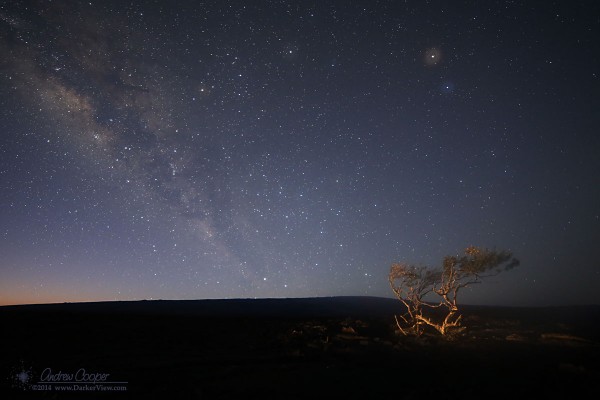
The photograph was planned… Somewhat. I knew there were some picturesque trees on the lava field along Saddle road. The plan was to shoot one of these trees silhouetted against the Milky Way and Mauna Loa. That was the plan. At least until the plan met reality.
Shot as planned the results were less than stellar. Actually they were rather boring. The rising summer Milky Way was spectacular, nothing else worked. The enormous bulk of Mauna Loa became a bump on the horizon from the low angle with the 14mm lens. The trees did not look like much against the dark.
Serendipity intervened… First a passing car lit the trees with dramatic results. Car headlights caught the trees at just the right angle to light up the right bits, a lucky bit of geometry and road alignment. Looking at the image on my screen I was intrigued… I repositioned the camera and shot again when another vehicle passed… This was working!
As I waited for other passing cars the shots deteriorated, odd glows across the frame. Were the headlights catching the big dome of glass at the front of the lens? Blocking the light from the headlights on the camera did not help. I pull out a flashlight to check the camera… Ack! The lens was fogging up!
Retrieving the anti-dew kit and a battery from the vehicle I secured a dew strap around the camera lens. At this point I wanted the shot and was willing to work for it. I was lucky again… I had thrown the dew gear in the car as a last moment afterthought.
It took time for the lens to warm and clear. As I waited dawn crept into the sky. I took a last few shots as the light increased and the stars faded. The dawn light added a nice shade of blue to the sky with a hint of peach to one side, another serendipitous bit that added to the photo. A last wisp of fog on the lens was just enough to create halos around Mars and the brighter stars.
Not a bad result! With a little skill and more than a little luck. The shot has been entered in the Hawai’i Photo Expo. Hopefully the jurors think the shot is as good as I think it is.
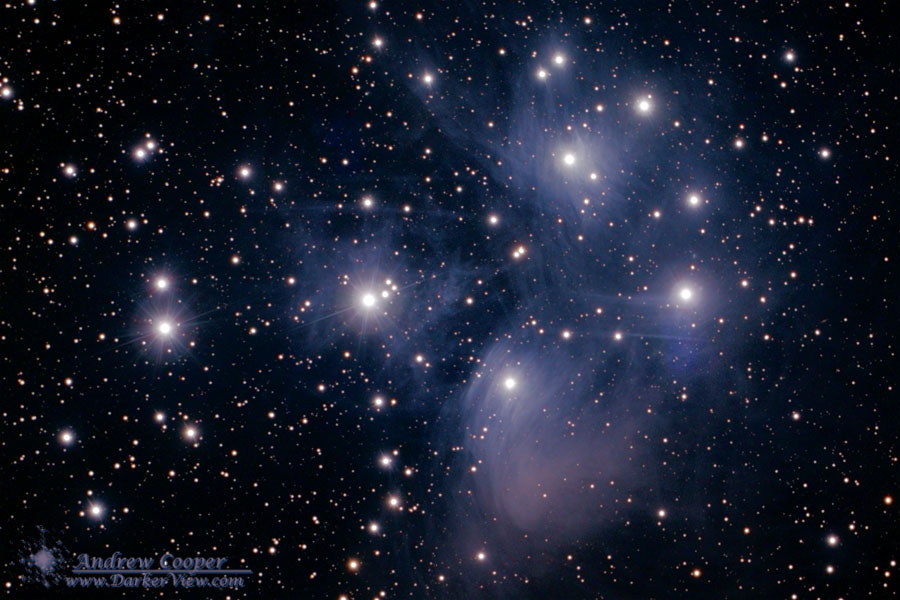
The Pleiades were not my primary target for the night, but that was setting and I was in no hurry to shut the gear down when there was a lot of dark remaining in the night. I glanced around the sky looking for a target appropriate for the field of view of the gear and just chanced to look at the star cluster.
Perfect…
Tonight the Moon and Jupiter will be close. The Moon will rise first, at 13:04HST, about ten minutes ahead of Jupiter, placing the two well up in the eastern sky by sunset. The Moon will be quite large, 65% illuminated and about 6° from the bright planet. Tomorrow night the pair will still be seen together, about 11° apart.
With Jupiter this close to the Moon it is an excellent time to see Jupiter in the daytime sky. Look 6° northeast of the Moon for a bright pinpoint of light. 6° is 12 times the size of the Moon seen in the sky, north will be to the left seen as the pair rises above the eastern horizon.
The current astrophoto setup in the driveway… The TeleVue 76mm atop the iOptron ZEQ-25 mount. The camera is currently the Canon 6D, providing a 5.35° x 3.57° field of view with a 3.52 arcsecond per pixel image scale.
Atop the main scope an SBIG STi provides auto-guiding. With a 100mm lens it has a 15 arc-second per pixel image scale. It is mounted with a custom mount machined for this setup.
The setup is intended to provide a high performance astrophoto setup with a minimum of fuss. This is about as far as I can reduce things without giving up performance. It is pretty portable, airline luggable at least. The whole setup fit in two suitcases for the trip to Oregon Star Party last summer.
The only real issue with this setup is the laptop. The big old 17″ HP Pavalion chews a lot of power, requiring an AC outlet to supply. I have my little Asus netbook configured to run the setup, a far more power efficient machine. With the netbook I can setup anywhere and shoot.
Cable management is a bit of a chore. A lot of separate cables must be routed to connect everything together. Much of the time I keep the setup assembled in the garage for deployment in the driveway. The cable tangle can be tamed with a handful of zip ties and velcro strips this way. A wheeled dolly allows the entire setup to be rolled out of the garage.
With this setup I have a capable astrophoto rig, capable of producing very nice material for processing. I just need a chance to get out and use it more often.


