I have been processing more images from this last week. This one is another classic nebula, the Eagle. The nebula, also known as M16 or NGC 6611 can be found in thick regions of of our galactic core towards the constellation of Serpens.
The eponymous eagle can be seen near the center of the brightest region, a structure of darker material likely held together by the gravity of objects inside it. In this case those objects would be forming stars, or protostars, the result of the dust and gas being drawn together under the influence of gravity.
I have a full set of color filters, once I have had fun re-doing many of these classic nebulae in hydrogen alpha I will probably begin doing full color versions. Color takes a lot more exposure time and much more processing. There are techniques to add H-alpha data to an RGB image to get more definition in the nebula structure, something I have not done and should probably figure out.
Next up is the Trifid Nebula in Hydrogen Alpha. This bright nebula is less than two degrees above the Lagoon Nebula as seen in the post a few days ago. Indeed, the bright wisps along the bottom of this shot are the northern bits of the Lagoon.
The Trifid, also known as M20 or NGC6514, is another stellar nursery where star formation is occurring as we watch. The dense gas and dust is being carved into a cavity by the stallar winds of these hot young stars within the nebula creating the bright core cut with dark lanes of dust that we see in this image.
To truly capture this region I need to take at lest one more frame of the area and put together the several resulting frames as a mosaic to cover this large and beautiful nebulae complex.
Sharpless 2-54 is an often overlooked nebula complex just 2° north of the far more famous Eagle Nebula M16. It is actually part of the same nebula complex the stretches from M17 through M16 to Sh2-54 and beyond. The nebula is much fainter, with not much appreciable without a camera attached to the telescope, thus the complex is not as well known.
The star cluster NGC6604 is found within the nebula, a collection of young stars recently formed from these clouds of gas and dust. In the photo here the cluster is seen just down and right of image center.
Again this image is taken through a hydrogen alpha filter to best show the wisps of glowing gas among the stars.
The nebula complex Sharpless 2-54 in Serpens in Hydrogen Alpha
With summer upon us the central core of the Milky Way galaxy dominates the late evening sky. This allows an astrophotographer a rich selection of targets well placed for shooting all night long.
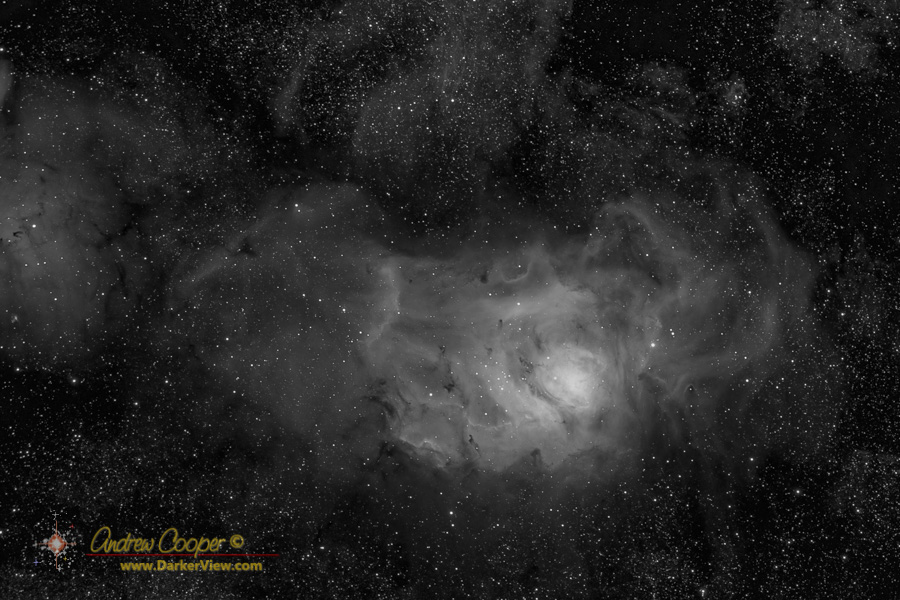
Among these targets are the large emission nebulae… M17, M16, NGC4628, NGC6334, NGC6357, SH 2-54, and a long list of others. The brightest among these nebulae is M8, the Lagoon nebula, a rich and complex region of star formation, sweeps of gas, and dark globules.
With a new hydrogen-alpha filter added to the camera’s filter wheel it is time to re-image some of these old favorites. The filter is a narrow-band filter allowing through a slice of the spectrum only a few nano-meters wide. The filter pass-band is centered on 656nm deep in the red, the glow of neutral hydrogen gas, this allows sharp images of these glowing nebulae complexes.
M8, The Lagoon Nebula taken in H-alpha light at 656nm
Supernova 2020jfo in M61 is not the only supernova occurring at the moment. Actually there are over sixty supernova in progress at the moment that we know of. The modern transient search programs locate them by the dozens, and while the average large galaxy might have one supernova a century, there are an enormous number of galaxies we can observe while monitoring for those great explosions.
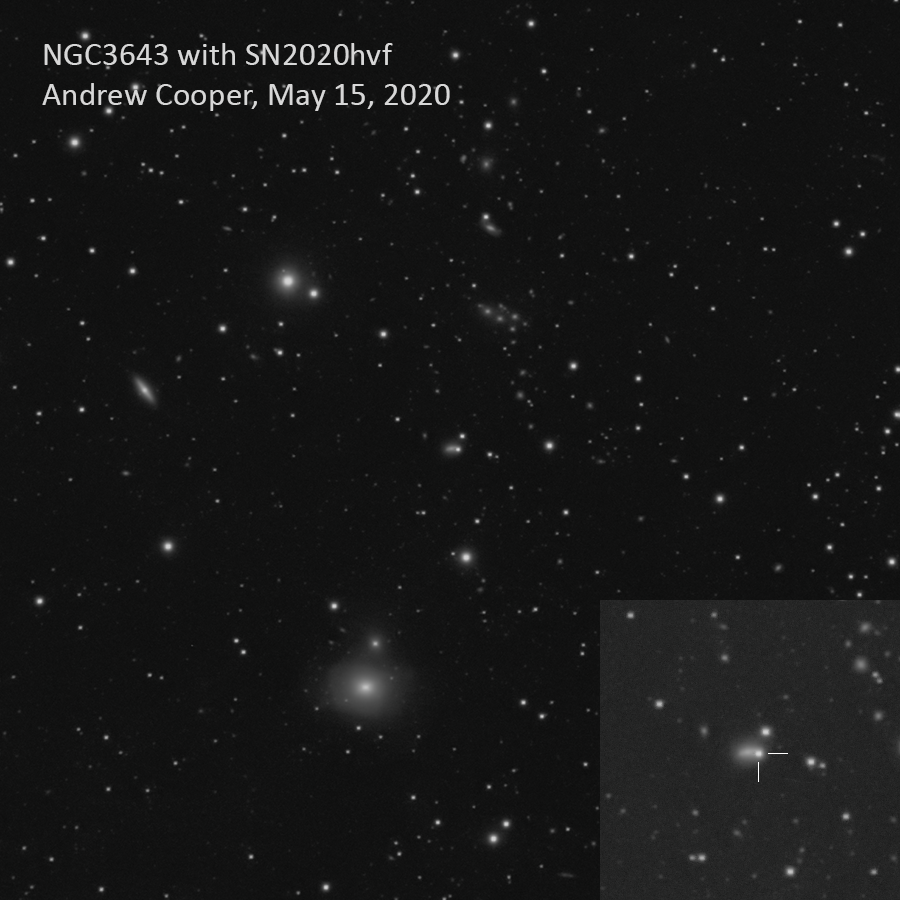
Currently the brightest supernova is 2020hvf at magnitude 12.4 hosted by galaxy NGC3643 in Leo. Unlike the pretty face-on spiral of M61, this small 14th magnitude galaxy is completely outshone by the supernova. Looking at the image one is struck by the realization that for a week or two that one star is outshining the combined light of the hundreds of billions of other stars that make up an entire galaxy.
NGC3643 with supernova SN2020hvf on the evening of Mar 15, 2020
M61 has been particularly bountiful when it comes to exploding stars. This should not be a huge surprise as M61 is also experiencing rapid star formation. With a lot of new stars around some of the largest stars will die early and die big.
Early this month the Zwicky Transient Facility noted a new supernova in M61, now cataloged as SN2020jfo. This explosion is now visible at 14.7 magnitude and can be seen by modest amateur telescope of at least 8-10 inches aperture.
Eight supernovae have now been observed in M61: SN 2020jfo, SN 2014dt, SN 2008in, SN 2006ov, SN 1999gn, SN 1964F, SN 1961I, and SN 1926A, an unusual number for any galaxy. In contrast our Milky Way galaxy last experienced a supernova in 1604.
Between shooting other targets I stopped by M61 last night to take a few exposures of the galaxy and see this supernova for myself.
NGC4303 – M61 with supernova SN2020jfo on the evening of Mar 14, 2020
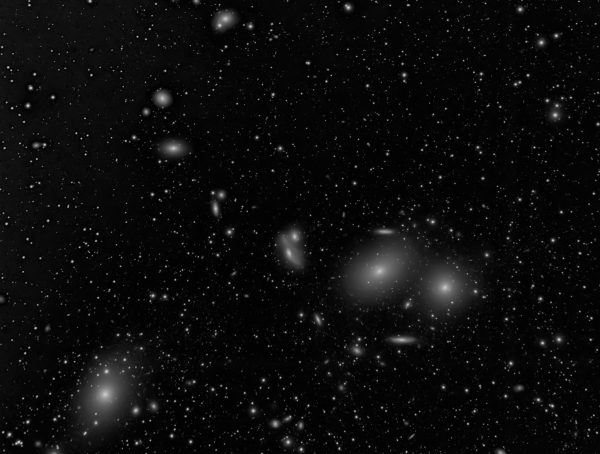
Shot photos from the driveway again last night. Several hours shooing at the heart of the Virgo cluster and Markarian’s Chain.
I was shooting color data, but clouds rolled through the field before I got any blue data. Will have to shoot again another evening. In the meantime I put together a monochrome version.
The two big elliptical galaxies towards the lower right are M84 and M86. In the center is an interacting spiral galaxy NGC4438, notably distorted through interaction with NGC4435 seen right above it. The big elliptical at lower left is M87.
Do not try to count the number of galaxies here, zoom in and dozens upon dozens become visible.
The heart of the Virgo Cluster around Markarian’s Chain.
A clear night finally appeared, clouds have been plaguing this particular dark of the Moon. What to do? Maybe do some astrophotography?
The nebula complex M17 in hydrogen-alpha
I have a new piece of kit, a ZWO ASI Air Pro that has been on back-order since November. With shutdowns in China and the rest of the mayhem it finally arrived this week.
The unit is a little dedicated astrophotography computer that makes a lot of the setup so much easier, while simplifying the snarl of cables on the telescope.
Controlling the camera, filter wheel, and guiding is done through a very nice app on the iPad. In less than an hour I had the basics figured out and was taking images.
A few technical issues to learn about through the night, such as how to best configure the WiFi for use with the home network, how to access and download the images to the desktop computer, etc., but no real problems. I took images through until dawn’s glow appeared in the data, running from twilight to twilight.
Social media is currently full of advice on what to do while stuck at home waiting out a pandemic. I find I need no advice… A dark sky and a telescope? No problem.
The observing notebook fills with notes beside the telescope
Awake at 4am this morning I pulled the Astrola from the garage and observed until the dawn lit the sky.
Once the evening clouds dissipated I again pulled out the telescope and observed for another two hours this evening.
Following the advice of staying at home I have been observing alone from our driveway. This weekend would have been our normal club dark-of-the-moon star party at Kaʻohe, getting together with other observers. Obviously this was cancelled.
This period of social isolation is measured in pages of notes on stars and nebulae, measured in the light-years I cross while peering into the universe.
Today is February 29th, that odd date that only occurs every four years.
The reason for a leap day inserted into the calendar, the existence of February 29th, is ultimately astronomical. Perhaps a little explanation is in order…
We originally defined days as the time it takes the Earth to rotate. While we define years as the time it takes the Earth to orbit once around the Sun. The problem is that these values do not divide evenly into one another.
Sunrise seen from the summit of Mauna Kea
The Earth takes about 365.24219 days to obit the Sun, when measured by the Sun’s position in the sky, what is called a tropical year. There are different ways to measure a year, but if one is concerned with keeping the seasons in sync with your calendar, then you are interested in tropical years.
It is that bunch of decimals, the 0.24219 etc., that is the problem, every four years the count drifts out of sync by roughly one day. The insertion of an extra day every four years helps bring the calendar back into synchronization with the orbit of the Earth and with the seasons.
Even leap years do not quite fix the problem as 0.24219 is close, but not quite 0.25 or one quarter of a day. Thus additional corrections are needed… Enter leap centuries.
Our current calendar was instituted by Pope Gregory XIII in 1582, setting up a standard set of corrections for the fractional difference between the length of a year and the length of a day. Scholars knew that errors had been accumulating in the calendar for centuries, resulting in a drift of several days.
Religious authorities were concerned that this drift had displaced important celebrations in the church calendar, in particular the celebration of Easter. After much argument it was decided to reform the calendar. The current solution was devised by a number of astronomers, including Aloysius Lilius, the primary author of the new system.
The Gregorian Calendar uses an extra day in February every four years, unless the year is divisible by 100, then there is no leap leap day that year. However, if the year is divisible by 400, then it is a leap year. While this may sound odd, it does create a correction much closer to the ideal value of 365.24219 days per year.
I am a geek, so let us put that into code…
1
2
3
4
5
6
7
8
9
10
if(year modulo4=0)then
if(year modulo100=0)then
if(year modulo400=0)then
leap=True
else
leap=False
else
leap=True
else
leap=False
Even this is not perfectly precise. The correction is close but will drift given enough time. The length of a tropical year also changes slowly over time. We will eventually have to add another correction to keep the calendar and the seasons in sync. But not for a few millennia, good enough, for now.
As 2020 is divisible by four and not divisible by 100, there will be a leap day added to the end of this February… Today.