
The following morning, February 25th, will see the Moon 7° below Venus. Observant sky-watchers will note Mercury another 16° closer to the eastern horizon and the rising Sun.
When you want to see the stars, find someplace dark

Exploring the cosmos
The following morning, February 25th, will see the Moon 7° below Venus. Observant sky-watchers will note Mercury another 16° closer to the eastern horizon and the rising Sun.
A result from Saturday night. About an hour of integration all told… Good color, very nice stars, good detail. While encouraging, I really need more time on this one, there is too much noise in the fainter regions of the nebula. I can get more data and add it to the stack to continue to improve the result. From up on the mountain I should be able to use longer exposures with darker skies. Colder conditions will reduce the dark current in the camera, also aiding in longer exposures.
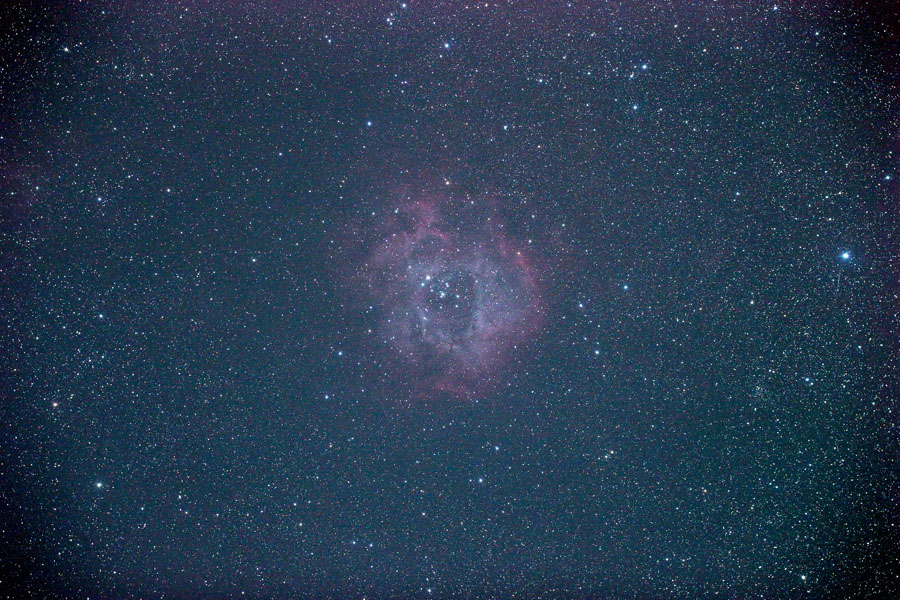
The Rosette Nebula is a large star forming region just east of Orion in the constellation of Monocerus. It is quite large, the main body seen in the photograph is well over a degree across. The dark region in the center is about the size of the Full Moon
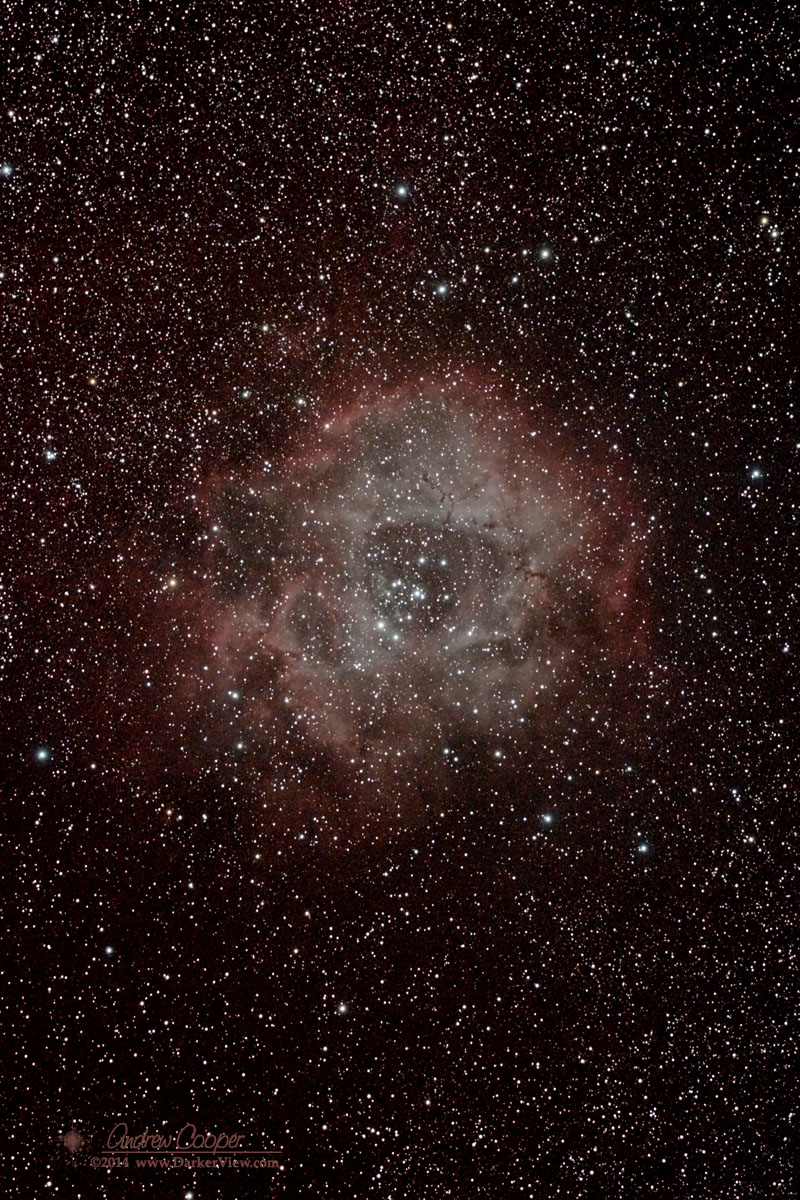
A good night in the driveway last night.
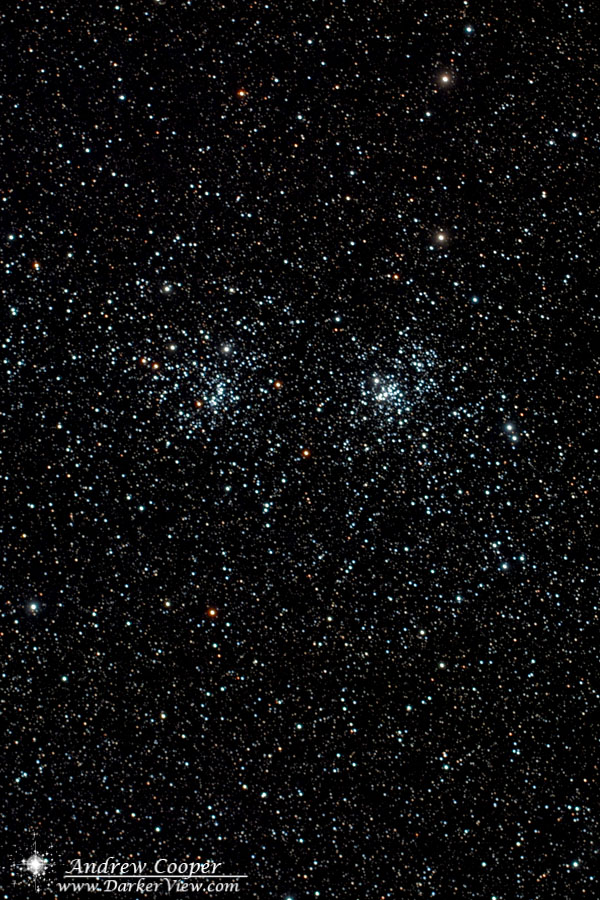
I want to use this combination camera and telescope with a very wide field to work over the dark nebulae of the Summer Milky Way. With 384mm focal length the full frame camera gives me over 5.35° x 3.56° field of view. The beehive also lent itself to the wide field, another large object that was worth a stop to shoot.
Aside from one little equipment issue to start, more an operator education issue, the gear worked great. Note to self… Must turn off camera WiFi before the camera will link to the computer via USB. I am currently using APT to control the camera, a very impressive bit of software. The auto-guider worked perfectly, frame after frame nearly identical. I can slideshow through dozens of sub-frames and not see any difference, no drift!
A single sub-frame of the Rosette Nebula is shown to the right. The Rosette is an emission nebula with most of the light emitted at the wavelength of Hα 656.28 nm. My Canon 6D is stock, no astrophoto modifications. Despite an IR cutoff filter that blocks much of the Hα light the camera captures a fair amount of the nebula. Perhaps I should get a 48mm Hα filter for the camera to shoot from the driveway.
With everything working so well I really need to haul the rig up to Hale Pohaku for a night of imaging under darker skies than I get down at 1000ft. Next weekend is dark-of-the-Moon weekend. Need to plan an outing?
It will take a bit to process the results of the night. As usual, keep an eye here on Darker View for the finished photos.
Tomorrow morning, Feb 21st, the Moon will be in close attendance with Saturn, separated by a little under 4°. The two will be high in southern the sky before dawn, a last quarter Moon will be 61% illuminated. Saturn can be seen as a 0.5 magnitude object just East of the Moon and west of the head of Scorpio. The following morning, Feb 22nd, the Moon will have moved to the other side of the ringed planet with a separation of just over 8°.
Viewers on the other side of the world will be able to see a very close pairing of the two, less than half a degree apart or even in occultaion depending on location. Close approach will be about 14:00 HST on the 21st. You could make an attempt to view the pair in the daytime sky, Saturn is bright enough to be seen next to the Moon in a modest telescope or even a good pair of binoculars. Unfortunately the Moon sets around 11:00, a few hours before close approach here in the islands.
The plan was simple. Stay on the summit after work to do some nighttime scenic photography.
I was hesitant in going up after suffering my recent ear infection. The ear is vastly better, no problems with clearing the ear for several days. After two weeks absence the list of things I needed to get done on the summit was getting lengthy and urgent. Yet I worried a bit about going up. An idea… Take my own vehicle. If I have trouble I can go at my own pace without holding up the rest of the guys. If the trouble is serious I can abort and head back down.
If I did bring my own vehicle I could get in a little photography along the way. I had not really had a chance to try out the Rokinon 14mm f/2.8 lens I had bought specifically for starry sky work. Why not stay late, watch sunset and take a few photos after dark? There is snow on the summit, the weather looked promising, the Moon would not rise until after 10pm, all good things.
The plan worked as envisioned. A good day getting stuff done. Actually a rather hectic day. The filter wheel problem of TRICK found and eliminated, the heater circuit at least looked at, I think the problem is still there. Warping data recorded for a segment in Keck 2 for the refurbishment project. Some wiring on TBAD completed, still more to do. An issue with the Keck 2 interlocks that popped up during the day was dealt with. Yes, a very good day.
A minimal dinner of instant ramen, and some paperwork accomplished while waiting for sunset.
Into the cold dark I go… The combination of the Canon 6D and the fast 14mm lens is impressive. This gear will really allow me to step up my game. I was able to shoot great material under very dark conditions. Photos that had been just out of reach for me until now. It will take me a couple days to go through and process the material, but a first look is very pleasing.
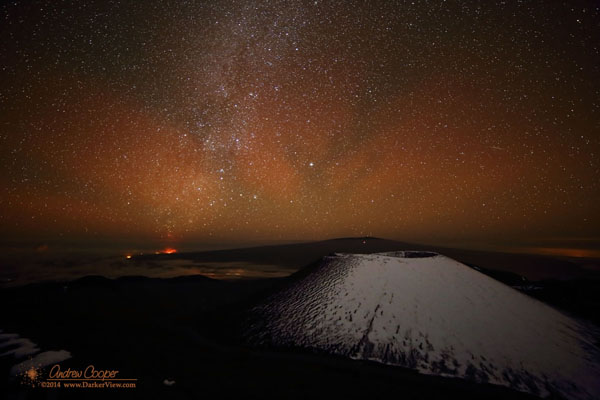
Only one problem… What is this red stuff showing up in my photos? Normal airglow is green, but this is crimson red and has very distinct structure? The idea of aurora crosses my mind, almost immediately dismissed as I am standing at 20°N latitude. I step away from the camera and the light for a bit. With some effort I can convince myself that I am seeing red in the sky, at least in the darker areas away from the Milky Way. But it is fleeting, and perhaps just an overactive desire to see something.
I get home and just out of curiosity I check the planetary Kp index… What?!? We have a Kp=6 geomagnetic storm in progress! Beautiful aurora photos are being posted from the upper midwest. Reports of aurora from across much of the United States. There is certainly a dramatic storm in progress. Perhaps this is a low latitude auroral glow!
There are some references to auroral glows detected at all latitudes during strong geomagnetic storms. Is this what my camera is detecting?
It is a nice photo. You can see the glow from the lava lake at Halemaʻumaʻu, the winter Milky Way, and a research laser shining straight up from the atmospheric lab atop Mauna Loa.

Today the planet Mercury passes through inferior conjunction, passing between the Sun and the Earth. In a week or so the planet will again be visible in the dawn sky, climbing higher each day. Maximum elongation will occur March 13th.
If you did not make a point to come to the last Keck lecture you missed a fun night.

Greg did a very nice job of explaining spectroscopy. this is never easy, the details can get pretty technical. Making sense of spectra while talking to a general audience is a neat accomplishment. This is even worse when you are talking about the spectra of water in the near infrared where there are thousands of emission lines. Good graphics and a step by step explanation worked, animations of dancing water molecules, and dancing Greg not withstanding.

When the crowd poured out we were ready. A lot of folks stayed to view, and five ‘scopes were in operation to meet them. I have to give thanks to Tony, Chris, Rickey, Cliff, Bernt, and Purcynth, who manned the scopes and answered the flood of questions. As we were breaking down the clouds were rolling back in, very good timing indeed.
The lecture was recorded and should show up on the Keck website soon. I’ll try to post a link to it when it does appear. In the meantime, if you have not already done so, get your email on the Keck Nation list so you know about these events before they happen.