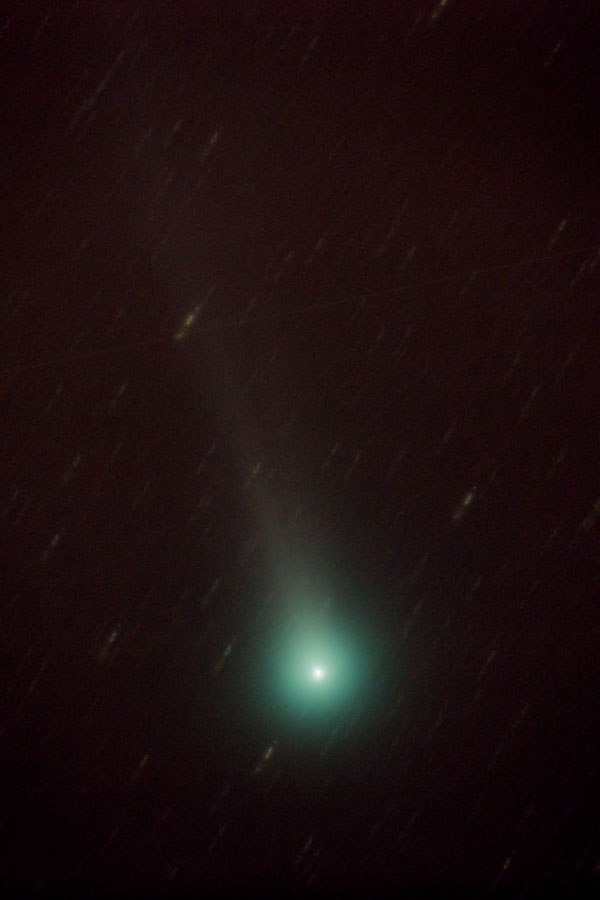
While comet C/2012 S1 ISON is getting all of the attention, it is not the only comet currently visible. There are a couple other good comets available to observe or photograph. On Sunday morning I tracked down and photographed three comets.
The ZEQ25, TV-76mm and Canon 6D setup and taking photos of comet ISONComet ISON is sharing the stage with comet 2P/Encke and comet C/2013 R1 Lovejoy. All three are bright enough to be spotted in a small telescope. Encke was about magnitude 8, Lovejoy and ISON were both about magnitude 5 on Sunday morning.
Despite following comet ISON for the last year, I had never actually observed it myself. Attempts to change this repeatedly ran into problems, either work commitments or bad weather. Over the last month cloudy skies have been more common than clear, even the big ‘scopes on the mountain losing a large amount of time to poor conditions.
Wondering what comet C/2012 S1 ISON is looking like today? There is a very good camera aimed at the eastern horizon from the summit of Mauna Kea. Just what you need to take a look for yourself.
The CFHT Cloudcam is a DSLR camera that is programmed to take exposures constantly through the night. Used by the telescope operators to monitor oncoming weather, the camera shows the sky conditions over the eastern coast of the island and the city of Hilo. The images are live during the night, each morning you can load a timelapse video of the entire night.
The camera has quite a following, quite a few people check the camera constantly. This includes quite a few UFO consipracists. If anything odd shows up on the camera the video quickly shows up on YouTube and linked to postings on the UFO sites. When the launch of a missile from Vandenberg AFB in California created a glowing sphere of light these websites went into overdrive with wild speculation.
Most of the mornings this week have been too cloudy to see the comet. I have been checking the video each day. Currently at magnitude 5 the comet will be a small dot in the imagery. As the comet brightens it should appear nicely in Cloudcam.
Another little lesson in astrophotography, one more in a very lengthy list… Do not use too short an exposure with the flat source.
Flat frames are used to calibrate out any uneven field illumination or dust in the field. This ever more important with the new camera, the larger, full frame sensor shows some vignetting at the corners. I use an electroluminescent source to do my flat frames, actually an old laptop back-light that has been re-housed in an acrylic frame. It provides an even illumination across the aperture of the telescope or lens I am using to acquire the flat field calibration frames.
A bad flat field taken at 1/4000 sec with the EL back-light flicker interacting with the camera shutterWhat I have discovered is that the EL backlight flickers. This is too fast to see with the eye, but if the camera exposure is fast enough it will create issues. This shows up as horizontal structure across the field as the flicker interacts with the camera shutter.
I discovered the effect as I took flats the first time with the Canon 6D. I had the ISO set to 6400 which resulted in a 1/4000 sec exposure. Fortunately I looked at the last flat and saw the problem before I dismounted the camera from the telescope, it was pretty obvious. Once the optical setup is disturbed it is not possible to re-shoot the calibration frames.
A proper flat field calibration frame, Canon 6D and AT6RC telescope.It took a few seconds of thought to realize what the problem was. I never realized an EL light flickers, or rather I had never thought about it. Given that EL lights are driven with a high voltage switching power supply, flicker should be expected. The switching frequency of the supply should be above the human threshold of hearing to avoid an annoying whine, at least 20kHz. It can not be too much higher than that or it would not have shown up in a 1/4000 second exposure.
Slowing the camera down removes the effect. As I could not change the aperture I simply reduced the ISO to minimum, this slowed the shutter speed to 1/15 of a second for the nice mid-scale exposure needed for flats.
The corrected flats reveal the usual things that a flat is takes to correct. The dark corners reveal the expected uneven field illumination. the dust doughnut reveals at least one notable speck of dust on the cover glass of the sensor. There is a dark band at the bottom of the frame which I believe to be shadowing from the edge of the mirror. Looking at the flat I realize I will need to be conscientious about taking flats with the Canon 6D.
Today Mercury reaches maximum elongation, the furthest point it will reach from the Sun in the sky and the highest it will be above the sunrise for this morning apparition. The planet is easily visible as a bright, starlike object about 19° above the rising Sun as the twilight begins. Over the next couple weeks Mercury will slide back into the sunrise, heading for superior conjunction on December 28th.
I had set the alarm clock for 0230 to get up with plenty of time to setup and take comet photos. What greeted me was a sheet of cloud, an all to familiar sight lately. I did not reset the alarm and went back to sleep. A couple hours later I found myself lying awake again, realizing I would probably not fall back to sleep I got up to look outside. To my surprise Orion shown brightly over the street.
Is there enough time to setup and shoot before dawn?
I rushed the alignment, hoping to setup in less than half an hour. Things did not go smoothly… The EOS utility in the computer did not recognize the 6D, I need to update the drivers. A thin cloud stubbornly sat in front of Polaris, I think I got the polar alignment, the star was very dim on the polar ‘scope. Even when exposures seemed to be going smoothly I they were not. I find out later the auto-guider had moved itself to a hot pixel, probably when a bit of cloud passed through. In the rush I did not get a dark frame for the guider, most of the frames show small guide errors.
One not so bad bit of serendipity… The Hubble Space Telescope went right through one of the frames.
Despite all I did get an image of the comet. It should have been better, rushing astrophotography is not a good plan…
Comet C/2013 R1 Lovejoy on Nov 15, 2013. Canon 6D with the AT6RC and a 0.8x focal reducer. 12 x 60s at ISO 6400.
Yes, the 6D on a telescope! Just getting things setup for some possible comet shooting. The clouds over Hawai’i may actually be breaking up after a week of very wet weather.
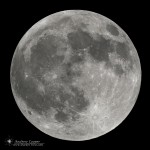
A 94% illuminated waxing Moon, Canon 6D and AT6RC with 0.8x focal reducer.
Comet ISON is sinking rapidly into the dawn. I have been waiting for a chance to photograph it for a couple weeks now. The gear is ready to go. Any morning that I have had available has been awash with clouds. Not strictly my problem, Keck has lost quite a few nights to weather over the same time period.
Tonight looks to be no exception. We have a number of engineering tests planned for Keck 1, including the first night on sky for a system many of us have put a lot of work into, the TRICK infrared tip-tilt detector for Keck 1 AO. It does not look good.
Update: The night was a complete loss, the telescope never opened.
Join us for a free astronomy lecture at Waimea’s Kahilu Theater…
Artist impression of the planet Kepler-78b and its host star. Credit: Karen Teramura (UH/IfA)The Search for Other Earths
Andrew Howard – University of Hawai’i
Andrew Howard, astronomer from the University of Hawaii’s Institute for Astronomy, will give an illuminating talk about the hunt for exoplanets and the quest for another Earth. Since 1995, more than 3,000 exoplanets have been discovered. Many of these planets look nothing like the planets of our Solar System — strange orbits, unusual compositions, and unknown beginnings. Dr. Howard will tour this diverse landscape of exoplanets, including the recent discoveries of planets the size of Earth.