
Postcard from the Summit – Operator’s Station
When you want to see the stars, find someplace dark

Exploring the cosmos
The Southern Delta Aquariid meteor shower will peak this weekend. This reliable shower usually produces 10-20 meteors per hour. The peak will occur on July 27th this year. As the shower has a broad peak there should still be a good showing a few days either side of peak.
As we are past new Moon there is some dark sky available in the evening, best viewing for this shower is in the morning, when a bright 60% Moon will rise. Moonrise will occur around 22:00HST on the 27th and 22:43 on the 28th. The radiant for this shower will rise at 09:22HST. This provides a slim window of darkness to attempt meteor viewing. After rising, the moonlight will dim the prospects for viewing the shower.
While science observations may be almost a decade away, the science possibilities of the Thirty Meter Telescope are already eagerly anticipated by astronomers. In the attempt to answer many of the basic questions of our universe, the limitations of the existing telescopes have become apparent. The eight and ten meter telescopes that represent the forefront of astronomy today are reaching their limit, a limit the research astronomy community is ready to step past.
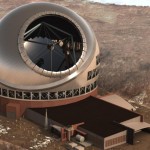
One thing was clear from the science presentations… The science case for the TMT is compelling. The sheer size of the new telescope will allow observation of the early universe that is just out of reach of the current generation of large telescopes. The thirty meter primary mirror will provide significant advantages even over the next generation of space telescopes in resolution and flexibility of operation. The excellent site available on Mauna Kea allows advantages over the selected site for the European E-ELT in Chile.
While the goal of the conference is to look ahead. It is interesting that what is being presented is a wonderful summary of where current research stands today. In the effort to detail what research could be accomplish with TMT, the astronomers succinctly cataloged the state of current research as it is limited by today’s instruments and telescopes.
Much of the first day discussion was focused on the possibilities of observing the very early universe, the first stars and galaxies that formed in the era just after the big bang. Current telescopes can observe a few tantalizing glimpses of this era, just enough to show astronomers what they do not know about the formation of our universe. A few massive galaxies bright enough to be seen across the gulf of time, a few fainter galaxies that are luckily aligned with closer massive galaxy clusters. Clusters that form gravitational lenses that allow us to peer through a keyhole into the dim past. Astronomer have used every trick they can muster to allow observation of this first era. The TMT will open the door into this first era of stars, allow real study of the beginning of what we see around us today.
Planning for the TMT is in the final stages, where the capabilities of the telescope and the instruments can be forecast with reasonable assurance that those goals will be met. Astronomers can use the design data of the telescope to simulate exposures and signal to noise ratios of the data, on targets they can just barely see today. This sort of planning is critical to the astronomy community, it may be another ten years before science observations begin, but when they do the astronomers will be ready to use the telescope to its fullest capability.
This sort of feedback is critical to the engineers as well. As instruments pass through final development, it is important to know what capabilities are most valuable, what to prioritize when the final design is produced. Questions of spectral resolutions, throughput and exposure times are often heard in the discussions.
Through conferences like this one, the astronomy community will know what to expect when the new telescope comes online around 2022. They will be ready to push forward our understanding of the universe. We know what to expect. But, as Andrea Ghez reminded us, we must “Expect the unexpected!”. Many of the discoveries made by Keck and the other great telescopes of the current generation were completely unexpected. It is likely that the universe still has a few surprises for us.

Look for the pair to rise about 4:13am, almost two hours before the Sun. The two planets will be 20 degrees above the horizon at sunrise. They should be easy to spot with Jupiter at -2 magnitude and Mars dimmer but still easy at 1.5 magnitude. Look 8° below the pair for Mercury still rising towards maximum elongation.
Mercury will begin a morning apparition this week. The planet is currently about 10° above the rising Sun, climbing higher each morning. Look for a 3rd magnitude star-like object just above the glow of dawn. Mercury will reach a maximum elongation of 19° on July 29th.
Over the next few mornings Mars and Jupiter will rendezvous in the dawn sky. This morning sees the two a little over 2° apart. Over the next few days that will narrow quickly with close approach occurring on the mornings of July 21st and 22nd with about 50′ of separation between the two planets. By the 26th the distance between the pair will again have grown to over 2°.
Throughout the encounter the two planets will precede the Sun by about 25°, rising about 04:00HST, well placed for observation.
Keep an eye out for Mercury below the pairing, a 2nd magnitude object about halfway between the conjunction and the rising Sun. The innermost planet will reach maximum elongation on July 29th.
The mornings of August 3rd and 4th will see a thin crescent Moon slide along the line of three planets in the dawn.
The bright stars of Collinder 399 form the Coathanger asterism. Also visible is the open cluster NGC6802 at the left of center. North is up in this view.

Not a hard job, but someone has to do it… Hanging off the weather tower again. This time all I am doing is taking pictures!
Paul and Fred from the the TMT telescope are walking the perimeter of the TMT site with a large white pole. At a few preset points they call me on the radio and I snap a couple photos. I spend the few minutes between each location just enjoying the view, or adjusting the climbing harness to find a less uncomfortable pose. At least the weather is quite nice.

The camera will most likely be mounted on the Keck weather mast. The location offers power and communications along with a secure mounting point. What we learn is good news, from the mast there is a clear view of the complete TMT building site
What remains to be done is the paperwork. First we must seek and receive approval from the Office of Mauna Kea Management. Any changes to the outside of any of the facilities must be approved before work begins. I have done this in the past whenever I modify one of the weather instruments. Usually not a major hurdle, but one that must be done right.
I have supported the TMT in a number of small ways. It will be exciting to watch the construction, we have a ringside seat at Keck!