
Postcard from the Summit – Testing
When you want to see the stars, find someplace dark

Exploring the cosmos
Today the planet Mercury passes through inferior conjunction, passing between the Sun and the Earth. In a week or so the planet will again be visible in the dawn sky, climbing higher each day. Maximum elongation will occur July 29th.
Today the Earth is furthest from the Sun, a point called apehelion. We will be about 152,096,000km (94,508,000miles) from the Sun. Compare this to the 147,099,000km (91,403,000miles) we were be at perihelion on January 1st, a difference of about 4,996,000km (3,104,000miles) occurring throughout one orbit.
It may seem odd that we are actually at the furthest for the middle of northern summer, you just have to remember that proximity to the Sun is not the cause of the seasons. The seasons are caused by the axial tilt of the Earth, creating short and long days throughout the year, with a resulting change in the angle and intensity of the sunlight.
| 2013 Solstices and Equinoxes | ||||
|---|---|---|---|---|
| UT | HST | |||
| Perihelion | Jan 2 | 00:59UT | Jan 1 | 14:59HST |
| Spring Equinox | Mar 20 | 11:02UT | Mar 20 | 01:02HST |
| Summer Solstice | Jun 21 | 05:04UT | Jun 20 | 19:04HST |
| Apehelion | Jul 5 | 18:59UT | Jul 5 | 08:59HST |
| Fall Equinox | Sep 22 | 20:44UT | Sep 22 | 10:44HST |
| Winter Solstice | Dec 21 | 17:11UT | Dec 21 | 07:11HST |
| Source: NASA Sky Calendar | ||||
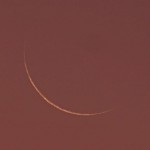
Tomorow morning, July 6th, will see a nice 5-7° triangle made up of a slim crescent Moon, Mars and Jupiter. Look for the trio to start rising about 04:30 HST with Mars rising first, followed by a 2.5% illuminated Moon. Last up will be Jupiter, rising about 04:55 HST. The Sun will not rise until 05:48 giving plenty of time to enjoy this conjunction.
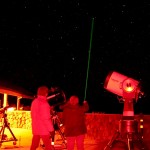
I wish it were this easy! Our summit crew is having way too much fun on a holiday.
At least I do not have to go up today, I am just on-call over the holiday weekend.
This week will see the reappearance of Jupiter in the dawn sky. This morning the planet will be 10° above the rising Sun, climbing quickly higher each morning. Look for a bright, -2 magnitude object directly above the bright glow of dawn.
Over the next couple weeks there will be a nice series of conjunctions between Jupiter, Mars, Mercury and the Moon.
So I check the Mauna Kea webcams. The VLBA antenna? Aimed South?
