NPR Segment on Keck Adaptive Optics

A nice NPR piece on Keck AO today. A decent discussion of the history and advantages of adaptive optics.

For Sharpest Views, Scope The Sky With Quick-Change Mirrors

It used to be that if astronomers wanted to get rid of the blurring effects of the atmosphere, they had to put their telescopes in space. But a technology called adaptive optics has changed all that.

Always a good thing when a system I put so much of my life into receives some good press!

AO Uranus
Uranus in two different wavelength, with and without the AO system on, credit Hammel/de Pater/Keck

Full Moon

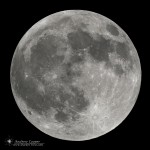
Full Moon
Full Moon taken 27Aug2007, 90mm f/12 APO and Canon 20Da
Full Moon will occur today at 01:32HST.

This full Moon will be a perigee full Moon, with the Moon appearing a bit larger and brighter. Today lunar perigee occurs within minutes of full, producing a full moon that is about 12% larger and 30% brighter than if full occurs while the Moon is at apogee.

Continue reading “Full Moon”

The Portents of ISON

Comets have long been regarded as omens of extraordinary portent. Novae, eclipses, conjunctions, anything seen in the sky can serve in this role, but bright comets have always held a special awe.

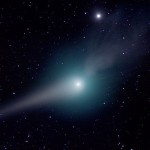
C/2007N3 Lulin
Comet C/2007 N3 Lulin on the morning of 22 Feb 2009
Even today those who seek signs are quick to seize upon any unusual astronomical event. A few months ago it was meteors, events over Chelyabinsk grabbing the attention. With ISON entering the inner solar system the attention shifts.

Bright comets are invariably seen as omens by some. History is littered with stories of comets and prophesies. This has not changed, there are many recent examples… Hale-Bopp, Hyakutake, Elenin, each has been used to make all manner of wild predictions. Comet C/2012 S1 ISON certainly fits the role. It will most likely be quite bright, easily visible without optical aid. It may even be visible in the daytime.

Continue reading “The Portents of ISON”

Employment Opprtunity at Keck – Student Assistant Systems Administrator

W. M. Keck Observatory position announcement

The Observatory seeks a Student Assistant to support the Computer System Administrator on a variety of computer software/hardware oriented assignments.

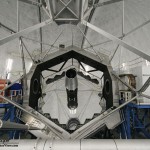
Keck 2
Looking into the optics of the Keck 2 telescope
Essential Functions:

  1. Hardware and software data entry.
  2. Windows computer software/hardware configuration/troubleshooting
  3. Tape organizing.
  4. Shipping and Receiving support.
  5. Network Table data entry.
  6. Assist as primary help desk for Systems Administration group.
  7. Work effectively with coworkers and others by sharing ideas in a constructive, positive manner; listening to and objectively considering ideas and suggestions from others; keeping commitments; keeping others informed of work progress and issues; addressing problems and issues constructively to find mutually acceptable and practical solutions; and respecting the diversity of the WMKO workforce in actions, words, and deeds.
  8. Maintain commitment to a high standard of safety, comply with all safety laws and WMKO safety policies/rules, and report actual and potential safety violations to appropriate supervisory or management personnel to further WMKO’s core value of safety.

Continue reading “Employment Opprtunity at Keck – Student Assistant Systems Administrator”

Summer Solstice

Summer solstice occurs today at 19:04HST. Today the Sun will occupy the most northerly position in the sky of the year. The term solstice comes from the latin terms Sol (the Sun) and sistere (to stand still). On this day the Sun seems to stand still as it stops moving northwards each day and begins move to the south. This is the first day of summer as marked by many cultures in the northern hemisphere. Alternately this is the first day of winter for those living south of the equator.

Many calendars will mark Jun 21 as the beginning of summer this year, this is correct for much of the world. Here in Hawaii the solstice will occur on the 20th when correcting for the time zone difference.

2013 Solstices and Equinoxes
  UT HST
Perihelion Jan 2 00:59UT Jan 1 14:59HST
Spring Equinox Mar 20 11:02UT Mar 20 01:02HST
Summer Solstice Jun 21 05:04UT Jun 20 19:04HST
Apehelion Jul 5 18:59UT Jul 5 08:59HST
Fall Equinox Sep 22 20:44UT Sep 22 10:44HST
Winter Solstice Dec 21 17:11UT Dec 21 07:11HST
 
Source: NASA Sky Calendar


Billion-Pixel View of Mars From Curiosity Rover

JPL press release

A billion-pixel view from the surface of Mars, from NASA’s Mars rover Curiosity, offers armchair explorers a way to examine one part of the Red Planet in great detail.

The first NASA-produced view from the surface of Mars larger than one billion pixels stitches together nearly 900 exposures taken by cameras onboard Curiosity and shows details of the landscape along the rover’s route.

The 1.3-billion-pixel image is available for perusal with pan and zoom tools at: http://mars.nasa.gov/bp1/ and a scaled down version (~159MB) is available for direct download here: http://www.jpl.nasa.gov/spaceimages/details.php?id=PIA16919.

Billion-Pixel View From Curiosity at Rock Nest, Raw Color
This is a reduced version of panorama from NASA’s Mars rover Curiosity with 1.3 billion pixels in the full-resolution version. It shows Curiosity at the “Rocknest” site where the rover scooped up samples of windblown dust and sand. Curiosity used three cameras to take the component images on several different days between Oct. 5 and Nov. 16, 2012. Image credit: NASA/JPL-Caltech/MSSS

The full-circle scene surrounds the site where Curiosity collected its first scoops of dusty sand at a windblown patch called “Rocknest,” and extends to Mount Sharp on the horizon.

Continue reading “Billion-Pixel View of Mars From Curiosity Rover”

Mercury and Venus

Over the next few days Mercury and Venus will pass by each other one last time in a dance that has lasted over a month. Tonight the pair are about 2°04′ apart. Tomorrow that will shrink to 1°55′ and widen the following night to 2°03′.

After the 21st, the pair will separate rapidly as Mercury dives into the sunset to inferior conjunction on July 9th.