The least massive galaxy in the known universe has been measured by UC Irvine scientists, clocking in at just 1,000 or so stars with a bit of dark matter holding them together.
This image shows a standard prediction for the dark matter distribution within about 1 million light years of the Milky Way galaxy. Image credit: Garrison-Kimmel, Bullock (UCI)The findings, made with the W. M. Keck Observatory and published today in The Astrophysical Journal, offer tantalizing clues about how iron, carbon and other elements key to human life originally formed. But the size and weight of Segue 2, as the star body is called, are its most extraordinary aspects.
“Finding a galaxy as tiny as Segue 2 is like discovering an elephant smaller than a mouse,” said UC Irvine cosmologist James Bullock, co-author of the paper. Astronomers have been searching for years for this type of dwarf galaxy, long predicted to be swarming around the Milky Way. Their inability to find any, he said, “has been a major puzzle, suggesting that perhaps our theoretical understanding of structure formation in the universe was flawed in a serious way.”
It began, as all these things do, with a phone call from Liz…
“It’s stuck”
“What is stuck?”
“SFP won’t move in K2AO.”
“Do not try to move it any further, I am up tomorrow for SegEx, I will go look at it.”
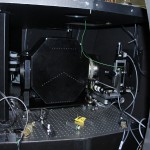
Looking into the partially disassembled side of the Keck 2 AO BenchLast time we tried to free up the SFP stage when it was stuck we carved an L shaped gouge in the cover plate. This is the hazard of optics that move under computer control. We tell the computer to move these optics under the assumption that the encoder position indication is correct, sometimes it is not. In reality there is no way to actually see where the stage is, an optical assembly moving deep within the AO optical bench. For most of the optical stages this is not a problem, if the encoder is not correct you can just reinitialize it and regain the position, the stage can not actually hit anything.
SFP is different, it can crash into the rotator if it gets lost. There is no real way to fix this issue, it has to be this way. SFP stands for Simulator Fiber Positioner, an artificial star created with a optical fiber. Placing the tip of the fiber at the telescope focus creates a bright dot of light that we can use to align and calibrate the AO system. The three axis stage can move the fiber into the light path and accurately position it just where you need it for system tests. There is also a diagonal mirror used to inject light from the telescope simulator and the spectral calibration source mounted atop the simulator.
This evening the Moon will join the ongoing dance of planets in the sunset. A very thin crescent Moon will be 13° above the horizon at sunset and 6° below and south of the brilliant Venus. 5° above Venus will be Mercury notably dimmer at only 0.4 magnitude.
Tomorrow the Moon will be a bit higher and show a little more crescent at 6% illuminated. It will be above Venus and about the same elevation as Mercury, if 7° further to the south.
Jupiter is still present, but probably too low into the sunset to spot at only 6° from the setting Sun. Maybe with perfect conditions?
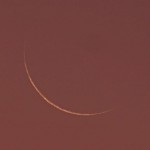
A very young moon over Waikoloa, this is only 26 hours after new, visible to the unaided eye as a sliver in the fading glow of sunsetNew Moon will occur today at 05:56HST.
An international team of scientists using the most powerful telescope on Earth has discovered the moments just after the Big Bang happened more like the theory predicts, eliminating a significant discrepancy that troubled physicists for two decades. The discovery will be published in the international journal Astronomy & Astrophysics on June 6.
The image illustrates the detailed modelling of a small piece of the surface of an old metal-poor star used to derive its abundance of lithium-6. Image credit Karin Lind, Davide De Martin.One of the most important problems in physics and astronomy was the inconsistency between the lithium isotopes previously observed in the oldest stars in our galaxy, which suggested levels about two hundred times more Li-6 and about three to five time less Li-7 than Big Bang nucleosynthesis predicts. This serious problem in our understanding of the early Universe has invoked exotic physics and fruitless searches for pre-galactic production sources to reconcile the differences.
The team, led by Karin Lind of the University of Cambridge, has proven the decades-old inventory relied on lower quality observational data with analysis using several simplifications that resulted in spurious detections of lithium isotopes.
This week Mars will appear in the dawn sky having passed through superior conjunction on April 17. Look for a 1.5 magnitude object to rise around 04:50, about 10° ahead of the Sun. The red planet will see opposition in April of 2014.
Tomorrow morning a very thin crescent Moon will share the dawn. Rising about 05:05 a 1% illuminated Moon will be 3° below Mars, closer to the rising Sun.
Jupiter is quickly sliding into the sunset heading for superior conjunction on June 19th. This evening the planet will be 10° above the setting Sun, in the next few days it will disappear into the glare. Look for Jupiter to reappear in the dawn during the first week of July.
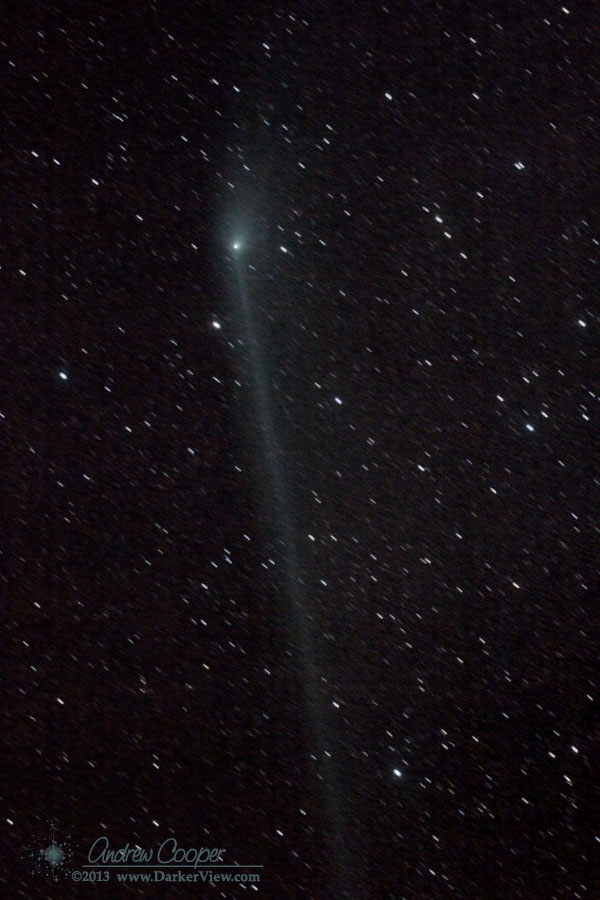
Well past perihelion comet C/2011 L4 continues to put on an impressive show. Amateur sky-watchers have been enjoying the impressive anti-tail reaching out a few degrees from the coma. True, you may need a telescope or at least good binoculars to see the comet. It may be dimming, but still worth the effort to observe.
Comet C/2011 L4 PanSTARRS, 10x4min with TV-76 and Canon 60D @ISO2000
I had been looking to acquire another astrophoto toy. The desire is for a small, portable astrophoto setup. Yes, I am aware that the words “portable” and “astrophoto” do not really belong in the same sentence, all things are relative.
Thus I have decided on the new iOptron ZEQ25. It is a new design, with some radical differences from the more traditional German equatorial mounts.
The mount is pretty small, a mere 10 pounds of steel and aluminum. Compact enough to be packed into a suitcase for air travel. Performance sufficient to do wide field astrophotography with focal lengths up to 1000mm and a DLSR camera. Perfect for use with either my TV-76 or AT6RC. Unlike my old Losmady G-11 it features a modern GOTO system and can be run from the computer.
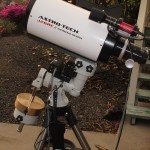
AT6RC atop an iOptron ZEQ25 mount, note the additional counterweight necessaryThe chatter over at Cloudy Nights was promising. A few early production mounts were in the hands of some stateside amateurs, and they have been posting their impressions and images. I was particularly impressed by the measurements of periodic error with results around two arc seconds. This was a small mount that could very easily be a good astrophoto option.
I ordered the mount from the good folks at OPT. It was not yet listed in the website catalog, but a phone call confirmed they were expecting delivery of three mounts shortly. I put down my deposit. A week later I had confirmation that the mount had been received and was ready for shipment to Hawaiʻi as promised.
This evening will see a line of bright planets in the sunset. Easiest to spot will be the brilliant Venus, shining at -4 magnitude and 15° above the setting Sun. 4°30′ below Venus will be Jupiter, quite low in the sunset, but bright enough to spot at -2 magnitude. 4°16′ above Venus will be Mercury, notably dimmer at -0.2 magnitude. The three will form an almost perfect line of bright objects in the glow of sunset, it should be a nice sight.