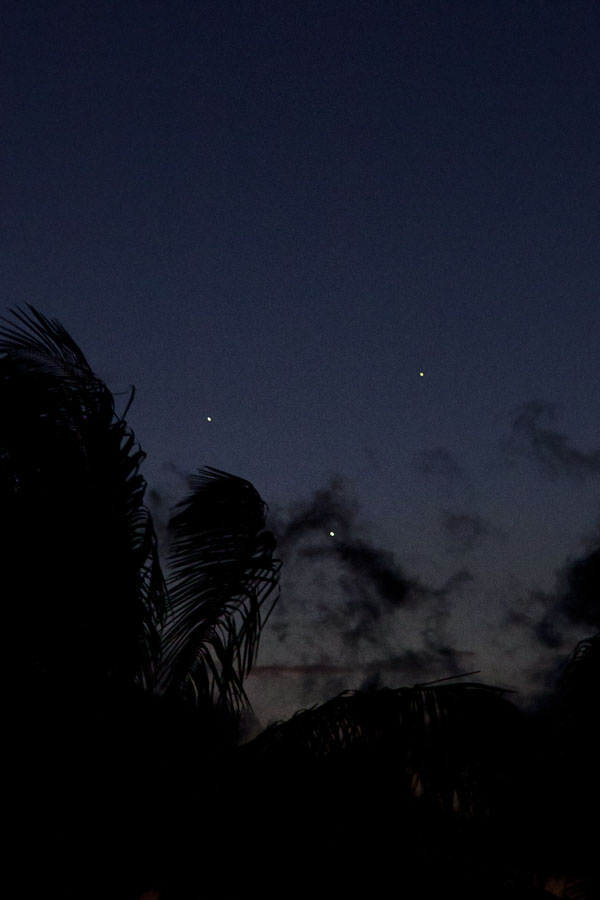
We actually had mostly clear skies and could see the planetary conjunction tonight, the three were almost in a perfect equilateral triangle.

When you want to see the stars, find someplace dark
Exploring the cosmos

While Jupiter will leave the stage, exiting into the sunset after the end of the month, Mercury and Venus will continue the dance well into June.

A penumbral lunar eclipse will occur, but it is so minor there is little point in trying to observe it. As the NASA eclipse site notes… “With a penumbral eclipse magnitude [6] of 0.0158, just 0.5 arc-minutes of the Moon’s southern limb will pass into Earth’s pale penumbral shadow; such a shallow eclipse is only of academic interest since it will be all but impossible to detect.”
W. M. Keck Observatory press release…
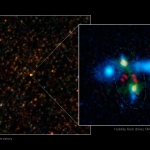
Two hungry young galaxies that collided 11 billion years ago are rapidly forming a massive galaxy about 10 times the size of the Milky Way, according to UC Irvine-led research conducted on the W. M. Keck Observatory and other research facilities around the world. The results will be published today in the journal Nature.

HXMM01 is fading away as fast as it forms, a victim of its own cataclysmic birth. As the two parent galaxies smashed together, they gobbled up huge amounts of hydrogen, emptying that corner of the universe of the star-making gas.
“These galaxies entered a feeding frenzy that would quickly exhaust the food supply in the following hundreds of million years and lead to the new galaxy’s slow starvation for the rest of its life,” said lead author Hai Fu, a UC Irvine postdoctoral scholar.
The discovery solves a riddle in understanding how giant elliptical galaxies developed quickly in the early universe and why they stopped producing stars soon after. Other astronomers have theorized that giant black holes in the heart of the galaxies blew strong winds that expelled the gas. But cosmologist Asantha Cooray, the UC Irvine team’s leader, said that they and colleagues across the globe found definitive proof that cosmic mergers and the resulting highly efficient consumption of gas for stars are causing the quick burnout.
Continue reading “Mega-galaxy is Missing Link in History of Cosmos”
This evening, and the next few evenings, will find Mercury, Venus and Jupiter in a tight triangle just above the sunset. The trio will be separated by less than 3° and will be well above the setting Sun, 14° at sunset, thus will remain in the sky for almost an hour after the Sun slides below the horizon.
Tonight will see Mercury and Venus even closer, separated by only 1°48′, tomorrow that will shrink to 1°26′ and 1°22′ on the 24th. The trio will all be quite bright, with Mercury shining around -1 magnitude, Jupiter at -2, and Venus around -4 magnitude. Keep watching as this trio will continue to be quite close through the end of the month.
Tonight will see a bright Moon just a few degrees from Saturn in the constellation Virgo. The Moon will be nearing full, about 94% illuminated and 4° south of Saturn.
Tonight the Moon will rendezvous with the bright star Spica in the constellation Virgo. The Moon is approaching full, just under 90% illuminated. Evening will see the two quite close, about 2° apart. As the night progresses this separation will diminish as the Moon slides just south of the star. For viewers in Hawai’i the minimum separation will be about 40′ around 2:00 in the morning with the star just 25′ from the Moon’s pole.
For the sixth year running I made the drive to Hilo to help in judging the Big Island Regional 2013 MATE Underwater ROV competition. Too much fun to miss!
As usual Keck provided much of the official staff. This is the fault of Keck software engineer Al Honey, the head official, who drafts the rest of us into being there! An engineer from Liquid Robotics and a couple folks from the observatories in Hilo rounded out the judging staff. Add teams from schools all over the island and mix with water to create an event.


On the evening of May 24th Venus and Mercury will be about 2° apart with Jupiter 4° above. Closest approach of the three will occur the evening of May 26th with the trio forming a neat triangle about 2° on a side. On the 28th Venus and Jupiter will be just over 1° apart. During the first few days of June, the planet Jupiter will bow out of the dance, exiting the stage into the Sun’s glare. Venus and Mercury will join up one more time for a few days after June 17th, with a close approach on the 19th and 20th with about 2° separation between the two. When Mercury also heads into the sunset this dance will end during the last days of June.
On the 9th and 10th of June the Moon will run across the stage, a very thin crescent around 2% illuminated and 6° south of the planets.
Much of the dance will take place about 15° above the sunset, high enough to be nicely visible, low enough that the glow of sunset will provide a colorful backdrop to light the stage.
The planet Mercury is starting an evening apparition. The planet should become visible this week just above the fading glow of the setting Sun as a magnitude -1 object. Currently about 10° from the Sun it will rise higher each evening, reaching a maximum elongation of 24° on June 12th.
Mercury will join Venus and Jupiter in the sunset making for a series of planetary conjunctions over the coming month.