For the sixth year running I made the drive to Hilo to help in judging the Big Island Regional 2013 MATE Underwater ROV competition. Too much fun to miss!
As usual Keck provided much of the official staff. This is the fault of Keck software engineer Al Honey, the head official, who drafts the rest of us into being there! An engineer from Liquid Robotics and a couple folks from the observatories in Hilo rounded out the judging staff. Add teams from schools all over the island and mix with water to create an event.
A ROV built from PVC pipe and bilge pumps maneuvers the course at the 2013 MATE ROV regional competition in HiloThe missions continue to increase in complexity. This year the task was a simulated undersea research platform. Various instruments were in need of upgrade or servicing. Opening a hatch on the “undersea instrument platform”, disconnecting power, removing an instrument, installing a new instrument, removing bio-fouling, a long list of tasks, each worth a few points in the final tally. Never-mind the instruments were made of PVC and the bio-fouling was actually pipe cleaners, it still was not easy!
The Moon, Venus and Aldebaran join up for an evening conjunctionThe three brightest planets are about to join up for an evening dance set. Currently Mercury is rising clear of the Sun’s glare into the evening sky. There it will join Venus and Jupiter for a conjunction that will continue, with various partners, for over a month. The three dancers will be well matched for brightness, with Mercury shining around -1 magnitude, Jupiter at -2, and Venus around -4 magnitude.
On the evening of May 24th Venus and Mercury will be about 2° apart with Jupiter 4° above. Closest approach of the three will occur the evening of May 26th with the trio forming a neat triangle about 2° on a side. On the 28th Venus and Jupiter will be just over 1° apart. During the first few days of June, the planet Jupiter will bow out of the dance, exiting the stage into the Sun’s glare. Venus and Mercury will join up one more time for a few days after June 17th, with a close approach on the 19th and 20th with about 2° separation between the two. When Mercury also heads into the sunset this dance will end during the last days of June.
On the 9th and 10th of June the Moon will run across the stage, a very thin crescent around 2% illuminated and 6° south of the planets.
Much of the dance will take place about 15° above the sunset, high enough to be nicely visible, low enough that the glow of sunset will provide a colorful backdrop to light the stage.
The planet Mercury is starting an evening apparition. The planet should become visible this week just above the fading glow of the setting Sun as a magnitude -1 object. Currently about 10° from the Sun it will rise higher each evening, reaching a maximum elongation of 24° on June 12th.
Mercury will join Venus and Jupiter in the sunset making for a series of planetary conjunctions over the coming month.
Living south of the Tropic of Cancer we get to experience an interesting phenomena that folks outside the tropics will not see. There are two days each year when the Sun passes directly overhead. In the islands this event is called Lahaina Noon.
Spring Lahaina Noon for 2013
Location
Date
Time
Hilo
May 18th
12:17pm
Waimea
May 19th
12:20pm
Kahului
May 24th
12:23pm
Honolulu
May 26th
12:30pm
Lihue
May 30th
12:36pm
Lahaina noon occurs twice each year as the Sun appears to move northwards with the spring and again as it moves southwards in the fall. For the islands of the Hawaiian archipelago the first day is between May 16th and May 31st. The second Lahaina Noon will be between July 10th and July 25th.
The date on which this event occurs each year depends on your exact latitude, the further north the later in the spring it will occur. Thus the day for Lahaina noon will vary by eight days from Hilo to Honolulu, and another five to Lihue. As you approach the Tropic of Cancer at 23°26’N Lahaina Noon will occur closer to the summer solstice. The date will also slip a little due to the out of sync nature of our seasons and our calendar. This is the reason we insert a leap year into the calendar every four years.
This year Lahaina Noon will occur on May 18th for residents living in Hilo, or May 26th for Honolulu. It is also important to remember that the Sun is not directly overhead at 12:00 exactly. As the islands lie west of the center of the time zone, true local noon occurs up to half an hour after 12:00.
On May 31, 2013, asteroid 1998 QE2 will sail serenely past Earth, getting no closer than about 3.6 million miles (5.8 million kilometers), or about 15 times the distance between Earth and the moon. And while QE2 is not of much interest to those astronomers and scientists on the lookout for hazardous asteroids, it is of interest to those who dabble in radar astronomy and have a 230-foot (70-meter) — or larger — radar telescope at their disposal.
The orbit for asteroid 1998 QE2 earth approach on 31 May 2013. Image credit: NASA/JPL-Caltech“Asteroid 1998 QE2 will be an outstanding radar imaging target at Goldstone and Arecibo and we expect to obtain a series of high-resolution images that could reveal a wealth of surface features,” said radar astronomer Lance Benner, the principal investigator for the Goldstone radar observations from NASA’s Jet Propulsion Laboratory in Pasadena, Calif. “Whenever an asteroid approaches this closely, it provides an important scientific opportunity to study it in detail to understand its size, shape, rotation, surface features, and what they can tell us about its origin. We will also use new radar measurements of the asteroid’s distance and velocity to improve our calculation of its orbit and compute its motion farther into the future than we could otherwise.”
The closest approach of the asteroid occurs on May 31 at 1:59 p.m. Pacific (4:59 p.m. Eastern / 20:59 UTC). This is the closest approach the asteroid will make to Earth for at least the next two centuries. Asteroid 1998 QE2 was discovered on Aug. 19, 1998, by the Massachusetts Institute of Technology Lincoln Near Earth Asteroid Research (LINEAR) program near Socorro, New Mexico.
The asteroid, which is believed to be about 1.7 miles (2.7 kilometers) or nine Queen Elizabeth 2 ship-lengths in size, is not named after that 12-decked, transatlantic-crossing flagship for the Cunard Line. Instead, the name is assigned by the NASA-supported Minor Planet Center in Cambridge, Mass., which gives each newly discovered asteroid a provisional designation starting with the year of first detection, along with an alphanumeric code indicating the half-month it was discovered, and the sequence within that half-month.
Bad news today, the Kepler Spacecraft has suffered a mechanical failure. As feared, one more of the reaction wheels that keep the spacecraft stabilized has failed. Of the set of four reaction wheels two have now failed, at least three are required to continue the mission.
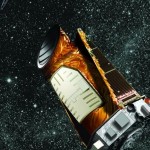
Artist’s rendition of the Kepler Spacecraft in orbit around the Sun peering at a distant solar system, press release image from the NASA Kepler websiteKeck and Kepler have been a potent team in finding and confirming hundreds of exoplanets. Kepler detects alien world through the transit technique, the very slight dimming of a star as a planet passes in front. Data from an instrument such as Keck’s HIRES spectrograph is required to confirm the find through the use of radial velocity data. Using the technique Kepler has discovered 130 extrasolar planets that are now confirmed. An amazing 2,700 possible planets are awaiting confirmation. Besides the discovery of exoplanets the Kepler data set has been a bonanza to astronomers looking for other phenomena. Magnitude data on more than 100,000 stars with unprecedented precision has allowed the discovery and study of a widerange of stellarphenomena.
Engineers will continue to see if the reaction wheel can be nursed back to some level of function in an effort to salvage the mission. The prognosis is not good, it is likely the Kepler mission has ended. In any case it will take astronomers years to learn what the massive haul of Kepler data can teach us and to work through the backlog of candidate planets. In a few years the spectacular success of Kepler will be followed up by TESS, the Transiting Exoplanet Survey Satellite, due for launch in 2017.
Planets, Stars, and How to Live on a Space Station
May 23rd Astronomy Program
Kailua Kona Library
3:30 PM to 4:30 PM
Allan Honey, a program engineer at Keck Observatory, will talk about the different distances in space between stars and planets. Allan’s son, Ben Honey, a flight controller for the International Space Station at the Johnson Space Center in Houston, will explain what happens when astronauts live and work in space. Allan Honey has worked at the Keck Observatory for more than 26 years, and Ben Honey grew up on the Big Island before leaving to study at Embry-Riddle Aeronautical University
Our May meeting will take place tonight, Tuesday, May 14th, 7:00pm at Keck Observatory HQ in Waimea. This month we have local photographer Ethan Tweedie in to talk.
The Antennae Galaxies, NGC4038 & 4039 as imaged by MOSFIRE, image credit Keck ObservatoryJoin the W. M. Keck Observatory for an evening of astronomy presented at the Kahilu Theater.
MOSFIRE is the newest and the most advanced astronomical instrument available today. Dr. Ian McLean from UCLA will describe some of the technical challenges developing and commissioning this multi-year, multi-million dollar instrument. He will also share early science results ranging from the discovery of ultra-cool, nearby substellar mass objects, to the detection of oxygen in young galaxies only 2 billion years after the Big Bang.
Wednesday, May 22, 2013
Show starts at 7 p.m.
Free and Open to the Public
The sunset is getting crowded. This evening will see a trio of the sky’s brightest objects low in the shades of sunset. Venus is still quite low, ony 10.3° from the Sun, shining brightly at -4 magnitude and rising higher each day. Well above Venus can be seen Jupiter, somewhat dimmer at -2 magnitude and 23° from the Sun.
In between the two a pretty crescent Moon is positioned, 4.4% illuminated and about 5° below Jupiter. Tomorrow night will see the Moon above and south of Jupiter with about 7° separation.
This is just the start of a sunset dance that will play out over the coming month. Stay tuned for Mercury to join Venus and Jupiter.