The Last Interferometer Run

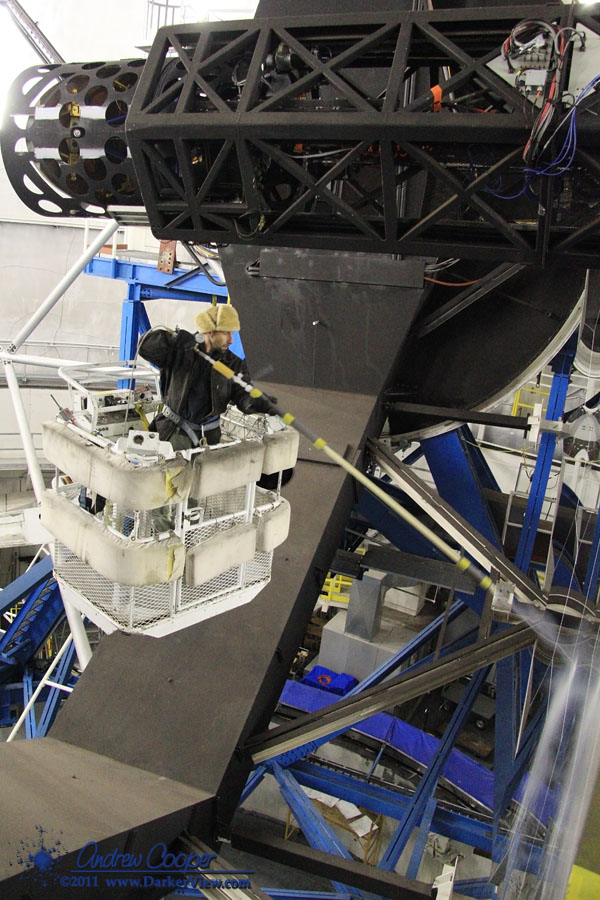
Tomorrow morning I will begin to power down the systems. One by one I will open the switches on gear that has rarely been powered off in years. In a matter of minutes it will be off. Dozens of computers, servo drives, camera controllers, racks of gear, silent and dark. I will also shut off the liquid nitrogen to each camera in turn. This will take a bit longer, a couple weeks will be needed to properly warm and back-fill each camera with dry nitrogen for storage. Meanwhile, Brett will carefully cover each optical surface in optical cloth and plastic. A few bits of gear installed in the telescope will be removed to be stored in the basement. By the end of August the Keck Interferometer will be mothballed.

This is the last run, three nights of observations. Two of those are behind us, the third beginning, the end is rapidly approaching.

FATCAT Dichroics
The FATCAT dichroic beamsplitters in the Keck interferometer beam lab
I look about at all of the gear and consider the thousands upon thousands of hours it took to assemble, test and troubleshoot this complex scientific instrument. Years of work by so many people. I look about the control room at the racks of equipment, the masses of cabling, the physical results of so much effort. The non-physical likewise represents a staggering amount of work, the software that allows the entire system to operate. My own contribution seems insignificant. Here and there I note pieces of gear I installed, cables run, cards I have modified, and some many parts of the system that I have had to repair across the years. The sense of loss at shutting this system down is overwhelming.

The plan is to carefully mothball the interferometer in place, in such a way as it could be reactivated with a few weeks of work. Maybe, some source of funding might allow the instrument to be used again, that is the hope. But we know how difficult the current budget environment has become.

Fast Delay Lines
The Keck Interferometer beam expanders and fast delay lines
Still, we are going out in style. This last run has attempted what has never been tried before… We are using AO lasers on both telescopes to reach targets never reachable before. The newly commissioned Keck 1 laser capability making this possible. We have successfully gathered data using the dual laser AO mode, a real first.

Oddly, one of our laser spotters did not make it to the summit and I was obliged to fill in. Fortunately it was a lovely night on the summit, not very cold and with no wind to make it miserable. For a couple hours I relaxed in the Laser Suzan chair, watching the sky. Above me arched the Milky Way, somewhat dimmed by a bright Moon, but still beautiful. A few bright meteors punctuated the night. The scene was a made a bit surreal by three lasers, all targeting the galactic core, the very center of our galaxy. Beside me the camera regularly issued the soft sound of the shutter, taking images of the night.

The second night was a series of galactic targets and a couple AGN’s. The final analysis will take time, but initial indications are that we have good data on at least some of the targets. A couple targets proved too faint for the system to track on. No surprise, we planned to reach a little with this last run.

Thus we begin this last night, the practiced evening routine is complete, final checks done. The last targets a list of selected YSO’s (young stellar objects) to be observed in L-Band. We settle in for the night, hopefully a quiet night. As usual, if I am busy, things are not good. All is going well, a fitting end to the instrument and a testament to all those who have put so much into the system. Something to remember.

The Moon, Mars, Saturn and Spica

A nice conjunction of a crescent Moon, Mars, Saturn and the bright star Spica will grace the evening sky tonight. All four will be within 12° of each other. The two planets and the star will all be about 1st magnitude, with the Moon showing about 37% illuminated.

The same quartet will get together again next month, for an even tighter grouping.

An Astronomy Discovery in the News

So a little telescope called Hubble takes a picture of a galaxy, a really distant galaxy over 10 billion lightyears away. Odd, it looks like this galaxy has gotten it’s act together and become a spiral galaxy, a lot earlier than we thought proper spiral galaxies would form. What do you do? Get some time on a bigger telescope and get some more data… Using Keck the OSIRIS spectrograph astronomers show that this is indeed a proper spiral galaxy, 10.7 billion light years away, which means 10.7 billion years in the past. The universe has just served up another surprise for astronomers, this is the sort of stuff we love.

BX442
HST/Keck false colour composite image of galaxy BX442. Credit: David Law; Dunlap Insitute for Astronomy & Astrophysics
Better yet, Keck gets a bit of good press for the discovery.

First spiral galaxy in early Universe stuns astronomers – BBC News

Earliest spiral galaxy found – CBC News

Astronomers find rare spiral galaxy in early Universe – The Sydney Morning Herald

Along with the sensible headlines there are those that play up the “This can’t be” angle of the discovery. For the most part the articles are fairly good, it is just the headlines that seem a little off, something to blame on the editors who write the headlines…

Hubble spots spiral galaxy that shouldn’t exist – Los Angeles Times

Astronomers Spot Ancient Spiral Galaxy From an Era When Spirals Should Not Exist – Popular Scince

Hubble spots rule-breaking spiral galaxy – 3 News

Headlines are always an issue in science reporting. Written by editors with a tendency to the excessive and sensational. Editors who often have little understanding of the science. We have seen what that can lead to, something that has been pleasantly rare with this latest discovery.

First Ancient Spiral Galaxy Discovered From 10.7 Billion Years Ago – Latinos Post

Is this the “first” spiral? We have no way of knowing. I have found no such quote from the astronomers involved with the discovery. The reason we study the early universe is that we do not know. This discovery shows that there could be others, perhaps even older.

There are other headlines, predictable headlines from the usual suspects. Every time science turns up some surprise, something that does not fit a simplistic view of the universe, those with an ideological agenda attempt to use the discovery to push their views… “Look at this! It disproves everything!!”, ” The scientists have it all wrong!!” Quite predictable…

Mystery galaxy could unravel Big Bang theory of creation – Catholic Online

And of course, scientists will need to look for other exceptions to the rule. If an inexplicable and significant number of premature spirals are found, then the Big Bang theory will need to be rewritten, or disposed of altogether, no matter how beloved it is today. After all, it is just a theory.

Yes, again you see the “It is Just a Theory” gambit, the creationists favorite canard. All a discovery like this proves is that the universe is a complex and fascinating place and that we still have much to learn.

“BX442 represents a link between early galaxies that are much more turbulent than the rotating spiral galaxies that we see around us. Indeed, this galaxy may highlight the importance of merger interactions at any cosmic epoch in creating grand design spiral structure.” – Alice Shapely of UCLA, co-discoverer of BX442

Earliest Spiral Galaxy Surprises Astronomers

W. M. Keck press release

In the beginning, galaxies were hot and clumpy – too hot to settle down and form grand spirals like the Milky Way and other galaxies seen in the nearby universe today. But astronomers have now been surprised by the discovery of a solitary grand design spiral galaxy in the early universe which could hold clues to how spirals start to take shape. The find was announced in a report in the July 19 edition of the journal Nature.

The ancient spiral, called BX442, was found by astronomers who first surveyed 300 distant galaxies using the Hubble Space Telescope, then followed up and confirmed using detailed observations and analyses from the W. M. Keck Observatory in Hawaii.

BX442 HST/Keck false colour composite image of galaxy BX442. Credit: David Law; Dunlap Insitute for Astronomy & Astrophysics

“As you go back in time to the early universe — about three billion years after the Big Bang; the light from this galaxy has been travelling to us for about 10.7 billion years —galaxies look really strange, clumpy and irregular, not symmetric” said astronomer Alice Shapley of UCLA. “The vast majority of old galaxies look like train wrecks. Our first thought was, why is this one so different, and so beautiful?”

Not only was the spiral shape clearly visible, but by using Keck’s OSIRIS instrument (OH-Suppressing Infrared Imaging Spectrograph), astronomers were able to study different parts of BX442 and determine that it is, in fact, rotating and not just two unrelated disk galaxies along the same line of sight that give the appearance of being a single spiral galaxy.

“We first thought this could just be an illusion and that perhaps we were being led astray by the picture,” said Shapley, a coauthor on the Nature paper. “What we found when we took spectra of this galaxy is that the spiral arms do belong to this galaxy; it wasn’t an illusion. Not only does it look like a rotating spiral disk galaxy; it really is. We were blown away.”

Continue reading “Earliest Spiral Galaxy Surprises Astronomers”

Employment at Keck – Senior Electronics Engineer

W. M. Keck position announcement

The W. M. Keck Observatory seeks a Senior Electronics Engineer to provide electronics engineering and project management support to develop new observatory capabilities and upgrades to our existing observatory infrastructure. Desired competencies include: sound electronics engineering and design skills, and demonstrated ability to plan and manage electronics and electro-mechanical systems projects. Ideal candidate should have excellent electronics engineering, design and project management skills, and should be a motivated self-starter who can manage multiple projects and priorities within a fast paced environment.

AO Bench Work
Working on the Keck 1 AO bench
The observatory operates two of the largest and most scientifically productive optical/infrared telescopes in the world. The twin 10-meter telescopes are located amidst several other world class observatories on the summit of Mauna Kea, at 13,796 feet above sea level on the Big Island of Hawaii, one of the premier sites for astronomy. The successful candidate will have the opportunity to join a skilled and deeply committed team of technical professionals who enable exciting and important astronomical discoveries.

Qualifications for this position include a Bachelor of Science in Electrical Engineering or equivalent and eight years of work experience performing design and documentation, analysis, fabrication, test, and troubleshooting of electronic and electromechanical systems.

Additional information about WMKO and this position may be found on our website at www.keckobservatory.org under Employment. This position requires you to submit your resume on-line at http://keckobservatory.iapplicants.com.

A Very Thin Moon and Mercury

This one will be a challenge. This evening a very thin Moon may be visible just below Mercury as the Sun sets. The Moon will be a mere 1.3% illuminated and only 7° above the horizon at sunset. Mercury may provide a bit of a signpost that can be used to find the Moon. It will be located 2.5° directly above the Moon, shining at 2.8 magnitude. As Mercury is heading for inferior conjunction, it too is a thin crescent. The pair will be 10° south from the point at which the Sun slips below the horizon.