
Category: Astronomy
Exploring the cosmos
Employment at Keck – Scientific Programmer
W. M. Keck Observatory Position Announcement…
The W. M. Keck Observatory (WMKO) has an immediate opening for a software engineer to support scientific programming needs for the Keck Observatory Archive (KOA). The successful candidate will work with the Keck Archive Scientist and other members of the KOA team and software group on all aspects of KOA software development: defining requirements, developing algorithms, writing applications, testing and implementing software, preparing documentation, and supporting software and users. Special attention will be paid to applicants with strong skills and experience in astronomical data reduction, especially spectroscopy.

Minimum qualifications for this position include a Bachelor’s degree in computer or physical sciences, or engineering, and at least 5 years of programming experience. Required are a good knowledge of database design, a high level of competency in SQL, PHP, C and C++ or JAVA programming; good knowledge of IDL, IRAF, Matlab or Python; experience in a Unix environment, experience developing web enabled database applications, good communication skills, good applied mathematical/statistical skills and the ability to work as part of a team. Desirable skills include an advanced degree, knowledge of astronomical data archive, familiarity with FITS data format, astronomical CCD image data, and astronomical data manipulation software.
This position requires you to submit your resume on-line at: http://keckobservatory.iapplicants.com/ViewJob-324999.html with your cover letter that states why you are uniquely qualified for the position.
Additional information about WMKO and this position may be found on our web site at www.keckobservatory.org
Postcard from the Summit – Mirror in the Hall
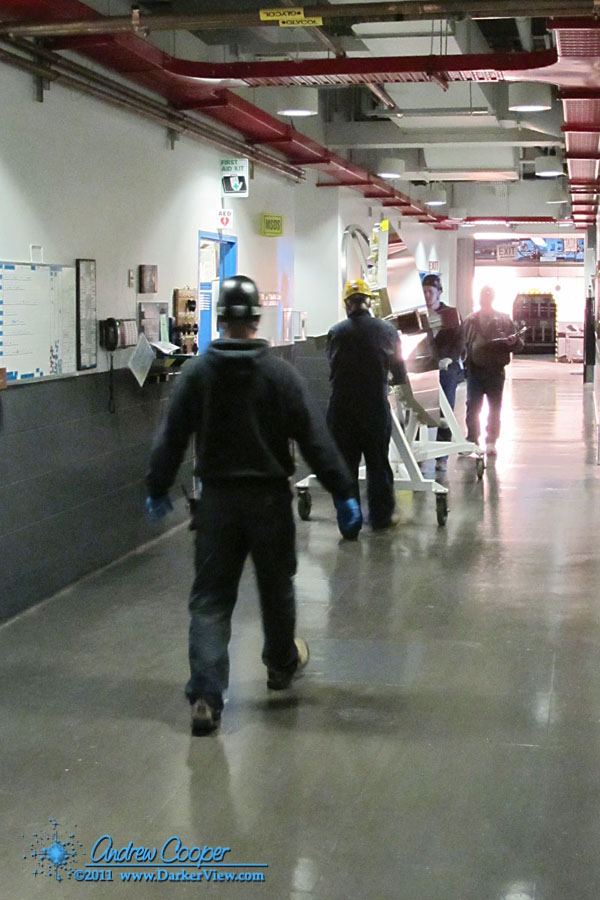
The radio call goes out… “Mirror in the hall, mirror in the hall!” Everyone gets out of the way as a mirror segment is rolled down the central hallway. It is being moved to the coating facility where it will be cleaned, stripped and re-coated with a layer of fresh aluminum.
Postcard from the Summit – Sunrise

Mercury at Maximum Elongation
Today Mercury reaches maximum elongation, the furthest point it will reach from the Sun in the sky and the highest it will be above the sunset this apparition. The planet is easily visible as a bright, starlike object about 15° above the setting Sun as the sky grows dark. Over the next couple weeks Mercury will slide back into the sunset, heading for inferior conjunction on Jul 28.
Postcard from the Summit – First Target of the Night

The Moon and Saturn
Saturn, the Moon and Spica will form a trio high in the sky at sunset tonight. The three will be within 7° of each other. The gibbous Moon will be 62% illuminated. Saturn will be shining at 0.4 magnitude while Spica is very close to 1.0 magnitude. Look for the planet Mars 25° west of Saturn at about the same brightness.
Postcard from the Universe – M46

Postcard from the Universe – Butterfly Cluster
Known as M6, NGC6405, or The Butterfly Cluster, this pretty open cluster lies just above the tail of Scorpius. Visible to the unaided eye under a dark sky, it is an easy photographic target.
I have been working on improving the color balance in my astrophotos. Color is an interesting and complex subject in photography, worse in astrophotography. I think the results are much better here that in my previous work. Hope to take a few more photos this week and will continue to experiment.

The Moon and Mercury
A very thin Moon will rendezvous with Mercury this evening. The pair will separated by about 8° and at the same elevation, over 20° at sunset. The Moon will be a very thin crescent, only 7% illuminated. A little over 5° north of Mercury will be Pollux, with Castor a bit further north, both stars about a magnitude dimmer than the planet which is currently about zero magnitude.