The Moon and Saturn

Saturn, the Moon and Spica will rise together in the east after sunset this evening. The three will be within 10° of each other. The Moon will be just short of full, over 94% illuminated as it rises. Saturn will be shining at 0.4 magnitude while Spica is very close to 1.0 magnitude.

Tomorrow night will see the Moon east of Saturn, but still close, just over 10°.

Student Engineering

It is always gratifying to see. Tangles of wire, zip ties, plastic and metal bent and warped into odd shapes, contraptions that occasionally come apart. They may not be pretty, buy they usually work. This is engineering!

Piloting an ROV
Students from Hawai'i Preparatory Academy pilot an ROV in the Big Island Regional MATE ROV Competition
The goal? To build and pilot and underwater ROV through a simulated mission. Not an easy task, actually downright difficult. That the engineers and pilots are elementary, middle and high school students makes the results that much more impressive.

This is the fourth year I have helped to judge the 2012 Big Island Regional MATE ROV Challenge. Back again, it is just too much fun to see what the students come up with. Last year I helped judge the technical presentations and posters. While that is OK, the action is in the pool. This year it was poolside judging, getting a first hand view of the event. I was not alone, Keck provided many of the judges for the 2012 event. An investment in the next generation of engineers and techs that will follow our path.

ROV
A student built ROV attempting a mission in the Hilo regional 2012 MATE ROV Competition
Most of the ROV’s followed the usual pattern we have seen each year. A box frame built of PVC pipe with bilge pump motors attached to provide maneuvering capability. Cameras provide the vehicles eyes. Indeed, the operators must control the craft with only the visuals on the display screen, no looking around into the pool.

The mission this year was to survey a shipwreck, a victim of war, an oil tanker lying on the bottom with the potential to create an environmental disaster. The students must survey the wreck, then attempt to remove a sample of the “oil” trapped within. No matter that the “oil tanker” is a frame of PVC pipes at the bottom of a swimming pool, this was a challenging mission.

There were a number of rookie teams this year. It showed, a rough day in the pool for several of the teams. Experience showed, those teams with a couple years of competitions behind them performed much better. It was Kealakehe that won the Ranger class title… again. Give the new guys another chance next year, and I think the competition will be much closer.

‘Ridiculously’ Dim Bevy of Stars Found Beyond Milky Way

W. M. Keck Observatory press release…

A team of American, Canadian and Chilean astronomers have stumbled onto a remarkably faint cluster of stars orbiting the Milky Way that puts out as much light as only 120 modest Sun-like stars. The tiny cluster, called Muñoz 1, was discovered near a dwarf galaxy in a survey of satellites around the Milky Way using the Canada-France-Hawaii Telescope (CFHT) and confirmed using the Keck II telescope, both of which are on Mauna Kea, Hawaii.

“What’s neat about this is it’s the dimmest globular cluster ever found,” said Ricardo Muñoz, an astronomer at the University of Chile and the discoverer of the cluster. A globular cluster is a spherical group of stars bound to each other by gravity so that they orbit around a galaxy as a unit.

“While I was working on the Ursa Minor dwarf galaxy I noticed there was this tiny little object close by,” Muñoz recalled. He made the discovery while he was a postdoctoral associate at Yale University. Most globular clusters have in the range of 100,000 stars. Muñoz 1 has something like 500 stars. “This is very surprising,” he said.
Muñoz 1
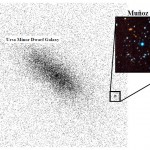
The Muñoz 1 globular cluster is seen to the right of the Ursa Minor dwarf galaxy in this image from the Canada-France-Hawaii Telescope MegaCam imager.

“It’s ridiculously dim,” agreed Yale astronomer Marla Geha. “There are individual stars that would far outshine this entire globular cluster.” That puts Muñoz 1 head-to-head with the Segue 3 globular cluster (also orbiting the Milky Way) as the dimmest troupe of old stars ever found.

Muñoz 1’s discovery was the result of a survey done with the CFHT MegaCam imager in 2009 and 2010. It was then confirmed by spectroscopic study using the Deep Extragalactic Imaging Multi-Object Spectrograph (DEIMOS) on the Keck II telescope. The researchers will be publishing their results soon in The Astrophysical Journal Letters.

The Keck data was critical for the study, said Geha, because it sorted out whether or not Muñoz 1 and the Ursa Minor dwarf galaxy were moving together.

“Nearly every galaxy has an entourage of globular clusters,” said Geha, “so we first thought that Muñoz 1 might be associated with the nearby Ursa Minor dwarf galaxy.” By using spectroscopic data to measure the relative velocities of the cluster and the dwarf galaxy, they discovered quite the opposite was the case.

“The velocities turned out to be wildly different,” said Geha. So the fact that they are near each other is just a coincidence, she said. What has been seen is more like a single snapshot of two cars traveling near each other and apparently together, but they really have different destinations and are traveling at very different speeds. Analysis of the brightness and colors of the stars belonging to Muñoz 1 and Ursa Minor also suggests that the tiny cluster is actually located about 100,000 light years in front of the dwarf galaxy.

As for how Muñoz 1 came to be so dim, a likely scenario is that it has gradually lost stars over the eons, said Geha. It’s also possible it was stripped of stars by passing through the Milky Way. But the direction of the cluster’s movement is not yet known, so it’s not known whether it has passed through the Milky Way.

Perhaps the most intriguing aspect of the discovery is the possibility that Muñoz 1 may be hinting that there are many more such globular clusters in the Galactic halo. After all, the CFHT survey covered only 40 square degrees of sky out of 40,000 square degrees in the entire sky.

“Assuming that we’re not just lucky to have found something very rare, there could be many others out there,” said Geha.

“To truly understand its nature, we will need to measure its mass,” added Munoz. To do that, astronomers would need to measure the velocities of individual stars in the cluster and see how they move with relation to each other. That, in turn, reveals the overall mass of the cluster. A lot of mass would suggest there is a lot of dark matter holding the cluster together, and maybe even qualify the cluster as the smallest, darkest galaxy ever discovered. Right now the Segue 1 dwarf galaxy holds that record. Geha was also involved in measurements with the Keck DEIMOS instrument that confirmed the nature of Segue 1.

“The goal of this survey was to understand the difference between dwarf galaxies and globular clusters,” said Geha. Muñoz 1 suggests there may be plenty of borderline objects out there waiting to be found, which could help sort that matter out.

A pdf of the paper is available at http://www.cfht.hawaii.edu/en/news/Munoz1/munoz12.pdf.

The Moon and Jupiter

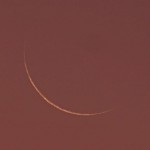
This evening will see a razor thin Moon just above the planet Jupiter, low in the sunset. The planet will be about 5° below a 3% illuminated Moon. The Moon itself will be only 19° from the Sun at sunset, about 18:42HST. It should be a dramatic scene with the pair immersed in the colors of sunset.

Celebrating Dark Skies

Earth at Night
A view of the Earth compiled from nighttime shots from the DMSP satellites, image credit NASA/Goddard Space Flight Center
Here on the Big Island we are fortunate to have very dark skies. Skies from which the stars shine brightly. This is not the case for so many, people who live where city lights have drowned out the glory of the universe in a haze of artificial light.

So often I talk to visitors who come from places where they might see a mere handful of stars. To live in or worse, to grow up in a major metropolitan area, is to lose the beauty that is our night sky. To lose the view of our universe is to reduce that vast universe to just our everyday world. You lose the imagination and sense of wonder that can change everything.

Maybe I am weird, I make a point to get out and spend nights under a dark sky. With a telescope I pass the night looking into the vastness of space. With that experience comes a broader understanding of the scale of our universe and our place within it. To see the galaxies, to know what they are, to gain a glimmer of understanding, it changes your view of who and what we are.

To me this is precious.

Light pollution may be an issue few understand. It has many consequences… Vast amounts of wasted energy and money, impacts on our health and the health of our natural environment. There are many reasons to minimize the impact of artificial lighting. Of these reasons, it is the loss of the starry night sky that can sever our connection to the universe.

This week is International Dark Skies Week. Take a moment to look up at the night sky and understand what you may have have lost.

The Magnificent Night Sky: How to Protect It from Keck Observatory on Vimeo.

Mercury and Uranus

Mercury and Uranus will meet up in the dawn over the next few days. The pair is separated by about 3° this morning. Tomorrow morning the separation will have diminished to about 2°19′. Close approach will be on the morning of April 22nd at almost exactly 2&deg. On the 23rd the separation will have increased to 2°14′. Both planets will be well up, about 17° elevation at sunrise.

While Mercury is easy to pick out with the unaided eye. Uranus will require at least a pair of binoculars to see at 5.9 magnitude. The close approach will aid in finding the outer planet. Check your charts, there are a couple 6th magnitude stars just as close to Mercury to confuse for the dimmer planet.