A First Attempt

Just getting back into astrophotography after quite a few years of observing visually. A new camera, updated software, it seems like I am learning all over again.

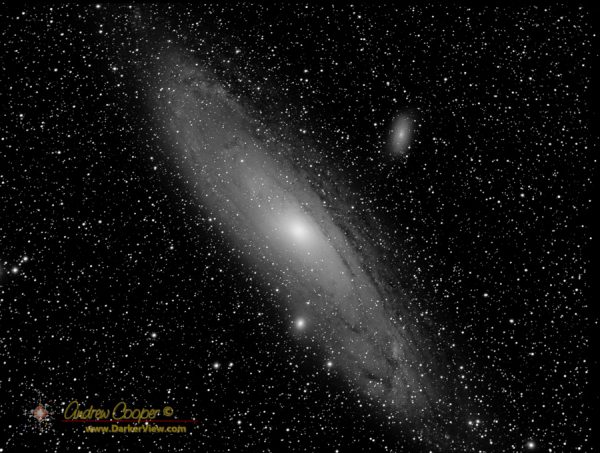
For a first run I processed a monochrome image of M31, the Andromeda Galaxy. A quick run of fourteen luminance frames, 8 at 5 minutes, 6 at 60 seconds combined into a single frame.

M31 or the Andromeda Galaxy, with M110 visible above and M32 visible below the core

I have color data for this image, but that will be a lot more processing. Given all of the various filters and calibration frames I really need to get the automated batch processing running before I do much color work.

Neptune at Opposition

Today the planet Neptune will pass through opposition, directly opposite the Sun in our sky. The planet will be well placed for observation all night long, rising at sunset, transiting at midnight, and setting at sunrise. If you are looking to observe Neptune, it is currently shining at magnitude 7.8 in the center of the constellation Aquarius.

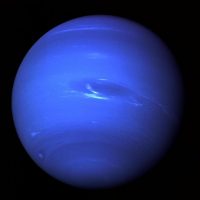
Neptune from Voyager 2
Neptune from Voyager 2, Credit: NASA /JPL

As the outer planets Uranus and Neptune move so slowly across the sky, the timing of oppositions is driven by the Earth’s orbit and occur each year at nearly the same time. Neptune’s orbital period is 164.8 years, taking over a century and a half to circle the celestial globe once. As Neptune was discovered in 1846, it has completed a little over one orbit since discovery.

Venus Appears in the Sunset

Crescent Venus
Venus approaching inferior conjunction, 24Dec2013

Over the next weeks Venus will appear above the sunset. Look for a brilliant, star-like object low in the glow of sunset, right above the setting Sun.

Over the following months the planet will rise high above the sunset, reaching maximum elongation on March 24th, 2020.

When Venus does reappear we can expect a few UFO reports by people unfamiliar with the normal workings of our skies. In late 2018, when it last emerged in the dawn we had a few such reports here on the island, including a very nice video and folks who could not accept the fact that the “strange light” was simply a bright planet.

Rising with Venus on this particular apparition is Mercury, the pair getting higher each evening until Mercury reaches maximum elongation on October 19th.

Mercury at Superior Conjunction

Today Mercury is passing through superior conjunction, passing around the far side of the Sun as seen from our earthbound vantage point. This fast moving planet will reappear in the sunset in about a week, rising towards maximum elongation on October 20th.

This will be a good apparition of mercury reaching over 24° from the Sun.

Mercury Events for 2019
ApparitionDate ElongationMagnitude
Evening Feb 2718.1°E -0.2
Morning Apr 1127.7°W +0.6
Evening Jun 2325.2°E +0.7
Morning Aug 919.0°W +0.3
Evening Oct 2024.6°E +0.1
Morning Nov 2820.1°W -0.3
Data from the Mercury Chaser’s Calculator by John Walker

Mars at Superior Conjunction

Mars during the 2005 opposition

Today mars is passing through superior conjunction, passing behind the Sun as seen from our earthbound point of view.

Mars will reappear in the dawn around the end of September, a star like object low on the horizon, just above the glow of sunrise.

Mars will spend the remainder of 2019 and much of 2020 in the dawn sky, reaching opposition on Oct 13th, 2020.

Getting a Mirror Re-Coated

The classic Cave Astrola telescope has become my roll-out, quick observing session ‘scope, often found in my driveway. I have also used it a few times at darker sites when I expect the weather to be damp or dewy as a Newtonian is more protected.

The restored 8" f/6 Cave Astrola under a dark sky at Kaʻohe
The restored 8″ f/6 Cave Astrola under a dark sky at Kaʻohe

While the restoration job was finished some time ago, I never got around to re-coating the optics. Meanwhile the telescope has seen good service on many occasions as I enjoyed this fun-to-use instrument.

The optics did need some attention… The primary mirror from the Astrola appeared to have not been re-coated since it was made in 1978. Thus the aluminum coating was over 40 years old. While the coating looked bad, it was still serviceable, producing reasonable images.

Still, the loss of light due to the old aluminum coating was probably reducing the effectiveness of this 8″ telescope to something more like a 6″ telescope. I had meant to get it re-coated some time ago, but we know how these things work.

Continue reading “Getting a Mirror Re-Coated”