
Over the next few night Venus will pass very close to Uranus. The pair will be close for about five days, around 2° or less from the 7th to the 11th. It is on the 9th that the closest approach will occur with the pair separated by a mere 19 arc-minutes, about 1/5th of a degree and well within the same medium power telescopic field. This a is chance to find the ice-giant with relatively little effort, there will be no nearby bright stars to confuse with the 5.9 magnitude Uranus. At high magnification both planets will be seen as disks, Venus 16 arc-seconds across, and Uranus a bit over 3 arc-seconds across. Venus is now far enough between the Earth and the Sun to become somewhat gibbous, being about 70% illuminated.
Category: Astronomy
Exploring the cosmos
Mercury at Superior Conjunction
Today Mercury passes through superior conjunction, passing behind the Sun as seen from the Earth. It will appear in the sunset later in the month, reaching maximum elongation on March 4th.
Mars Opposition 2012
About a month from today, on March 3rd, the planet Mars will pass through opposition.
Mars orbits the Sun every 1.88 years, with Earth only taking one year for each orbit. Like two runners on a track the two planets race each other around the Sun. But we have the inside lane, lapping the red planet every two years. These events are called opposition, when Mars is closest to us and best positioned for viewing by earthbound telescopes.
Closest approach of the two planets is not necessarily on the same day as opposition, but can vary up to two weeks. This year closest approach will occur March 5th with the two planets approaching to 99,331,411 km (61,721,554 miles) at 07:01HST.1 At this distance the red planet will show a disk 13.89″ arc-seconds across in the eyepiece.2
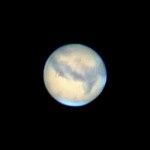 Mars during the 2005 opposition
Do not worry about viewing on the 3rd or 5th, any time in the month leading up to and after opposition the viewing will be very good. With even a modest telescope it should be possible to see the bright polar caps and light and dark markings on the planet.
All month Mars will be visible throughout the night, high in the sky at midnight. This is the time to enjoy observing our closest neighboring planet while it is nearby and high in the night sky.
1) 2012 Mars Opposition at SEDS
2) The 2012 Aphelic Apparition of Mars
Super-Earth Detected in Habitable Zone of Nearby Star
W. M. Keck Observatory press release…
An international team of scientists has discovered a potentially habitable super-Earth orbiting a nearby star. With an orbital period of about 28 days and a minimum mass 4.5 times that of the Earth, the planet orbits within the star’s “habitable zone,” where temperatures are neither too hot nor too cold for liquid water to exist on the planet’s surface. The researchers found evidence of at least one and possibly two or three additional planets orbiting the star, which is about 22 light years from Earth.
The researchers used public data from the European Southern Observatory and analyzed it with a novel data-analysis method. They also incorporated new measurements from the W. M. Keck Observatory’s High Resolution Echelle Spectrograph (HiRES) and the new Carnegie Planet Finder Spectrograph at the Magellan II Telescope. Their planet-finding technique involved measuring the small wobbles in a star’s motion caused by the gravitational tug of a planet.
The team includes UC Santa Cruz astronomers Steven Vogt and Eugenio Rivera and was led by Guillem Anglada-Escudé and Paul Butler of the Carnegie Institution for Science. Their work will be published by Astrophysical Journal Letters, and the manuscript will be posted online at arxiv.org/archive/astro-ph.
The host star is a member of a triple-star system and has a different makeup than our sun, with a much lower abundance of elements heavier than helium, such as iron, carbon, and silicon. This discovery indicates that potentially habitable planets can occur in a greater variety of environments than previously believed.
Continue reading “Super-Earth Detected in Habitable Zone of Nearby Star”
Neptune Slides Into the Sunset
The first week of February will see Neptune slide into the sunset. The planet will pass through superior conjunction on February 19th to re-appear in the dawn during first weeks of March.
The Morning Commute
When heading to Waimea this time of year, I am driving right at sunrise. Sometimes you just have to stop and take the photo, or in this case a full set of photos for a panorama, even if I risk being late for the truck to the summit… (Click image to view properly)

Keck Lecture at Kahilu February 9th
Tom Soifer
Seeing the Invisible Universe
Kahilu Theater
Thursday, February 9
7:00pm
Astronomy is enjoying a golden age and the W M Keck Observatory is a world leader in cosmic exploration. With generous support from Rob and Terry Ryan, Keck Observatory invites you to take a journey beyond this world to the frontiers of discovery. Your guides are Keck’s astronomers. They will bring you a rich and varied Universe and an evening filled with beauty, drama, mystery and surprise.
Tom Soifer is professor of physics at the California Institute of Technology and the Director of the Spitzer Science Center. He is also the Chair of the Division of Physics, Mathematics and Astronomy at Caltech and a member of the Board of Directors of the W. M. Keck Observatory. The Spitzer Space Telescope is NASA’s latest Great Observatory, designed to explore the infrared portion of the electromagnetic spectrum. Spitzer was launched in August of 2003. In his talk, Soifer will describe some of the most exciting results from the Spitzer mission, among its many discoveries have been measuring the thermal emission and spectra from hot Jupiters orbiting other stars, finding “Fullerene (buckyball)” molecules in space, observing prebiotic molecules in galaxies seen less than 3 billion years after the big bang, and measuring the masses of the most distant and youngest galaxies known.
There is no charge for admission to any events in the Makana series.
Presented by W.M. Keck Observatory.
The Moon and Pleiades
Tonight a bright gibbous Moon will be just under 5° from the Pleiades star cluster. The Moon will be 62% illuminated, bright, but the cluster is bright enough to be seen even against a bright Moon. As the Pleiades move to the west over coming months there will be a few more lunar conjunctions, with increasingly smaller crescents.
Astronomy Basics, So Far…
I have completed the first set of the Astronomy Basics posts I intended to do. I really wanted to get these posted as support material for the astro-events posts.
- Degrees, Arc-Minutes and Arc-Seconds
- Magnitude
- Elongations, Conjunctions and Oppositions
- Meteor Watching
- Lunar Apogee and Perigee
As I finished these I realize I should probably continue and hit a few more subjects. Look forward to a few more Astronomy Basics posts in the coming months.
Degrees, Arc-Minutes and Arc-Seconds
How do we measure things in the sky?
Throughout the descriptions of astro-happenings here on Darker View, I use the terms degrees, arc-minutes, and arc-seconds. This is how astronomers measure size and separation of objects in the sky.
The degrees used by astronomers are the same as those you learned in high school geometry, the same as marked on that old school protractor forgotten in the back of the desk drawer. 360 degrees mark a circle, 360 degrees reach once around the sky.
Degrees measure rotation, and just about everything in astronomy rotates… As the Earth rotates on is axis, the sky goes wheeling overhead. When we move a telescope from one point in the sky to another we rotate the telescope about its axis. How far does it rotate? That is measured in degrees.