Venus at Superior Conjunction

Crescent Venus
Venus approaching inferior conjunction, 24Dec2013

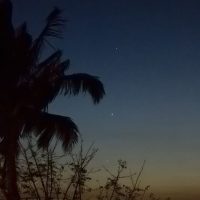
Today Venus is passing through superior conjunction, passing behind the Sun as seen from our earthbound point of view.

Venus will reappear in the sunset in mid-September, a brilliant star like object low on the horizon, just above the glow of sunset.

When Venus does reappear we can expect a few UFO reports by people unfamiliar with the normal workings of our skies. In late 2018, when it last emerged in the dawn we had a few such reports here on the island, including a very nice video and folks who could not accept the fact that the “strange light” was simply a bright planet.

Venus will spend the remainder of 2019 in the evening sky, reaching maximum elongation on March 24th, 2020.

Mercury at Maximum Elongation

Mercury, Venus and Jupiter
An evening conjunction of Mercury, Venus and Jupiter on 30 May, 2013

Today Mercury is passing through maximum elongation, the furthest it will rise above the rising Sun in the dawn sky. After today the planet will slide back into the Sun’s glare headed for superior conjunction on September 3rd.

This is a modest apparition, with the planet only 19° from the Sun.

Continue reading “Mercury at Maximum Elongation”

Perseid Meteor Shower

Over the next week the Perseid meteor shower will peak. As the most reliable shower each year this is also the most viewed meteor shower. Plentiful shooting stars combined with warm summer evenings makes this shower the easiest and most comfortable to view across much of the northern hemisphere. Quite a difference from the other reliable showers such as the Leonids and Quadrantids, that occur in November and January. Consider a warm summer night under a dark sky full of stars, a picnic blanket, relaxing while shooting stars streak across the sky. What could be better?

Leonids in Orion
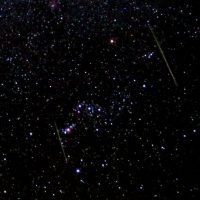
A pair of Leonid meteors streak through Orion

The Perseid meteor shower occurs when the Earth passes through a stream of debris along the orbit of Comet Swift-Tuttle. This shower has been consistent throughout recorded history, mentioned in Chinese, Japanese and Korean records as early as the 1st century. Active from July 17th to August 24th, the shower will build slowly for weeks before the peak. A week before or after peak the shower can still be seen with around 20 meteors each hour. The shower is a northern hemisphere event, for southern observers the radiant never rises above the horizon.

Continue reading “Perseid Meteor Shower”

A Night Between Hurricanes at Kaʻohe

Our monthly dark skies star party had been originally planned for the night of July 27th, a few days before full Moon. With the governor’s emergency order all access to the mauna was closed, and the gals at the DLNR office let me know I could not get a permit. With that I put out a message I hate to post… Star party cancelled.

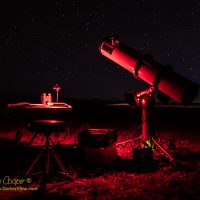
The NexStar 11 setup under the Milky Way at Kaʻohe
The NexStar 11 setup under the Milky Way at Kaʻohe, photo processed with Prisma

One week later and things look better, the emergency order has been rescinded and we again have access to the mauna, no problem getting our permit.

The problem this time looked to be weather, no big problem… Just a couple of hurricanes.

Continue reading “A Night Between Hurricanes at Kaʻohe”

An Open Letter from the Observatories of Mauna Kea

The observatories that call Mauna Kea home have written an open letter to the community expressing our position on the ongoing events in our local community…

Aloha to our scientific colleagues around the world,


On behalf of the more than 500 people employed by the Maunakea Observatories, we offer a perspective about the Maunakea situation with the sincere hope that our words encourage greater understanding of the complex circumstances in which we find ourselves.


Staff members of the Maunakea Observatories, many of whom are born and raised in Hawaiʻi, feel a deep and personal connection to the special people and place of our Hawai‘i Island home. We live and work together in a community where our success is measured by the quality of our relationships, one of the paramount reasons life here is enriching, rewarding and inspiring. Even in conflict, our differences don’t define us; our humble, reverent appreciation of our community does. The diverse mix of scientists, technicians, engineers, administrators, and students of the Maunakea Observatories continually seek a path forward that strengthens the future of our island community. Our local staff, family members, and friends have a wide range of views and strong feelings about the events that surround us. We deeply respect all these viewpoints, which come from our family and friends, and we both believe and champion their right to express them.


In our community, we are weathering the pain of rifts in these carefully tended relationships that will take mutual respect and time to heal. We know these challenges across our island home have gained attention with our peers in the international astronomy community. We understand your expressed concerns. We also urge your appreciation of the nuances and complexity of the issues we now face.


The future of Maunakea astronomy will be defined primarily by the diverse people of Hawaiʻi. The vast majority of island residents support the Maunakea Observatories, who have been part of this community for more than 50 years. Conflict about the Thirty Meter Telescope does not change the long-standing support our Observatories have earned, but it will undoubtedly influence its future. For the benefit of the people who work on the mountain, for those who practice their culture and religion on the mountain, we look to a future beyond coexistence because that still implies barriers. We look to a future in which knowledge and worldviews hybridize to create a reality more beautiful and resilient than its progenitors.


This is beginning already, through A Hua He Inoa, the interstellar asteroid ‘Oumuamua, black hole Pōwehi, and the unusual asteroids recently officially named Kamo‘oalewa and Ka‘epaoka‘awela by Hawaiian students. We look to a future for Maunakea where studies of the universe are buoyed by the wisdom of Hawaiian kupuna and grounded in the richness of Hawaiian culture. We are nurturing this future now as devoted members of the Hawaiʻi Island and international astronomy communities. We ask for the informed understanding and support of our international astronomy community to uphold this vision, which we believe will be an important part of everyone’s future.


Mahalo,

Director Doug Simons, Canada-France-Hawaii Telescope
Director Pierre Martin, Hoku Kea Observatory
Director Jennifer Lotz, Gemini Observatory
Director Paul Ho, James Clerk Maxwell Telescope (East Asian Observatory)
Interim Director Robert McLaren, Institute for Astronomy
Director John Rayner, NASA Infrared Telescope Facility
Director Michitoshi Yoshida, Subaru Telescope
Director Klaus Hodapp, UKIRT
Director Hilton Lewis, W.M. Keck Observatory (Keck I and Keck II)

Mercury at Inferior Conjunction

Today Mercury is passing through inferior conjunction, passing between the Sun and the Earth. This fast moving planet will reappear above the dawn in about a week, rising towards maximum elongation on August 9th.

This is a modest apparition, with the planet reaching only 19° away from the Sun.

Mercury Events for 2019
ApparitionDate ElongationMagnitude
Evening Feb 2718.1°E -0.2
Morning Apr 1127.7°W +0.6
Evening Jun 2325.2°E +0.7
Morning Aug 919.0°W +0.3
Evening Oct 2024.6°E +0.1
Morning Nov 2820.1°W -0.3
Data from the Mercury Chaser’s Calculator by John Walker

Kohala Skies

While much of the island focused on events taking place on the slopes of Mauna Kea, we had a better plan for Monday evening… Take some activities, and a couple telescopes out to a local library and share the sky with anyone who came.

Shelly the the Pretty Purple Telescope
Shelly enjoying a view of Jupiter through the PPT

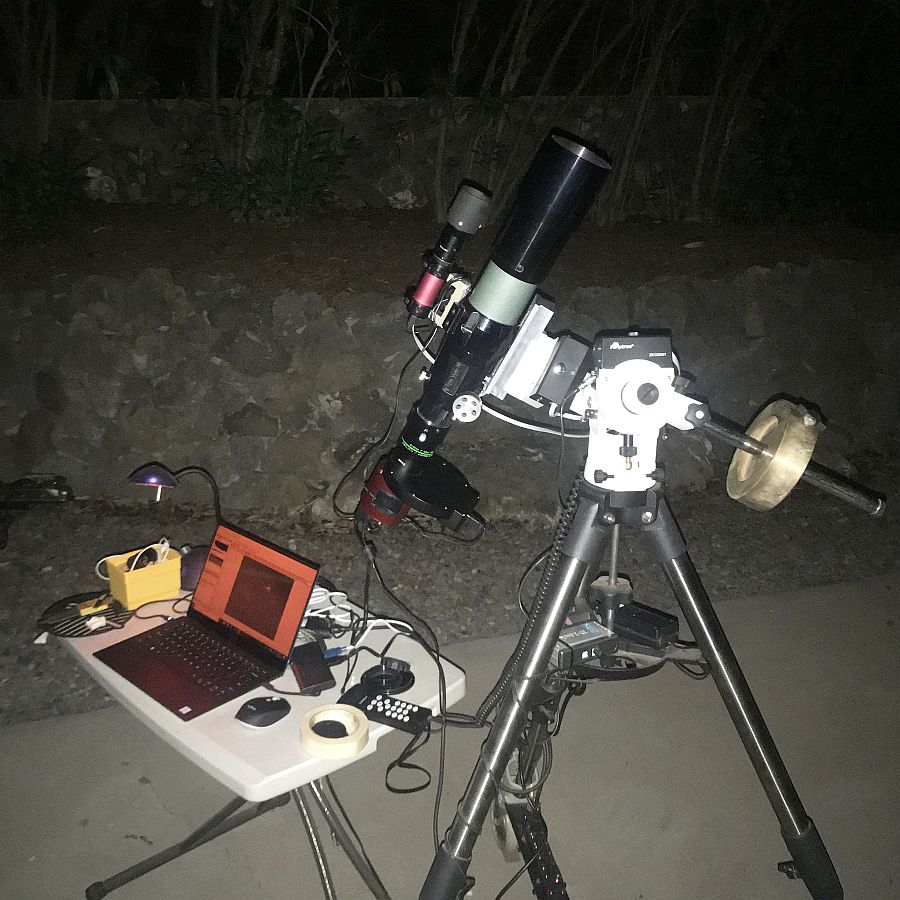
We planned to bring a presentation and activities to the Kohala library. While the gals presented inside we had a couple telescopes setup outside the front door for anyone to enjoy. Thus is was a team of four… Shelly, Kelleen, Scott, and myself that arrived at the library about 5pm.

The drive over the Kohala on the mountain road is often pretty in the late afternoon. This day was no exception, the afternoon lighting the rolling green hills, Haleakala on Maui looming directly ahead of me as I drove.

I do worry about setting up a star party in Kohala as the weather is notoriously fickle and heavy rain squalls can sweep off the ocean very quickly. I was greeted by nearly clear skies, a pleasant surprise that bode well for the evening.

Continue reading “Kohala Skies”

Full Moon

Full Moon
Full Moon taken 27Aug2007

Full Moon will occur today at 11:38HST.

This evening look for the Moon rising in the east just as the Sun sets in the west. Across the Big Island this can often lead to moonbows as the low elevation moonlight interacts with fog and clouds.

A partial lunar eclipse will be visible in Europe, India, and Africa. None of this eclipse will be visible here in the islands.

Continue reading “Full Moon”

The Moon and Saturn

This evening, July 15th, the Moon will pass quite close to Saturn. For viewers in the islands the pair will be closest as it grows dark, slowly separating as the night advances.

Saturn
Saturn on April 15th, 2016

At sunset the two will be separated by about 40 arcminutes. Keep in mind that is a center to center distance, considering the size of the moon this puts the planet about 25 arcminutes from the limb of the Moon, close enough to appear in the field of a medium power eyepiece in most amateur telescopes.

Viewers in the South Pacific and Australia will be able to view an occultation of Saturn by the Moon this evening.

As the Moon is also quite close to full it will be rising at sunset, thus a good eastern horizon is desirable to see this event early in the evening. Look for a bright, slightly yellowish star-like object just north of the Moon as it rises.