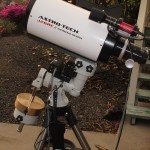
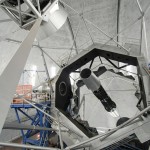
The Astro-Tech 6″ RC is a wonderful little telescope… A true Ritchey–Chrétien design, at a size well matched to DSLR astrophotography. It was get one now or never, these were the last of the production run, and now they are gone.
Best of all, Astronomics was letting them go at a fire sale price… Less than $300 each!! It may have taken months on a waiting list, but I finally received one. Then it took another two months of waiting for some necessary accessories to make it work! No problem with the wait, I was patient… mostly.
With the final parts, the extension tubes, in hand. I determined to spend part of my four day Thanksgiving weekend getting the new ‘scope into service.
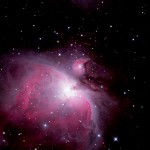
NGC1976 or M42, the Great Orion Nebula, sum of 113 frames at 35x5min, 38x1min, 20x20sec, and 20x5sec. Taken with the Canon 20Da and a AT6RC telescope.It took hours to rearrange the setup, un-bolting and re-bolting telescopes to and from the plates of aluminum that hold everything. Carefully aligning each of the four items in the setup… Main telescope, guide telescope, the finder CCD camera and a Telrad. Finding the best focus, recollimating the 6″RC, re-balancing the mount, fixing a computer power supply issue, rearranging and tying up all the myriad of cables, etc. etc… Astrophotgraphy really is the art of endless details. Finally, late into the evening, I took the first test image.
A few images later and things were not looking all that bad, maybe even functional. Better yet, my venerable ST-4 autoguider seemed to be tracking well. Maybe take a real picture? What to shoot? Something easy… M42 was rising over the garage… Why not? Just a test for the new setup, a fair chance something will go horribly wrong.
AT6RC atop an iOptron ZEQ25 mountResult? Not too bad. This is despite many shortcomings… I forgot to take raw images, thus I had to process from the JPEG’s. I didn’t get any decent calibration frames. There seems to be substantial flexure between the guide ‘scope and the imaging ‘scope, but it is slow and does not effect individual frames. Actually the registration drift over the hours helped me process out the hot pixels and other image artifacts by creating an effective dithering. I did lose a few frames to vibration, the mounting could be stiffer, and I must be careful to walk softly on the concrete slab of the driveway during exposures.
But still, not bad for a first real attempt.
The stars look nice across the frame, showing that the collimation is decent, always an issue with the RC design. I suspect the optical quality of the telescope is quite acceptable. The brighter star images are a bit “fat” but that is due more to the mediocre seeing over Waikoloa. After all of these years shooting with a refractor, I had forgotten how pleasing diffraction spikes can be. Better yet, with the scope positioned for north up on the tube, the spikes are neatly at 45° to the cardinal directions. I am looking forward to some more imaging sessions with a new telescope.
Last night the Moon and Venus were a mere 2.5° apart. I tried to look for the pair after sunset, but all I was able to see was a dim glow in the clouds. My friend Maureen was luckier, she was able to catch the pair through a gap in the clouds while the same clouds were lit up by the sunset. I am just a little jealous…
A thin crescent Moon and Venus in the sunset, photo by Maureen Salmi, used with permission
There are few opportunities to visit most of the telescopes on Mauna Kea. Only two of the thirteen telescopes maintain any sort of regular public access. Keck opens a viewing gallery during business hours on weekdays and to the MKVIS weekend tours. Subaru provides interior tours, but only with advance reservations. Visiting inside any of the other telescopes is normally not open to the general public, but can be arranged with some work.
Thanks to the work of a few individuals the West Hawai’i Astronomy Club arranged tours of both Gemini and CFHT. Marc Baril was kind enough to arrange the CFHT tour, setting up staff and transportation for the visit. This included a pair of CFHT 4WD vehicles taking folks from Waimea to the summit. Many thanks are owed to Joy Pollard who set up the Gemini portion of the tour. Weekend tours are not normally arranged, but Joy managed to put together the needed staff to allow us to visit the telescope on a Saturday. The result was a couple great tours of these facilities.
Arriving at a very foggy summit to visit Gemini and CFHTThis marks the second recent summit tour available to members of the West Hawai’i Astronomy Club. Last year we toured the W.M. Keck Observatory. This year CFHT and Gemini allowed us to view a pair of telescope that have helped keep Mauna Kea at the forefront of astronomy for decades.
The weather was pretty awful, winter weather closing in on the summit for the last couple weeks. We arrived at the summit to encounter patchy snow, dense fog and a bitter chill. This would not be an opportunity to enjoy the stunning vistas or sunset that the summit of Mauna Kea is renowned for, we could barely see the next telescope, much less the sunset. At least the road was open to the public and our tour could go on.
We convened in the control room of the Gemini telescope. Here our guides, Joy and Sonny, explained the operation of the telescope and how the operators controlled everything through the night. Our tour of Gemini ran a bit longer than the scheduled hour. During that hour we toured the control room, the coating facility, and the telescope itself.
Members of the West Hawai’i Astronomy Club listen to guide Sonny Stewart explain the operation of Gemini ObservatoryIn contrast to many of the other telescopes on the mountain, Gemini is an almost new facility, having seen first light in 1999 and begun science operations in 2000. It is a beautiful telescope, the 8.1 meter instrument sits in a spacious dome. As someone who’s experience has been that a productive environment is always bit messy, the clean facility of Gemini seems a bit odd.
A few levels below the main dome floor is the coating facility. This is where the telescope mirror receives a new reflective surface very few years. For a single piece eight meter primary, a vacuum chamber slightly larger is required. The large chamber makes it seem as if there is a flying saucer docked in the lower bay of the telescope building. The many viewing ports and vacuum lines simply adding to the impression.
The members of the West Hawai’i Astronomy Club pause for a group photo at CFHTAfter Gemini it was on the CFHT… The contrasts between the telescopes was dramatic. CFHT is a facility that shows the scars and wear of decades of research. There was an eclectic mix of new equipment intermingled with gear that had been running for over thirty years since the telescope began operations in 1979. This is a facility that started recording observations with photographic plates, along the way making the transition to electronic CCD image sensors. The telescope now boasts one of the world’s largest cameras, the 340 megapixel MegaCam.
Again we visited the coating facility, complete with the massive cranes and the vacuum chamber needed to coat mirrors up to three and a half meters in diameter. This facility is also used by the IRTF and UKIRT observatories to coat the primary mirrors for those telescopes. A treat for me was visiting the OHANA interferometer test lab in the coudé room below the telescope. A project I knew a fair amount about, but had never seen.
The tour finally arrived at the telescope itself. The large equatorial design is such a contrast to the alt-azimuth designs of the more modern designs of Gemini, Subaru and Keck. The enormous steel horseshoe and yoke represent a classic design used for large telescopes throughout the 20th century. We wandered about the dome floor, learning about the details of the telescope, the drives, and the instruments. The AO system was scheduled for the night and was mounted to the telescope. While the massive MegaCam prime focus camera was sitting to the side of the telescope.
The hoped for view of sunset from the upper balcony of the CFHT telescope was nothing to write about. Clouds obscuring all but a hint of sunset’s colors. The final treat was instead an opportunity to ride the rotating dome while the telescope slewed. The show highlighted this big machine, a testament to the people who build and operate these telescopes to push the boundaries of human knowledge deep into the universe.
These tours take a fair amount of work to put together, but are very much worth it. I expect we will do another tour in the spring. Perhaps do a couple of the radio telescopes? CSO, JCMT or SMA? Personally I have never had a chance to properly appreciate the sub-millimeter observatories on the summit. CSO is due to be dismantled in a couple years, it would be a good time to visit this groundbreaking facility.
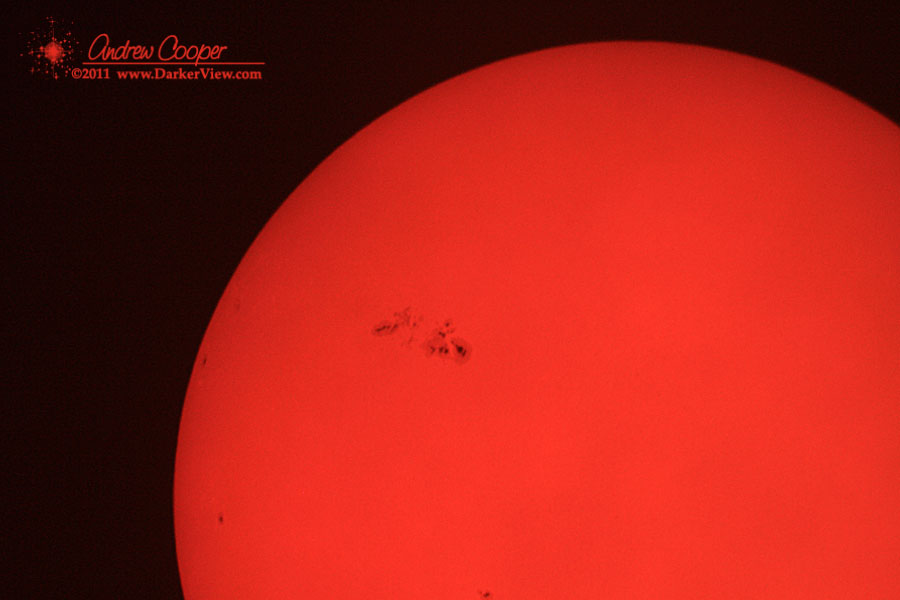
As we approach solar maximum, large sunspot groups have again become a common sight. The last few years have seen an unusually quiet solar minimum, long stretches of time when not a single sunspot appeared. that has certainly changed, the Sun is now dotted with sunspots, with the occasional monster. At it’s peak, AR1339, seen above, was over 100,000km across. That is larger than 15 Earths, side by side. I mean monster!
The photo was taken with the Canon 60D, a 0.8x TeleVue adaptor, a C-11 and a Thousand Oaks full aperture solar filter.
Sunspot group AR1339 as seen on the afternoon of 5Nov2011
One of my favorite moons in the solar system has to be Hyperion. This small icy body is one of those truly weird places.
An oblong shape roughly 360 x 200km (220 x 120miles) the moon is composed of primarily water ice with a small amount of rock in the mix. The moon is thought to be highly porous, a loosely held together rubble pile perhaps. This is indicated by the odd appearance of the many impact craters, looking as if the impacting body is absorbed as much as vaporized. The material of the crater walls then slumping back into the void.
My apologies if you have already seen this video, it is making the rounds. On the other hand it is so totally spectacular I just had to post it.
A series of time lapse sequences taken from the International Space Station. There are cities, seas, lightning storms and aurorae, star and skyglow and more. Hit the Vimeo icon for a better description than I can write. Turn off the room lights, expand to full screen and enjoy…
Winter has arrived on Mauna Kea. the last few weeks have brought regular snow, ice and fog to the summit. Quite a few nights have been completely or partially lost to weather. We always wonder what winter will bring. In the last few years I have seen winters with hardly a lost night, and no substantial snowfall. Other winters I have helped dig our way into the building. What the winter of 2011-2012 will bring? We will just deal with what Poli’ahu delivers.
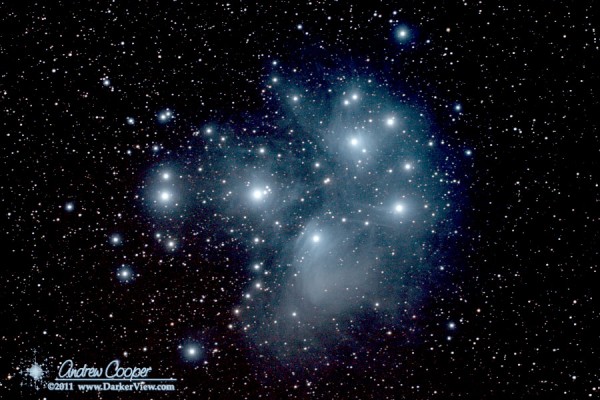
Yes, I have shot the Pleiades many times before. Still, a nice test of the new camera. I was limited to short exposures, 2 minutes in this case, as I was not setup for guiding. I took more frames instead, over thirty exposures of two minutes each for an hour total. After throwing a few out I still had enough to beat down the noise. I expect that with guiding and longer exposures the result would be better, but this wasn’t too bad…
The Pleiades, M45, sum of 27x120s exposures, TV-76mm and Canon 60D
It is interesting to write a piece for a more traditional format. With the added advantage of having a professional do the editing, with feedback. The result is much like the articles I have written for Darker View. Some rehashing of material I have used here, but re-written to provide a more complete story. The photo below is the one chosen by the editor to illustrate the article.
For meteor watchers there is probably no more anticipated show that the annual Leonid Meteor Shower. The Leonids are renowned for reliable showings featuring bright fireballs.
The reputation is not without reason, Leonid events over the last decades have produced spectacular showers. The 2001 Leonids have become legendary, for a few brief hours on the morning of November 17th the shower became a true meteor storm, with rates of more than one thousand meteors an hour visible across the western United States and the Pacific. The sky was constantly peppered with streaks, many dim, but some very bright, every few minutes a fireball would be brilliant enough to light up the landscape. Other observers will mention that the 1998 Leonids produced a impressive number of bright fireballs, making that year particularly memorable.
1833 Leonids, the engraving is by Adolf Vollmy based upon an original painting by the Swiss artist Karl Jauslin, that is in turn based on a first-person account of the 1833 storm by a minister, Joseph Harvey Waggoner on his way from Florida to New Orleans.Nor is the 2001 event unprecedented. This has happened in the past, with Leonid meteor storms occurring several times in the last couple centuries. In 1833 a massive shower woke residents across the eastern United States with a fury that had many thinking that Judgment Day was upon them.
The Leonid meteor storms incited terror and religious revelation, but also stimulated the study of meteor science. It is from studies of these storms that astronomers began to realize that meteor showers were natural, and predicatable phenomena. This led to the realization that the annual meteor showers were associated with comets with orbits that cross the orbit of the Earth.
Just how impressive a show depends on a set of complex factors, meteor prediction is not an exact science, but astronomers are getting steadily better at these predictions. The meteoroids are found in clouds of debris left behind by a comet. In the case of the Leonids this is comet Temple-Tuttle, which has an orbital period of 33 years. All along the orbit of the comet there is a cloud of debris, small bits of dust and sand sized grains of rock-like material. Prediction is a matter of figuring out how this material will move about under the influences of gravity from the various planets and other factors like the pressure of the solar wind and even sunlight.
Unfortunately for meteor watchers, the 2011 Leonid shower is expected to be fairly weak, with ZHR rates around 20. There are some predicted peaks, due to specific regions of debris left behind by the comet several centuries ago, but the average meteor size is predicted to be quite small, leading to to faint meteors. This is further complicated by a bright waning gibbous Moon present during the shower peak. This is probably not a good year for Leonid observing.