Just watched UARS go overhead. Possibly the last chance before it reenters the atmosphere tomorrow. Pretty too, I was outside Waimea and the satellite went right over Mauna Kea. The bright satellite was skimming through high cirrus lit by the last rosy glow of sunset. Notably brighter than the predicted -1 magnitude, I would say at least another mag brighter, with a couple flashes near -3 or -4.
Category: Astronomy
Exploring the cosmos
Pits in the Ice
You know it is cold when the very air starts to freeze.
This is what happens in a Martian winter when no sunlight reaches the polar region. It grows so cold that the atmosphere, mostly carbon dioxide, begins to freeze and fall to the ground as snow. Frozen carbon dioxide, dry ice, accumulates into a permanent polar cap. While the extent of this polar cap waxes and wanes with the Martian seasons, there is always some ice.
The image below, taken by the HiRISE camera aboard the Mars Reconnaissance Orbiter shows of a section of the southern permanent polar cap. Late summer has caused much of the polar cap to sublimate (convert back to gas), exposing some of the rock under the ice.
Here much of the terrain is shaped by the annual freeze and thaw cycles. These pits are probably the result of these cycles and are about 60m (200ft) across. Soon the region will return to the darkness of winter and the pits will be re-buried in the ice.

Neptune and Triton
Mike Brown did more than give a lecture while in Hawai’i. He just finished a four day observing run using Keck 2 with AO and OSIRIS, as well as gathering data with NIRSPEC. The target? Among other things Mike and his team observed Neptune and the large moon Triton. Triton is thought to be a captured KBO (Kuiper Belt Object). These objects, including well known Pluto, and lesser known, but just as large objects like Eris, Haumea, Makemake and Quaoar, are Mike’s area of expertise.
It is always nice to see a system I help maintain operating well and producing images like this…

More K1 Laser Time Lapse
We were doing more engineering tests with the K1 laser Sunday night. And as usual, Dan Birchall, working the night over at Subaru, took advantage of the opportunity to do some time lapse photography. Enjoy…
ISS Time Lapse
I do not usually post random YouTube vids here. But sometimes I just have to. I seriously suggest you select 1080pHD and expand to full screen now.
The shot starts over the west coast of North America heading south. This particular orbit went right down Central and finally South America. You can pick out a lot of major metropolitan areas, Los Angeles, Phoenix, Mexico City, etc., by the lights. Also spectacular is the lighting in several storm complexes along the coast of Mexico and further into South America.
A Very Dark Night
Planning a night of observing is a challenge. There is the choice of equipment, setting up observing lists of objects to target. And then there is deciding where to go.
Finding a dark spot can be a challenge in Hawai’i. Almost every bit of land is gated and tied up in bureaucratic rules. We often use the area around the Mauna Kea VIS to observe. Located at 9,000ft on the south side of Mauna Kea the area has much to recommend it for amateur astronomy. This land is under the administrative control of OMKM, who actively support astronomy, both professional and amateur. But the area does have a number of lights, and there is regular vehicle traffic, even in the middle of the night. Thus I have been actively looking for other places.

State land is an interesting issue in Hawai’i. No camping is allowed outside of designated sites, period. But, according to the DLNR administrative rules it is not camping unless you are… “in possession of a backpack, tents, blankets, tarpaulins, or other obvious camping paraphernalia, any time after one hour after sundown until sunrise in a forest reserve” (Section ยง13-104-2 Hawai’i Division of Forestry and Wildlife). I made certain I had no “camping paraphernalia” with me. I am merely picnicking… in the middle of the night.
It’s Fixed
A long frustrating day.
With four days of observing scheduled starting tonight, the pressure was on. Both Keck telescopes, four nights, lost for something I am responsible for? Not an attractive prospect. Everyone in the department has a helpful hint or two, some of them even made sense, most we had already tried. Phone calls and emails fly as everyone chimes in, even the guys at JPL who built the cameras get involved.
It was not until three in the afternoon that I found it. Comparing oscilloscope traces between the two FATCAT instruments I note something amiss in the video signal. Most of the waveforms makes sense, even look OK if viewed alone. The colored trace on the screen isn’t the same as the working camera. Now I recall a couple other waveforms I had looked at earlier and wondered about, even to the point of making some notes about. Realization dawned with an enormous sense of relief. Those clock edges are not supposed to be rounded like that!
I pull the clock driver board out of the working camera and install it in the problem child… The noise goes away!
I stole a spare clock drive card from the instrument guys, from the spares for LRIS. I suppose I will hear about raiding their precious stash Monday when they find my note.
I need both cameras and two good clock boards. The spare has to be configured correctly, which takes another hour of logic and good guesses in the absence of decent documentation. Only two hours before dark we perform the final checkouts on the system, the mood notably lighter as we realize it is going to work.
As I write this the FATCAT cameras are on-sky, detecting fringes of interfering light from some distant star.
It’s Broke
Yes, it is broken. Worse, I do not know how to fix it.
Specifically it is the primary fringe tracking camera, FATCAT, that has unacceptable levels of noise. We are due to be observing with it tomorrow night. No fringe tracker, no interferometer. After several days of troubleshooting I still have no idea what is wrong. I do know about a lot of things that are working, having painstakingly checked many parts of the system. The level of frustration is building.
Back to the summit tomorrow. Which sucks. I was supposed to be helping out with the Planet Walk tomorrow. Setting up a solar telescope to allow kids to see our star. Instead, it is back to the frustration of a broken camera.
An Interesting Day
Any day that starts with two flat tires is bound to be an interesting day.

I had planned on working on one of the cameras in Interferometry. The camera has been having trouble automatically filling with liquid nitrogen. In addition I had a list of smaller issues that needed to be dealt with. Unfortunately one of those minor issues turned out to be not so minor.

The entire day was busy from beginning to end. I attempted to finish the last few tasks on my list as the last few minutes of the day sped away. The rest of the guys were ready to leave about a quarter to five, while I was still connecting a few last metrology cables. “Yes, I am coming!” I answered on the radio for the second time. I grabbed my tool bag and headed to the door as the clock hit 17:00.
One of those days I return home exhausted. I will have to head up again, quite soon, to deal with other problems still unfinished. Hopefully a somewhat less complicated day.
A School Star Party
Something was wrong… it was not raining.
Four previous times we have attempted to do this, hold a star party for the students of Waikoloa Elementary School. Four times it has been either cloudy, or outright raining. Yes, raining in one of the driest areas of the island, a place that gets, maybe, ten inches of rain each year.
We even had clear skies!
It was a great event, perfect skies, several big telescopes, and hundreds of eager eyes.

They hit us just after 8:00pm, a steady stream of students and parents drawn to see the sky. I would guess that well over two hundred folks came by the star party. The skies in Waikoloa are wonderful for this sort of thing. Nice and dark, with the summer Milky Way glowing brightly overhead. We slewed from globulars to nebulae, to binary stars. Steady lines of folks waiting to look through each telescope. I have never gotten tired of the reaction when someone sees something spectacular through the eyepiece for the first time.
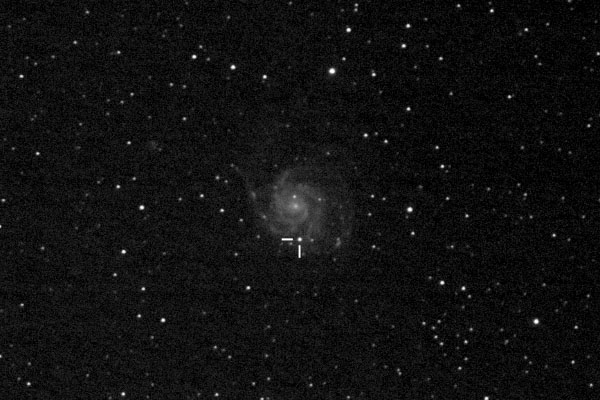
Cliff used his 24″ ‘scope to hunt down the new supernova in M101, visible as a small star like object at the edge of a faint halo. I was wondering which star was actually the supernova. Examining some photos afterwards I realized we were looking at the correct object. It will be interesting to observe this event over the coming week, as a nearby Type 1A supernova it should get quite bright.
My thanks to the guys from WHAC who supported this event. Mr. O, our school contact had everything perfectly arranged, from the flyers, to insuring the lights and sprinklers were off for the night. It was a great event, I expect we will do this again.