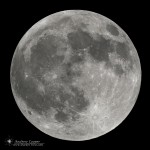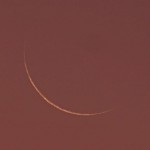
New Moon will occur today at 09:16HST.
A total solar eclipse will cross the South Pacific and South America today.
This coming weekend, July 6th, offers a slim 4 day old moon, a good night to get out and enjoy the dark.
Continue reading “New Moon”When you want to see the stars, find someplace dark

Exploring the cosmos
New Moon will occur today at 09:16HST.
A total solar eclipse will cross the South Pacific and South America today.
This coming weekend, July 6th, offers a slim 4 day old moon, a good night to get out and enjoy the dark.
Continue reading “New Moon”I was a bit concerned as I drove to the site, a heavy fog all the way up Saddle Road persisted as I turned off on the old Saddle Road to climb the ridge to Kilohana. It was not until halfway up the gravel access road that I broke out of the fog, just a hundred yards before the Kaʻohe site.
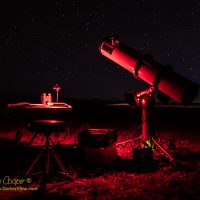
On top of the fog it was gorgeous, a beautifully clear sky overhead with the first stars peeking out. Time to setup a telescope!
I brought the restored 8″ Cave Astrola expecting to spend the evening exploring the clusters and nebulae of the southern Milky Way in Scorpio or a bit further south. This rich region would be well positioned through the night.
We had a small group this particular evening, just six of us… Andre and Anna, Maureen, Andrew, Cliff, and myself set up by the gravel pile. There were pleasant conversations in the night, cookies and brownies to share, and views through each other’s telescopes.
Continue reading “A Crisp Night at Kaʻohe”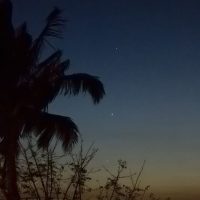
Today Mercury is passing through maximum elongation, the furthest it will rise above the setting Sun in the evening sky. After today the planet will slide back into the Sun’s glare headed for inferior conjunction on July 21st.
This is the most favorable evening apparition of the year, reaching over 25° from the Sun. The October apparition is almost as good
reaching over 24° from the Sun.
The summer solstice will occur at 05:54HST today.

The Sun has reached the most northerly declination it will achieve this year. After today the Sun begins to move south in our skies.
Today will be the longest day of the year for those of us located in the northern hemisphere.
Today is considered the start of summer for most cultures in the northern hemisphere, or the start of winter for those in the southern hemisphere.
| 2019 Apsides and Seasons | ||||
|---|---|---|---|---|
| Event | Universal Time | Hawaii Standard Time | ||
| Perihelion | Jan 03 | 05:20UT | Jan 02 | 19:20HST |
| Spring Equinox | Mar 20 | 21:58UT | Mar 20 | 11:58HST |
| Summer Solstice | Jun 21 | 15:54UT | Jun 21 | 05:54HST |
| Aphelion | Jul 04 | 22:11UT | Jul 04 | 12:11HST |
| Fall Equinox | Sep 23 | 07:50UT | Sep 22 | 21:50HST |
| Winter Solstice | Dec 22 | 04:19UT | Dec 21 | 18:19HST |
| Data from US Naval Observatory Data Services | ||||
Full Moon will occur today at 22:31HST.
This evening look for the Moon rising in the east just as the Sun sets in the west. Across the Big Island this can often lead to moonbows as the low elevation moonlight interacts with fog and clouds.
Continue reading “Full Moon”Jupiter will pass through opposition at 05:11HST today.
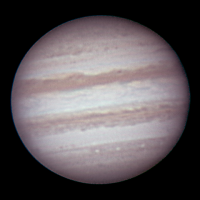
Jupiter orbits the Sun once every 11.86 years. As the giant planet continues on its way the Earth swings around much faster on our inside track. As a result we lap Jupiter once every 399 days, passing between the planet and the Sun. During opposition Jupiter will rise at sunset, transit at midnight, and set at dawn. This makes the planet available for observation for the entire night.
Look for a bright object rising in the eastern sky after sunset. It is difficult to mistake for anything else, shining at it’s brightest during opposition, a brilliant -2.7 magnitude. For the remainder of the spring and much of the summer, the planet will be quite prominent in the evening sky.
This evening was the local hearing for the proposed Mauna Kea Public Access Rules. As the hearing took place at Waikoloa School I had no excuse not to go, it is practically at the end of our street. Of course I was going to attend even if I had to drive across island, this is an issue that directly affects me.
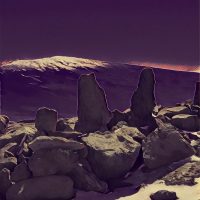
And yes, I testified, attempting to summarize my three pages of written testimony in three minutes. I suspect I got the gist across in a clear fashion, I will submit my written testimony as well.
Other than myself the testifiers were completely drawn from the anti-telescope community. It is unfortunate that the issue has become so polarized that no other members of the community attended. Access to the mauna affects more than just the astronomy and anti-astronomy folks, this should be of interest to anyone who calls the island home.
As such many of the testifiers paid scant attention to the contents of the rules, instead of providing constructive input so much testimony was simply another protest against the Thirty Meter Telescope. Some form of rules need to be put in place with or without the new telescope.
Continue reading “Mauna Kea Rules Hearing”It is now round three for the Mauna Kea public access rules. The first versions of the rules were simply bad and rightly faced unanimous criticism from the community. Virtually nobody testified in support of the first version at the public meetings.
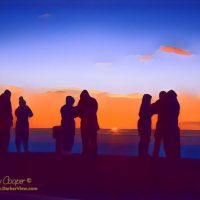
This latest version of the rules is much better, at least someone properly edited the rules and there are no complete blunders in the language.
There are still some items in the rules that are problematic. In general the university is attempting to regulate public activity on the mauna far beyond their mandate in the lease or in the comprehensive management plan.
Continue reading “Public Access to Mauna Kea… Round 3”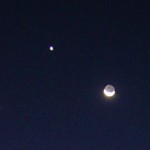
This evening will feature a a pretty set of planets and the Moon low in the sunset. Mercury, Mars, and a thin crescent Moon will be visible above the glow of the setting Sun.
The Moon will be a very thin sliver, a mere 4% illuminated. Look 7° above the Moon for Mars. Mercury will be harder to spot, about
7° below the Moon, closer to the sunset and a little north (to the right).
New Moon will occur today at 00:02HST.
This coming weekend, June 8th, will feature a 5 day old Moon, a good night to enjoy the dark.
Continue reading “New Moon”