
Puʻu Kole Panorama
When you want to see the stars, find someplace dark

Exploring the cosmos

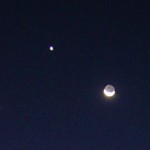
This evening will feature a 6 day old crescent Moon 5° from Mars. Look for a bright orange object a few degrees above and to the north of the Moon to spot the planet.
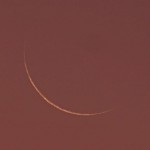
New Moon will occur today at 01:28HST.
A partial solar eclipse will occur across parts of the North Pacific and Japan during this new Moon.
Continue reading “New Moon”

Today Venus is passing through maximum elongation, the highest elevation it will attain in the dawn sky for this apparition.
The planet is currently 47° ahead of the rising Sun. After today the brilliant planet will slide back into the glow of dawn headed for superior conjunction on August 13th, and an evening apparition starting in mid-September.
The next full Moon on January 20th, will feature a sunset total lunar eclipse visible across the islands. The eclipsed Moon will rise just as the Sun sets on the opposite horizon.

The eclipse will be just underway as the Moon rises on the island of Hawaii, with the Moon rising at almost exactly 18:00HST and the total phase of the eclipse starting 41 minutes later. Maximum will occur at 19:12HST with the Moon 14° above the horizon.
| January 20, 2019 Total Lunar Eclipse | |||
|---|---|---|---|
| Event | Contact | UT | HST |
| Penumbral Begins | P1 | 02:36:28 | 16:36:28 |
| Partial Begins | U1 | 03:33:55 | 17:33:55 |
| Total Begins | U2 | 04:41:18 | 18:41:18 |
| Greatest Eclipse | Max | 05:12:18 | 19:12:18 |
| Total Ends | U3 | 05:43:18 | 19:43:18 |
| Partial Ends | U4 | 06:50:42 | 20:50:42 |
| Penumbral Ends | P4 | 07:48:05 | 21:48:05 |
| Data from Fred Espenak’s eclipse website | |||
Many references state that the eclipse will occur on January 21st, and it will, in time zones further east than us here in Hawaii. We are ten hours behind UT, thus it will be the evening of the 20th when the eclipse occurs in the islands.
An easy to view evening eclipse, no reason not to get out and view this one, no need for an alarm clock!
Earth’s perihelion will occur at 19:20HST today.
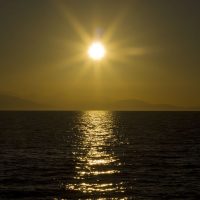
Perihelion occurs when the Earth reaches its closest distance to the Sun for the year.
It may seem odd to some the perihelion occurs in the middle of winter. One must recall that the distance from the Sun is not the cause of our seasons, that is the effects of axial tilt.
| 2019 Apsides and Seasons | ||||
|---|---|---|---|---|
| Event | Universal Time | Hawaii Standard Time | ||
| Perihelion | Jan 03 | 05:20UT | Jan 02 | 19:20HST |
| Spring Equinox | Mar 20 | 21:58UT | Mar 20 | 11:58HST |
| Summer Solstice | Jun 21 | 15:54UT | Jun 21 | 05:54HST |
| Aphelion | Jul 04 | 22:11UT | Jul 04 | 12:11HST |
| Fall Equinox | Sep 23 | 07:50UT | Sep 22 | 21:50HST |
| Winter Solstice | Dec 22 | 04:19UT | Dec 21 | 18:19HST |
| Data from US Naval Observatory Data Services | ||||
2019 is looking to be a pretty ordinary year for events, with a few decent events to look forward to. The highlights will be a sunset total lunar eclipse on January 20th, the η-Aquariids meteor shower in early May, a transit of Mercury in November, and a nice set of planetary conjunctions in the sunset and sunrise.
There are dozens of posts scheduled here on DarkerView to remind my readers of these and many more events before they occur. Frankly, I need the reminder myself. Stay tuned for all of the great events the sky of 2019 will offer us.
The remainder of this post is a quick summary of the events our sky has to offer in 2019.
Continue reading “The Island Sky for 2019”Today Saturn passes through superior conjunction, rounding the far side of the Sun as seen from our earthbound vantage point.

Saturn will re-emerge in the dawn sky towards the end of the month. Look for the planet low in the glow of dawn, rising higher each day. It will swing by Venus on February 18th, passing about a degree away.
Saturn will pass through opposition on July 9th, crossing into the evening sky.